← The Thomas and Bridges Story, 1540–1840
Chapter III: Donaldson Creek Church organized
The early settlers of Trigg County brought with them into their new land a reverent and deep-seated belief in their Creator. Practically every family had packed a Bible in with their belongings and many read them daily as they trudged along on their journey to the west. Also included among the scant supply of books usually were a hymnal, most of the songs of which were sung in a minor key, and a copy of “Pilgrim’s Progress.”1
Ten years before James Thomas left the Cashie River plantation his brother Ezekiel purchased a Bible. It was printed in Edinburgh, Scotland, and the title page read: “Printed by the Assigns of Alexander Kincaid, her Majesty’s printer, MDCCLXXXVII” (1787). It was a small volume and its contents were reproduced in rather fine print. On a blank page in front, Ezekiel had written in ink: “Ezekiel Thomas is my name, with this pen I rite the same, Ezekiel Thomas, January 17, 1796.”
Three years later, Ezekiel gave the Bible to his brother, James. Just below the first inscription were these words: “James Thomas, his bible, his hand and pen, he offers nothing good but goodness. Signed January 1799.”
The next notation bore no date but likely it was written after the family had arrived in Kentucky. It read: “Cullen Thomas, his hand and pen he write hes good, but God nose when. Cullen Thomas, his Bible.” Cullen, oldest son of James II, was 15 years old when he came to Kentucky, and due to the clarity of his handwriting, likely the Bible had been presented to him by his father only a few years later at which time he wrote his capricious verse. He also wrote the name of his father and mother just below.
The last inscription which apparently resulted from Cullen’s generosity, was this: “Starkey Thomas, his Bible, October 16, 1815.”
The Bible eventually found its way into the Perry Thomas family and is now owned by one of his descendants. It is, however, somewhat worse from wear, understandably so after having been handled and read for the past 183 years.2
Many family Bibles were brought across the mountains on that long, tedious journey from North Carolina to Kentucky. Others were purchased from itinerant peddlers and booksellers after the families had arrived and settled in their new homes. Many of these Bibles are still in existence. A New Testament that belonged to Shadrach Futrell, some of whose descendants married into the Thomas family, also printed in Edinburgh, Scotland, by the same printer of the Ezekiel Thomas bible, was dated 1786. It is now owned by one of the Futrell descendants.3
Other existing Thomas family Bibles, most of which apparently were purchased after the family moved to Kentucky, include: the Bible of James Thomas III, youngest son of James and Mary, published in 1827, owned by Mrs. Edna Sullivan, a great granddaughter; two Perry Thomas family Bibles, owned by grandson John Sherman Thomas, and the Peyton Thomas family Bible, owned by Jim Lawrence.
Although the church-going habits of the early settlers in the Donaldson Creek valley date back to Virginia and North Carolina, it was some time before they officially organized a new church in Kentucky. For the first several years after arrival, they were too busy building homes, clearing farmland and getting crops planted, tended and harvested, to take time to build a house of worship. Instead, they held religious services in their homes. During the summer, services were often held in brush arbors — a framework of wood on top of which was piled a roof of leafed branches — to provide shade during the daylight hours, and keep out the dampness of the dew during the summer evenings. Seats were of crude boards attached to stakes driven into the ground.
It was several years after James Thomas II and Drury Bridges arrived in Kentucky before a church was officially organized in the valley. Meanwhile, some of the settlers attended the Dry Creek church, but the inconvenience of traveling the five or six miles for Sunday services, made it imperative that they organize their own. Thus on the “second Sunday in April” (April 10) 1814, the Donaldson Creek Baptist Church was organized.4 The organizers were three ministers, Thomas Ross, Dudley Williams and Thomas McLean. At the time of its organization it was called an arm — or mission — of the Dry Creek Baptist Church. A total of 27 people constituted the list of charter members. Three more were added on the day of official organization making a total membership of 30 to launch the new church. These members included: Drury and Charity Bridges, their twin daughters, Seletha Bridges and Piety (Bridges) Brunk; Caleb, Carlton, Sterling, Elizabeth, Mary and Sophia Lindsay; Joel, Daniel, David and John Cohoon; John Futrell, Margaret Holland, Isabel and Sarah Craig; Mary (Standley) Thomas; Bathsheba (Futrell) Colson; Mary Cowand; Sarah Mashburn, Sarah Hargrove, Charity and Nancy Boren, Sarah Wilson, Sarah Young, and, added on the day of organization: Allen Sholar, Isaac Sumner and Nancy Colson. The first pastor was Thomas Ross.5
The following year, Thomas McLean was chosen pastor and for the next four years the church continued to function under the auspices of the Dry Creek church. During that time 11 more members were added. These were: James Thomas II, Nathan and Charity Futrell, Stephen and Keziah Boren, John Craig, Sr., Elizabeth (Futrell) Thomas; John Allen, William and Frances Ryan, and Christopher Pritchard.
The Donaldson Creek Baptist Church became a full-fledged church on the “second Sunday in July” (July 12) 1818. Ministers present for the organization were Thomas Ross, the first pastor, and John Mallory. They also had help in the official organization from members who attended from the Dry Creek, Saline Creek and Little River churches. The new church was constituted on the same abstract of principles as those adopted by the Dry Creek church when it was organized.6
Thomas McLean was elected first pastor after official organization and the first deacons were John Allen and Nathan Futrell.7 Rev. McLean was legally qualified as a minister of the gospel at county court, Trigg County, June 19, 1820, in regular commission with the Baptist churches and was granted the rights to solomize the rites of matrimony. James Thomas II and Drury Bridges executed a 500 pound bond as security.8
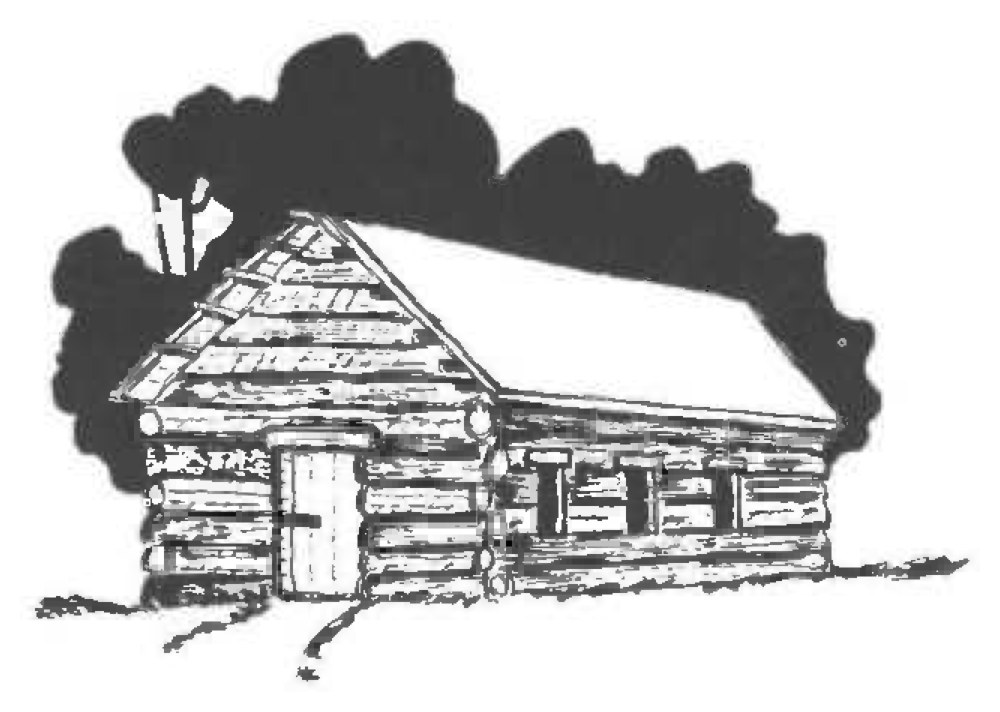
After the church became an official body, next move by the congregation was to acquire a building. Basil Holland, who owned property later purchased by James Thomas III, donated an acre of ground and members set to work cutting logs with which to build their first house of worship. The entire neighborhood turned out for the “log rolling and church raising” and in due time the new place of worship had been built. It was crude to be sure, but its log walls, stick-and-dirt chinking and hand riven board roof did not dampen their spiritual enthusiasm. The structure was located in the corner of a field on the south side of the Donaldson Road opposite the present church building. This log structure, with various repairs made during that time was used for approximately 20 years—until about 1840—at which time a larger log structure was built in order to accommodate the increase in membership.
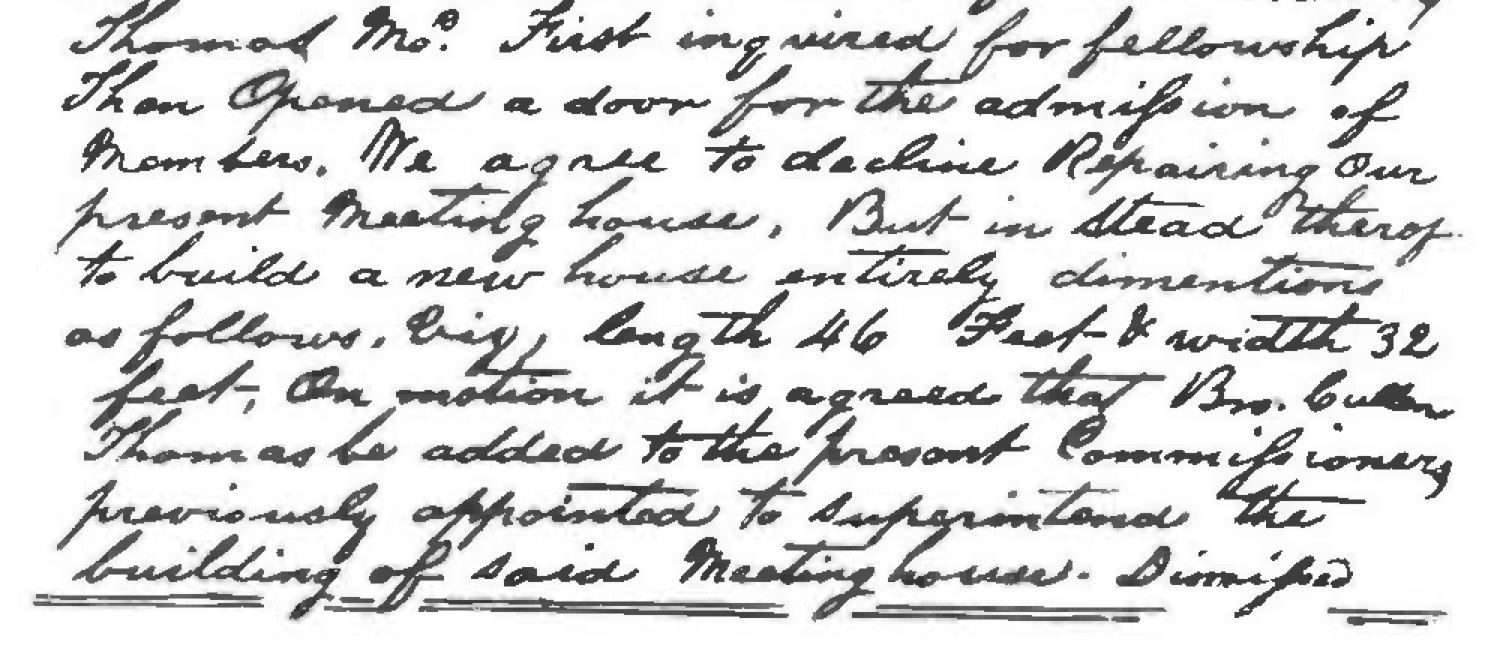
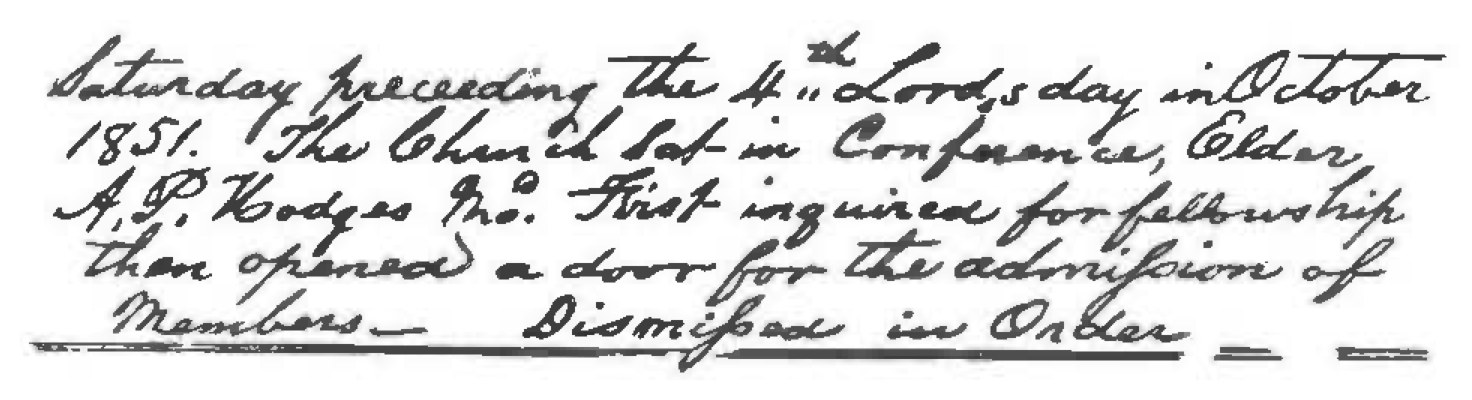
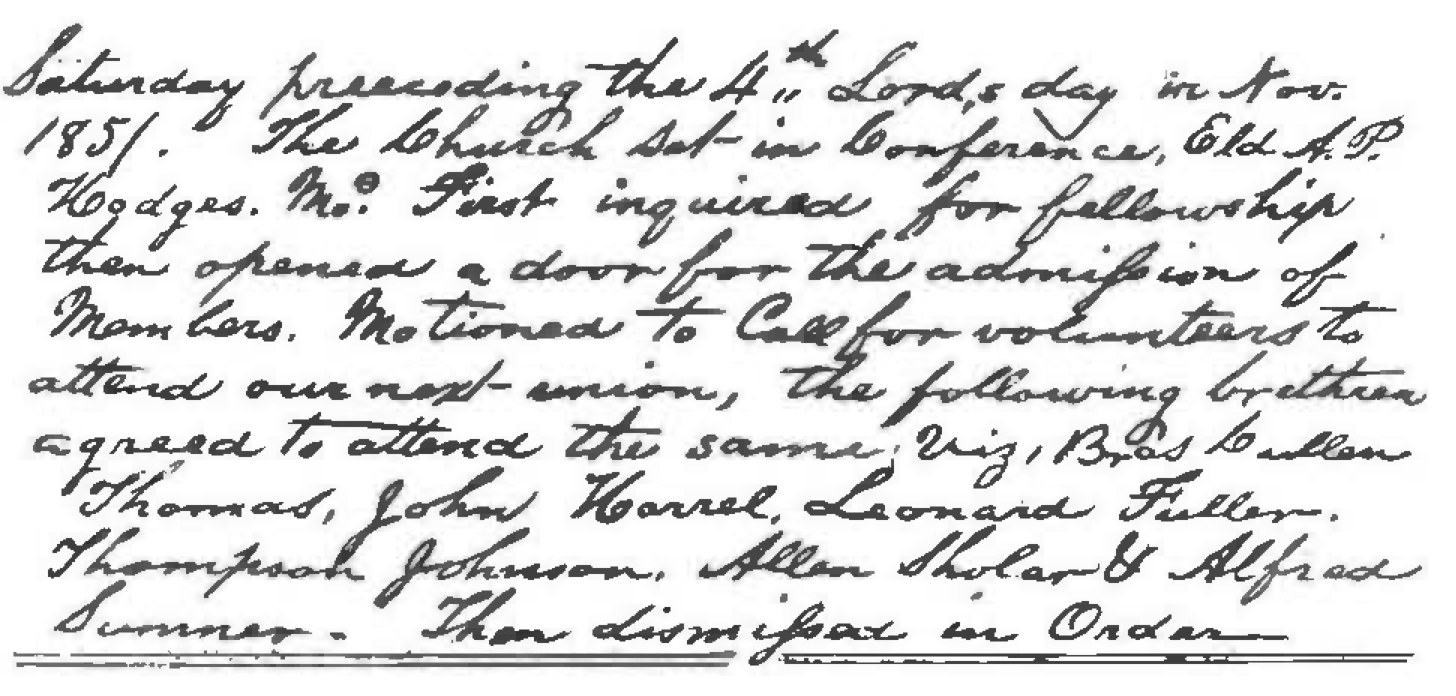
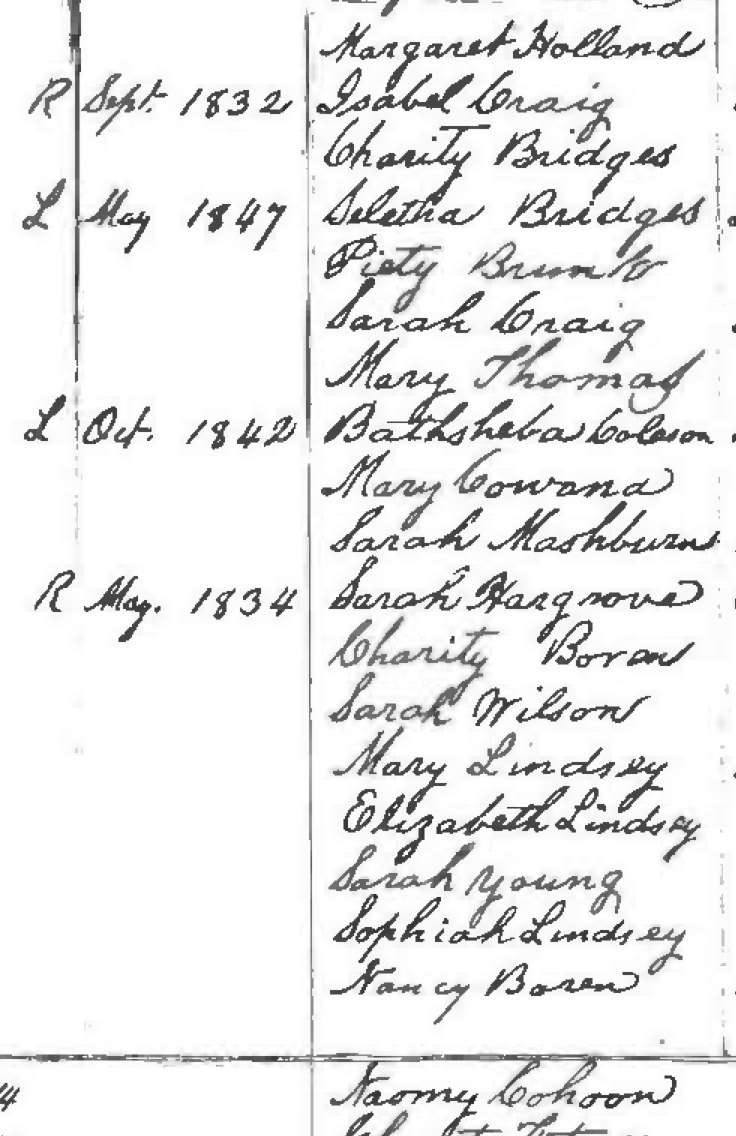
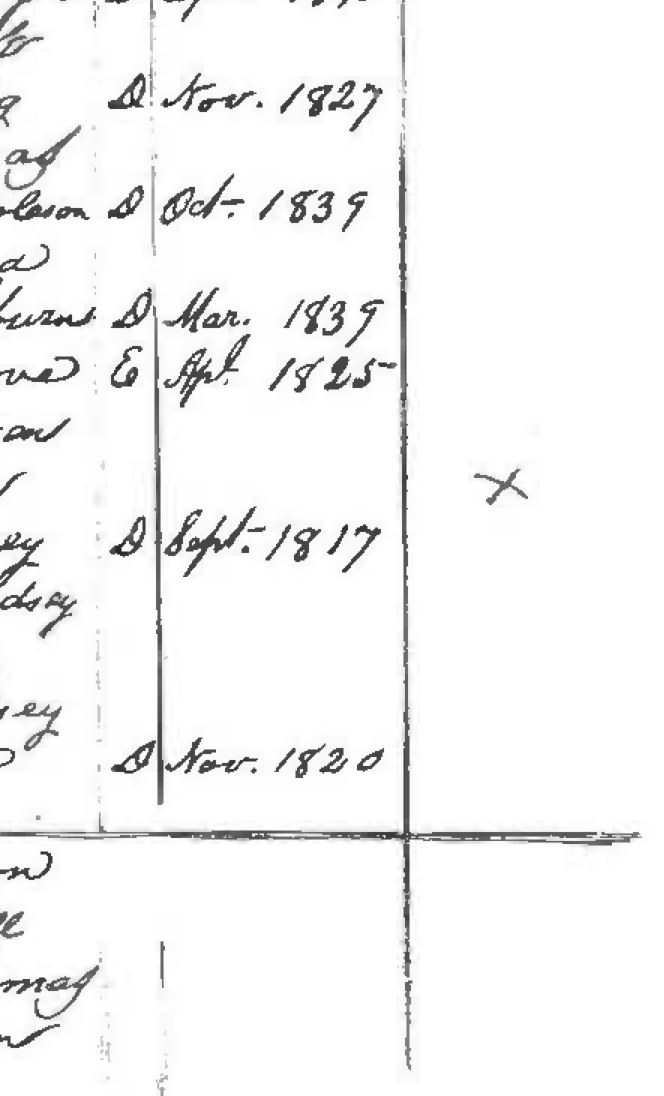
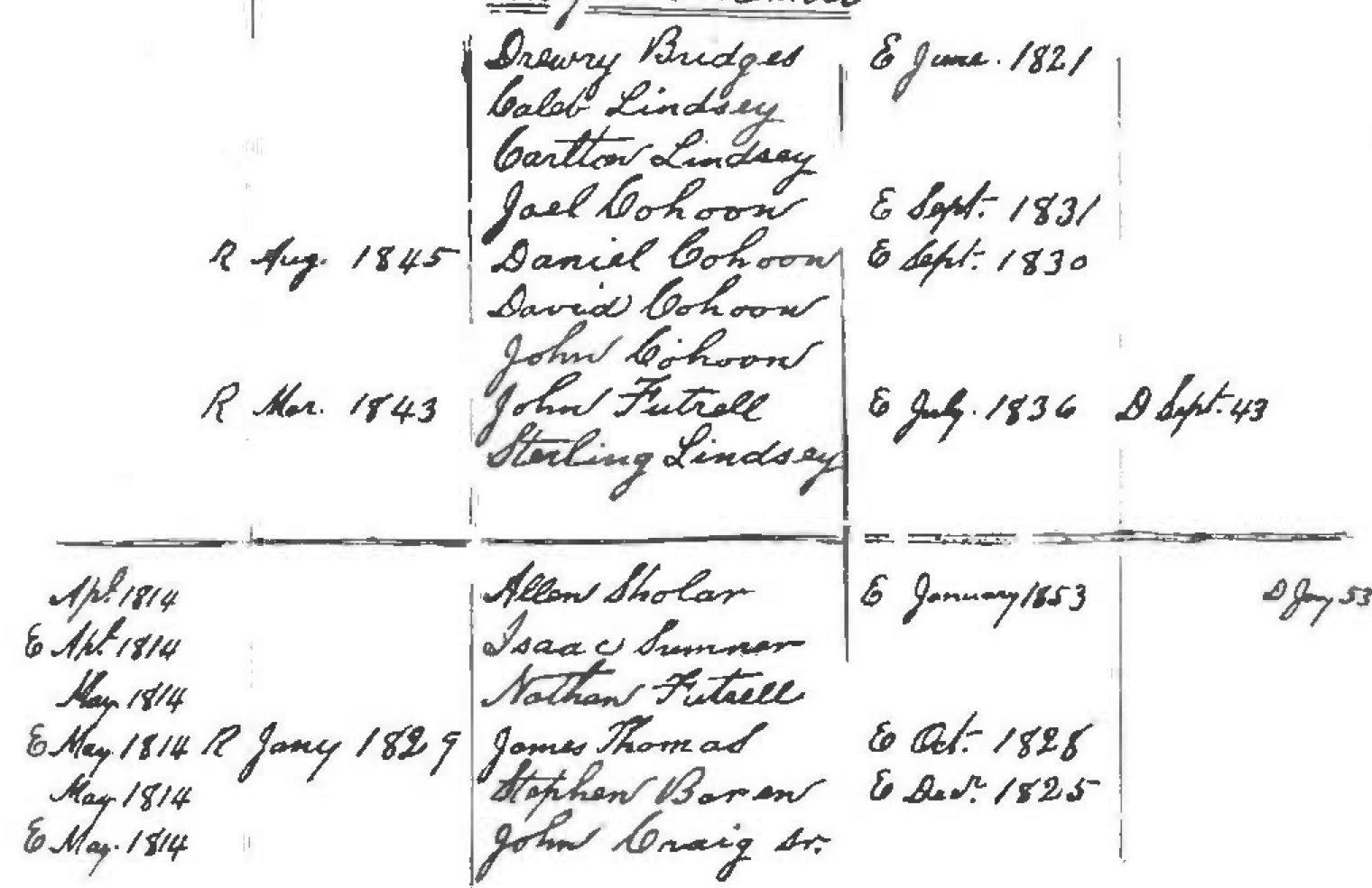
Although church records prior to 1851, except the original membership list, have been lost, those since that year are still extant. At a business meeting held on Saturday, September 25, 1852, the members voted to erect a new sanctuary. It was to be 48 feet long by 32 feet wide and to be built of logs. Starkie Thomas was moderator of the meeting, Perry Thomas was clerk, and Cullen Thomas was appointed as one of the members of the building committee.9 All three men were sons of James Thomas II.
The third church building was erected about 1854. It was a frame structure and built on the original site of ground that had been donated by Basil Holland in 1818. This building stood until 1886 when it was torn down and rebuilt on the north side of the road, using the same material, the reason for which was not made clear in the minutes. According to the record, the results left something to be desired with one report saying that the building was not as good as the old one. Despite this however, the building was used for 27 years before it was replaced in 1913 by a more serviceable frame building. This time the structure was erected on a plat of land just behind the old building. This building, with certain additions and improvements including electric lights and air conditioning, still stands and is used regularly as a sanctuary by the present church organization.
Evidence that the early church took the rules of decorum of its congregation quite seriously is revealed in the strict accounting its members had to make before the church’s governing body. Numerous times, its members were censored for dancing, playing the violin for dancing, using profane language, intoxicants, arguing with a neighbor or working on Sunday. Fortunately, after a proper period of remorseful repentance, such offending members whose names had been dutifully taken from the church roll were readmitted after having been called before a committee of deacons and questioned. As the Thomas and Bridges families were a fun loving people, it is interesting to note that they came in for their share of dismissals and readmissions.
From organization in 1814 until the period of about five years following the Civil War, the Donaldson Creek Baptist Church as well as most other churches throughout Trigg County, received Negroes as members. These Negroes, slaves of the families who were members of the church, were listed on the church roll as property of their owners. One account in the minutes of October 18, 1860, mentions Louisa, property of Cullen Thomas, as a candidate for baptism.
Similar mentions are found throughout the minutes of that period.
One interesting incident was recorded in the January 1865 minutes. Two Negro members, Dick and York, were excluded from membership in the church for leaving their masters and joining the Union army.10
After President Abraham Lincoln issued his Emancipation Proclamation and the Negroes were freed, they adopted the surnames of their former owners and in most instances continued to live on the farms with their former owners as they always had. However, they did organize their own church.
The minutes of September 7, 1867 show that the membership voted to give the Negro members their letters to enable them to unite with their own church. This action continued for several months as the Negro members slowly began to move their membership. However, it was well in the 1870’s before all the Negro members of the Donaldson Church had left.11
Members of the James Thomas II family have been active in the church since its organization in 1814. Among them were Peyton Thomas, grandson of James, who was elected clerk in 1853 following resignation of his uncle, Perry Thomas. Peyton served as clerk for 39 years—until 1889—when he resigned. Five years later—June 1894—G. A. Bridges, a grandson of Peyton Thomas, and great grandson of Drury Bridges, was elected clerk and served for 42 years.12 He was succeeded in the 1930’s by Odell Thomas, descendant of James III, and who later was succeeded by Bayliss Sumner, also a descendant of Perry Thomas and William Bridges. Choir director for many years before his death in 1964 was Edd C. Thomas, grandson of James Thomas III. Rev. Keidell Thomas, a descendant of Perry Thomas, was ordained by a group of ministers who met at the Donaldson Creek church May 7, 1923. He later served as pastor.
Scores of descendants of James Thomas II and Drury Bridges, have walked down the aisle of this church to express their faith in God. Today, as has been the custom since 1814, new members are baptized by immersion in nearby Donaldson Creek with appropriate ritual, usually accompanied by the singing of the historic old hymn, “On Jordan’s Stormy Banks.”
The Donaldson church is considered to be the “mother” of the Oak Grove Baptist Church. It was constituted in 1875 by the Revs. George A. Patterson, L. H. Averitt and Daniel Hanberry, with the first membership totaling 39 persons. Among them were many who had been members of the Donaldson Creek church including Starkie Thomas, his son James J. Thomas, who had been ordained a deacon at Donaldson; Laban Allen, Edmund Lancaster and Humphrey Lawrence.13 A sanctuary was built the same year of organization on land deeded to the church by Stanley Thomas and Humphrey Lawrence.
The first pastor was Rev. E. C. Faulkner. Second pastor was Rev. J. H. Spurlin, who served as such as late as 1884. During that period membership was increased to 130. Officers of the church at that time were: J. J. Thomas, clerk; W. B. Thomas, Peter (Pete) Light, and J. J. Thomas, trustees.11
In the 1940’s, the Maple Grove Baptist Church was organized and a building was erected not far from where Drury Bridges settled in 1804.
“Seed Time on the Cumberland,” by Harriette Simpson Arnow, MacMillan, New York, 1960.↩︎
Most of the Old Testament portion of this bible is still intact. It is in the collection of Allison W. Thomas, a descendant of Perry Thomas.↩︎
Filson Club Historical Quarterly, April 1967, pp 169-172.↩︎
“Know Your County,” column, Cadiz, Ky., Record, 1935, by A. C. Burnett, from notes made in 1928 by G. A. Bridges; Donaldson Creek Church Minute Book.↩︎
Ibid↩︎
Ibid↩︎
Note reference 4.↩︎
Trigg County Order Book A, page 10.↩︎
Note, reference 4.↩︎
11, 12, 13, Ibid↩︎
Perrin, page 92.↩︎