← The Thomas Family in 300 Years of American History
Chapter VI
THE SEVEN BROTHERS
The Tenth Generation
By 1886, the three oldest sons of Buck and Susan had moved into town and established themselves in nonfarm occupations. Will was 27 years old and had been married for 5 years. John Wesley was married also and lived in town. Jim, as yet unmarried, lived with Will and Nora.
We know that some, and probably all, of Buck's sons, when they were growing up, had their own livestock projects. Their father gave them a few cows and calves, and with these as a start, they developed small herds of their own. Horses and mules were likewise raised. These projects were started on the family farm but were moved into town as they increased in size.
In the decade between 1882 and 1892 the older brothers may have carried on a cattle and mule business from the lot on Gilmer Street, just south of the Public Square. This was the "old home place" where Buck and Susan had lived before moving to the farm. Will had bought it from his parents on January 1, 1881. He had ample space on the lot for engaging in various activities such as buying and selling livestock. The lot was large enough to contain barns and necessary areas for keeping cattle, horses, and mules in considerable numbers. At any rate, Buck Thomas in 1870 had rendered for taxation 7 horses and 30 cattle, all of which would have been kept on this lot.
During the 1880's John Wesley was occupied for several years in hauling merchandise in and out of Sulphur Springs. At least some of his time was spent in hauling goods from the river port of Jefferson, Texas, to Sulphur Springs. He undoubtedly hauled much of the merchandise sold by Buford and Harrison and possibly others also. This was a period of commercial growth for the town, especially because of the coming of the railroad to the town. In 1879, the East Line and Red River Railway Company had extended its line westward from Jefferson to Sulphur Springs. Although the coming of the train reduced the need for long-distance hauling, it increased the overall need. Much hauling was required also for building the new brick courthouse which was started on the east side of the public square in 1881.
Although by the 1830's the use of oxen was giving way to mules, it is likely that for heavy hauling and especially on cross-country trips, John used four or five yoke of oxen for his heavily loaded wagons. The trips were slow and arduous, and the driver slept many nights under the wagon on the ground. On one such trip, he contracted pneumonia. According to an obituary, now preserved in his father's family Bible, he recovered promptly, but resumed working too soon, had a serious relapse and died shortly thereafter. He died on September 28, 1887, just two weeks after his second child was born.
At the time of his death, he and his wife lived on College Street, in a house which he had bought on January 6, 1886. It was bought from R. K. Kimberlin and wife, for $900. John paid $150 down and gave 4 promissory notes, the last of which was to be paid off on April 1, 1887. Perhaps John had failed to make the last payment, since family tradition tells that his brothers paid off the notes after his death.
Will and Jim, meanwhile, were engaged in what now would be called agribusiness. Hopkins County in those years was increasing rapidly in population, and likewise in agricultural production. The share cropper system of farming, which had been started a decade earlier, at the end of the Reconstruction era, was by then widely practiced. Under this system one Negro family was provided with a two-room shack in the middle of a cotton field, plus "forty acres and a mule." With a mule and a plow the tenant planted and harvested his cotton and corn, and at the end of the season when the crops were harvested, the produce was divided into shares between the landlord and tenant. The mules were necessary to this system, and Will and Jim were the business men who supplied this need. In the agricultural community of that time they served the same need that is met today by the farm-implement dealer and repair plant.
As their business grew, they were forced to import fresh supplies of horses and mules from outside the County. The logical place to turn for such supplies was West Texas, especially the plains area some two hundred miles west of Fort Worth. They began to buy livestock from this area. As time went on, they considered the possibility of moving to that area in order to buy the animals they later would sell in Hopkins County.
In 1892 they made the move. At the time Will was 33 years old. He and Nora had been married for 11 years, but had no children. Will's younger brother, Jim, was 28, and still unmarried. The three of them—Will and Nora, and Jim— went by wagon to Sterling City (Sterling County) which was the center of the horse and mule business in Texas.
The area along the Concho River had been, for the past two decades, a center for rounding up wild mustangs. This activity merged into the development of an extensive horse and mule business. It was an area, too, from which hundreds of thousands of Texas Longhorns in the post Civil War era had been rounded up and driven north to the markets along the Kansas railways.
In those years Texas was the principal supplier of horses and mules for the farms of the Nation. In 1890 Texas had 1,518,167 horses and mules, valued at $38,552,000, According to the Texas Almanac, the number had been increasing rapidly: 89,227 horses and mules in 1850; 333,807 in 1860; 625,585 in 1870; and 805,606 horses only in 1880. Horses were shipped to New York, Chicago, and other large cities in the Nation. A specialized market, with higher prices, was in supplying animals for military purposes or for playing polo.
Their 340 mile trip to Sterling County was slow. The mule-drawn wagons were slowed even more than usual by the large herd of cattle they took with them. Most nights, of course, they slept on the ground. When they arrived, they found the high, open spaces mostly unfenced. Barbed wire, which had first been patented in 1874, was only then being widely introduced on the cattle ranges of America. For a while the only place they could find to live was in a sod house, sometimes also called a dugout. This was a one-room primitive house built on the treeless plains. The house was dug out some two or three feet below the surface, and instead of having vertical walls, it had sloping walls and a roof, covered over with dirt and sod. It was similar to an Eskimo's igloo, except that it was made of dirt and sod instead of ice.
We do not know just what property they finally obtained. It may have consisted primarily of corrals and lots for feeding and shipping. At any rate, they soon found a more modern place to stay; they began their business contacts and also began to socialize with their neighbors.
Jim, as a young single man, often rode his horse to neighboring ranches to attend the week-end "hops". On one of these occasions he met a fifteen-year-old girl, beautiful but shy. She was Hattie Tweedle, daughter of the owner of a neighboring ranch. The Tweedles had come to the western country from Bell County, Texas. At least one of her grandparents, reportedly, had come to Texas with Stephen F.Austin and had lived in the Austin Colony. Jim and Hattie married on September 23, 1893, and their first three children were born in Sterling County.
When Mack was 20 years old he visited in Sterling City for at least several months, working and living with his older brother. His seven-year-old nephew, John Wesley, Jr. was there too. Probably Mack took little Johnnie out with him. In letters home, in March 1895, to his mother and to his sister-in-law, Mollie Thomas, he reported that Johnnie was happy there; he had a lariat and thought himself the best cowboy in the world; that he would be reluctant to go back home, since he would have to leave his friend, Buster, who apparently was his age. Mollie wanted her little boy to come home, but Will and Nora wanted him to stay with them. Mack wrote, "I'm having a good time, and I have met several nice girls, but I haven't been to a dance yet. One is scheduled soon." Mack apparently did not like the western plains. "The wind out here is something awful," he wrote. "I have to wear glasses all the time. And it is the most lonesome country you ever saw! Looks like a desert! Mack concluded by asking his mother to tell his brother, Marvin, to write and tell him how his cattle back home were doing. Mack was concerned because several of his cattle out there had died. He ended by saying he would be home in a few weeks, "as soon as the spring grass comes out."
The Thomas brothers maintained their contacts with Hopkins County during those years. Much of their business was in supplying horses and mules to the farmers of Hopkins County. According to a report in the Sulphur Springs newspaper in 1895 their specialty was the provision of dependable stock on easy credit terms. A typical transaction was consummated on November 7, 1898 and the written contract was recorded in the County Clerk's office. Under its terms:
W.B. Thomas sold 128 head of steer cattle in the City of Colorado, Texas, to be of aged 2 & 3 years, for which D.A. Sturdivant will pay $20 a head, and Thomas will furnish the money to pay freight on same to Sulphur Springs. Said Sturdivant is to furnish 500 bu. of corn, 1,000 bundles of hay, and 250 tons of ensilage and to furnish necessary means to feed said cattle, on his farm near Fairyland in Hopkins County and Thomas will have a lien on all. such cattle for freight and cotton seed meal until full debt is paid off.
Although much of their business was with Sulphur Springs farmers, there is no reason to think that they sold only to this source. Undoubtedly, they sold to all the major markets of the nation and even to the buyers from foreign countries. This was especially true in 1899 when British buyers came to Sterling City in large numbers in order to buy mules for use by their army which at that time was fighting the Boer War in South Africa. Out of 85,000 mules which the British buyers obtained in the United States, 50,000 came directly from Texas and possibly 10,000 more came from other markets that had originally bought them from Texas. One wonders whether Will and Jim perhaps "made a killing" on these sales to the British buyers and then moved back to Sulphur Springs.
During these same years Bascom was starting a career along quite different lines. In 1891, at the age of 20, he graduated from Central College in Sulphur Springs with a B. S. degree. In some autobiographical notes written in 1895 and published in the newspaper he edited and published, he said that he was at Central College "for several years" before his graduation, that "his happiest hours were those spent in the company of the literary lights of the age," that his father had given him "every educational advantage then available," and that he possessed a library "unsurpassed by any man his age in the State."
Bascom was the only one of the 7 boys to obtain a college degree. However, all six brothers were given the best education that was locally available. All of them attended in their early years the small school near their home. This was known as Thomas School and was operated by Independent School District No. 96. Buck Thomas may have been a member of the School Board for this District, although we cannot be sure since county records do not exist for the years before 1907. In that year the Thomas School was still in existence. It operated for 8 months out of the year. One teacher was employed, at a salary of $35 per month. The total cost of running this school for the year 1907 was less than $300.
There had been a high school in Sulphur Springs since 1876 when the District Conference High School (of the Methodist Church) was established. In 1882-83 this school was granted a charter by the State to operate as Central College. In 1886, imposing new buildings were constructed on Church Street, north of the railroad tracts where Lamar School now stands. In 1895 this property was sold to Professor Eastman and became Eastman College. In addition to the imposing three-story administration building, there was a dormitory. In 1895-96 the college had about 165 students; about half the matriculants were from out of the city. Many of the boarding students were from adjoining counties but a few came from as far away as Nacogdoches. The College included a primary department, a college department, and a Music Department. The College Department listed curricula in English, Science, and Mathematics.
When Bascom was graduated from Central College, he was elected valedictorian of his class. During the year following his graduation he engaged in a program of specialized reading which was in preparation for the project he began in the spring of 1892 when he began traveling as a "boy lecturer." He visited many towns and cities in Texas and in the Indian Territory. He traveled by himself and acted as his own manager. He lectured at courthouses, opera houses, churches, and in lodge halls—wherever he could obtain suitable space. He handled his own advertising and expenses and the negotiation of fees.
After his return home, he published six lectures in pamphlet form. The subjects of the lectures were: Mutations of Time; Is Christ a Myth? Despair of Ingersoll; Mysteries of Death; Vision of Temperance; and Is the World Eternal?
On December 15, 1893, Bascom, in partnership with his younger brother (either Mack or Marvin) bought the Sulphur Springs Gazette and became its publisher. In those days, newspapers were run as political organs. All were highly partisan and constituted an excellent forum for anyone with political interests or ambitions.
We have not been able to ascertain how long Bascom operated the weekly newspaper. Probably it was not more than two or three years. By that time he moved to Austin where he worked in the State Land Office and in the Office of the Comptroller. This was an indication of his switch to politics which was his main concern until the time of his retirement.
In about 1895 Mack and Marvin began operating a family shoe store on the west side of the square. From that time on until 1918 one of the Thomas brothers was in the shoe business at that location—in the second store north of the southwest corner of the Square, where Main Street begins. Their newspaper advertisements and their business stationary listed McTyeire Thomas and E.M. Thomas as proprietors.
On June 27, 1895 Bascom had married Minnie Little of Ladonia, Texas. She was 22 years old at the time, and Bascom 23. After their marriage, Marvin had lived with them. Where they had lived earlier, we do not know, but it may have been with their Buford cousins. The Thomas and Buford families had remained very close over the years and existing pictures and mementos attest to their continued close relationship.
Hub Thomas was seventeen years old in December, 1895. He was a student in Eastman College that year, but was also working part time for Mack and Marvin in their shoe store. On December 10, 1895, Marvin Thomas wrote his fiancee, saying, "For a while now I will not have to work quite such long hours in the store; Hub quit school today until after the holidays are over, and will be working for us full-time. Thus did Hub Thomas learn the shoe business at an early age. The brothers, as always, were helping each other.
Some glimpses of life and courtship in those days are given by the letters written in 1895 and '96 by Marvin Thomas to his sweetheart and future wife, Luella Hargrave. Luella was descended from the Hargrave family who had settled in the Sulphur Bluff area in the 1840's. She was orphaned at an early age, and was adopted by Mrs. Lucy (Hargrave) Holderness. Soon after her marriage, Mrs. Holderness lost her husband; thereupon "Miss Lucy" began a long and distinguist career as a school teacher. She reared Luella as her daughter; Luella's sister, Bertha, was adopted by one of her father's brothers.
Marvin's letter, dated January 22, 1896, was written early in their friendship, definitely before their engagement. It reflects the formality of social relationships in those days. It reads as follows:
Dear friend: Will try and not weary you with so long a letter this time. No, Luella, I'll take that back for in reality I do not believe my letters tire you. For if they should tire you I could not believe I had a single friend in whom I could place confidence . . . . . . . . . . . . Luella, I wish I could run across another girl just like you. By George, the more I see and know you the better I like you. You are a woman that appreciates favors and acts of kindness that come from your friends. I have not got a friend on earth that I would do as much for at a test as I would for you. . . . . . . . . . . . Say, I wish I could be out there Friday night and see that grand concert, but I s'poss I can't come. I hope you wont cry about it though. There is a big hop here tonight and what do you think, I'm going. I am going with Ella Ashcroft. Tomorrow night there is to be a Leap Year Hop and I hope to get to go, and Friday night a big show. Wish you were here and help me enjoy some of these great hours. I will most assuredly be glad when your school is out. Trade is very dull, sure am afraid I will have to assign. Luella, excuse this short epistle and perhaps I will write a long one next time.
Your best friend,
E. M. Thomas.
His letters to her were usually written about nine o'clock at night, at the end of the day's work. On Monday night, the store stayed open even later, especially on the first Monday of each month which was "horse traders' day"— an event which attracted large numbers of farm people to town.
On Sundays Marvin usually rented a horse and buggy and drove to Birthright where Luella was teaching school and boarding with a local family. In one letter he spoke of a possible lawsuit with the owner of the livery stable where he had rented the horse and buggy. It seems that the horse died and the stable owner claimed that he was "overdrove". Marvin denied that he had driven irresponsibly, but we do not know the outcome of the dispute.
Several of the letters indicate the influence of his upbringing in the church and in a religious home. In December 1896, he told Luella that on several nights he had closed up early (that is, at 7:30 p.m.) to go to week-night preaching services. He reported that he heard the new preacher, Reverend Sweeden. "He is a hummer," he said. "He preached on prayer and I made my mind up that as soon as I am married I am going to begin the first night to hold family prayers. You and I must pray every night before going to bed." Apparently, his fiance was of similar persuasion. In one letter she chided him about dancing and promised that "she would stop him from doing that." Marvin"s letters were sprinkled with Biblical phrases such as "all-wise Creator", "praising my maker", God being my helper," "Holy Ghost,'' and "the footstool of Heaven."
His letters stopped in January, 1897, when Luella quit her teaching job and came home to her Aunt Lucy. She and Marvin were married in February or March of 1897.
Hub Thomas, meanwhile, was working more and more for his brothers while finishing his education. His special friend was Virginia (Virgie) Russell, daughter of John G. and Rebecca (Holderness) Russell, both of them members of pioneer settlers of Hopkins County. Virgie's father was a son of Henry Russell who had been a sheriff of Hopkins County in the pre-Civil War days when Tarrant was still the county seat. Her maternal grandfather was Dr. R. C. Holderness who had been born in North Carolina in 1827. In 1850 he had graduated in medicine from the University of Pennsylvania and had then moved to Arkansas where he practiced medicine for a while before moving on to Hopkins County in 1863.
As was the custom in those days, two or three times a week Hub penned a short note, something like the following:
Feb. 15, 1897
Dear Miss Virgie:I would be so pleased to see you at Church Supper tonight and to walk you home afterward.
Respectfully,
Hub Thomas.
After the letter was signed and sealed in an envelope and addressed, it was given to a little black boy who for a couple of pennies made sure it got to the proper young lady. After she read it and took note of the time and place, she replaced it in the envelope and dropped it to the bottom of her trunk, for rereading years or decades later.
When Hub and Virgie were married on October 10, 1899, the youngest of Buck and Susan's sons had permanently left home. Mack had married the year before, on March 3, 1898, to Mary Angeletta McDonald. She was a daughter of William Paisley McDonald who was an early settler in Reilly Springs, a village in the southern part of Hopkins County. Mary's mother was Jemina Jane Yantis, the daughter of another pioneer family in that community. When the McDonald family arrived in Hopkins County, in company with a large group of settlers from Mississippi, they found that the Yantis family and numerous others had arrived in the locality before the Civil War. Reilly Springs was a thriving village and remained so until the turn of the century.
* * * * * * * * * * * * * *
At the start of the new century, happy and prosperous days seemed to lie ahead for the Thomas family, and indeed for all of Hopkins County. When the Federal census was taken in June of 1900, it was found that Hopkins County had 27,950 residents. The past two decades had been a period of relative prosperity and rapid growth for the County. In each of the two decades since 1880, the population of the County had increased by more than one-third.
By 1900, Will and Jim had moved back to Sulphur Springs from west Texas. Jim continued in the cattle and mule business and probably Will was his partner. For two years Jim and his family lived in a small house only a stone's throw from his parents' home. The house probably was situated on the small tract of land he had bought from his parents on August 30, 1886, for $135. However, in 1902 he moved into town to be near Sulphur Springs public schools which were so much better than the one-room school house in the area of the original Thomas farm. Jim built a new house on Jefferson Street, just west of its intersection with Patton Street.
Meantime, Will and Nora lived in a small house on Van Sickle Street which was later occupied by Bascom and his family. Although Will was at first a partner with Jim in the horse and mule business, he gradually withdrew. He invested more and more of his funds in town lots and on these he constructed small cottages for rent. By the end of the decade, he built for his family a two-story house on College Street, and as he turned his interest exclusively to real estate, he turned his home into a small apartment house, perhaps with three apartments, in addition to his own quarters.
In 1900 Bascom was living in Austin, Texas, employed by the General Land Office. The Land Commissioner was George Finger, a relative whom Bascom had campaigned for. Bascom and Minnie's third son was born in Ladonia, Texas, on July 31, 1899, and was named George Finger Thomas, in honor of the Land Commissioner.
Hub, as the new century dawned, was just 21 years of age and just three months married. He and Virgie debated the alternatives for his business plans—whether to work in partnership with his brothers, Mack and Marvin, who were operating their Thomas Bros. shoe store, or to start a store in some other town. He decided on Whitewright, Texas as the place for starting a business career. Whitewright was a small town with a population of about 2,000. It lay on the main road that ran northwestward from Sulphur Springs to Sherman, Texas and on to Indian Territory.
It was not long, however, until the happy situation of the family was interrupted by a serious development. It happened during the late spring or early summer of 1900 when Marvin got into a fight with a young man named Allen Brashear and killed him. The circumstances are not clear, beyond the fact that Brashear, who was drunk or at least had been drinking heavily, made scurrilous remarks about Bertha Hargrave, the sister of Marvin's wife, Luella. Both the young men—Marvin was 27 and Brashear was about 18—had been attending a political (or some kind of public) meeting. The fight took place on the public square where many people witnessed the affair. Brashear was killed with a small penknife which happened to hit squarely on the jugular vein, causing almost immediate death from the loss of blood.
Because so many people were witnesses, there was much local interest in the trial that followed. On September 12, 1900, bail was set for $15,000 and Marvin was released on a writ of habeas corpus. Jurors answered a summons to appear in the case on September 25, 1900. On the next day, however, the trial was postponed "at the request of the defendant." A special venire was convened in January, 1901, and the trial started on February 18, 1901. Marvin pleaded not guilty. Four days later the case went to the jury which on the next day announced a hung jury. Apparently there was a new trial in March, 1901 at which time Marvin was found guilty. However, this verdict was promptly set aside by the judge, on the basis that it was not fairly arrived at. A new trial was ordered and it began on September 21, 1901. The defendant, "speaking for himself but with his counsel present, pleaded not guilty." On October 5, 1901 the judge granted a change of venue to Delta County because "so many jurors have formed and expressed opinions in the case ..... . . and members of a former jury have discussed matters outside of the testimony prejudicial to the defendant." Trial was ordered for the next regular session of the court to be held in Delta County. At this trial Marvin was found not guilty.
Existing court records do not describe the exact conditions under which the fight took place. In looking back at the event from the vantage point of three-fourths of a century, we must remember that in 1900 there still lingered in rural and small-town America the tradition of settling personal disputes by personal combat. Although dueling had died out several decades earlier, the mores of the day sanctioned quick and effective retaliation if one's honor was questioned or if his "women folks" were besmirched. In this trial there seemed no doubt that extreme provocation was present. The jury had to determine, chiefly, whether "a fair fight" had taken place.
As often happened in such affairs in those days, a family feud developed. Older cousins of the writer remember the Sunday morning when a showdown occurred during the heat of the trial and the controversy. Bascom and Minnie, with their little sons, were in their surrey, driving to the farm to have dinner with his parents. Somewhere along Jefferson St., not far from the Jim Thomas home, a member of the Brashear family sat on the front porch of his home with a shotgun on his knee. As the Thomas family approached in their surrey, he called out, "Stop there or I'll blow your head off. No Thomas is going to cross in front of my property." Bascom, always the most hot-headed and impetuous of the Thomas boys, defied him. He slapped the reins of the horse against its rump and started ahead. But his wife, Minnie, grabbed the reins and hauled them in. She pleaded and begged and finally her husband turned around and circled the block to avoid the conflict.
There must have been some extended conversations that day as to the best course to follow. Marvin decided that it would be best for him to relocate his home and business in some other town. "I've caused the trouble," he said, "so I should be the one to move." There was much discussion of finances also. Marvin's legal expenses were heavy and had been a drain on all their resources, so there was some question as to how Marvin could dispose of his share of the partnership with Mack Thomas in Thomas Bros. shoe store. It is probable that the older brother, Will, bought Marvin's interest in the store and thus made it possible for him to move to another town and open his own business. During the spring of 1901 the business stationary used by the Thomas Bros. firm was reprinted. Thereafter, it showed W.B. Thomas, rather than E.M. Thomas as the partner of McTyeire Thomas. There is no evidence, however, that Will actually worked in the store.
On May 23, 1901, Marvin was in Waxahachie, Texas, looking for a new location in which to open a shoe store. He wrote to Luella, "I have been in Terrell and Ennis. Haven't made a deal yet, but I am figuring on a house in Ennis. I'm not coming home until I rent a business house. Ennis is a fine town; it'll probably be there."
On July 5, 1901, he was living at the YMCA in Ennis. "Yesterday was a big holiday in Ennis," he wrote, "15,000 people were in town. I gave away 1,000 fans for advertising; will pass out still more today. I hope to get my business house open by August 10th. I will then go to St.Louis on a business trip; after that I'll be back to get you and our two babies. And we'll take our furniture to Ennis. We had a big parade yesterday. There were 40 to 50 fine floats, 25 or 30 decorated bicycles, and 3 brass bands. Streets were full of tent shows. Every train that came into town was filled with people from miles around."
Two days later he wrote: "It's early Sunday morning and in a little I will be going to Sunday School. I studied my lesson last night, so you see, I am making a good start in Ennis." He went on to relate that finding a suitable house in Ennis was difficult but he hoped to make a choice soon, "a very nice place which rents for $15 a month." He was scheduled to leave for St.Louis on July 8th and expected to be back in Sulphur Springs by July 20th in order to move his family and furniture to Ennis. The move was made as scheduled. His business in Ennis prospered and he was respected and honored as one of that town's leading citizens for some twenty years, until he moved to Dallas in November, 1923.
Marvin's trouble and the ensuing trial was a great blow to the family. The reputation of the family, their standing in the community, was at stake. There was also a considerable financial expense in legal fees and all members of the family are said to have contributed heavily. The family pulled together and stayed together. Marvin, of course, suffered most of all. In his sudden anger, he did an act he regretted the rest of his life. But he didn't let it dominate his thinking or his life. When he moved to Ennis he carried on as though nothing had happened. His first week in town he joined the local Methodist Church and was a leader in church and other local activities. He himself made no mention of any past troubles and people accepted him according to his life and work in their midst. If any of his neighbors knew of his earlier trouble, it was never mentioned. Marvin's daughter, Rose, never knew the circumstances of her father's leaving Sulphur Springs until he himself told her in 1917.
During these early years in the new century, Thomas Bros., owned at first by Mack and Marvin and later by Mack alone, was the leading shoe store in Sulphur Springs. Their natural territory was the town plus the farming community within six to eight miles of town. This was the distance which a family in its wagon could drive into town, spend several hours shopping, and return home, all in one day. They increased their normal volume by taking shoes in a wagon (or sometimes in a railway box car) to neighboring towns where they would conduct a big "sale" for three or four days, trying to saturate that market before moving on. Mack's letters to his wife who remained at home told of his methods. In one town he hired a wagon and a Negro band and marched and paraded through the town with a bull horn, telling of the sale and the bargains, and where the shoes could be bought. On March 12, 1905 he was in Paris, Texas. He wrote, "We had our first day here yesterday and sold $250. I think that was real good." He continued, "Everybody in Paris knows Thomas Bros. We sure had our house crammed all day. We did not sell a single lady just a single pair of shoes." On this trip he had with him as an assistant, Robert Russell, who was a brother of Mack's sister-in-law, Virgie Russell Thomas.
On August 8, 1903 he wrote his wife from Greenville, Texas, "We have just returned from Terrell. It is now 9 pm and at 11 pm we will leave for the Territory. Can't tell you when I will be home." In August of 1904, Mack was in St. Louis, Missouri, on his annual trip to buy shoes for the winter season. Marvin was there, too, and they stayed at the Hotel University, on the corner of 16th and Pine Streets. (Rates: $1 per day and up, European Plan) The next week, their wives, Mary and Luella, arrived and the two couples took in the sights at the St. Louis World's Fair. After their return home, they made quite a hit with their family and friends by serving tea iced, rather than hot. At the Fair, tea was served iced for the first time in America, thus exemplifying the Fair's objective which was to display the latest developments in the fine arts and industrial products.
During his forays into the outer territory, pushing his special sale of shoes, Mack probably kept in touch with his younger brother, Hub. The latter's business in Whitewright was not doing well, especially after a local college discontinued operations in that town. Hub had depended on the young college students for much of his business. After the college closed, he moved his stock of shoes to Coalgate, Oklahoma (the Indian Territory). It is likely that Mack helped him move his stock to Coalgate and to get his store opened in the new town.
Hub operated his business in Coalgate for about 3 years. In 1906 he got sick and needed help. Mack went to his assistance, and with a wagon and team of mules, brought his stock back to Sulphur Springs. Coalgate had gone down because the coal mines began to go out of business, partly because petroleum and gas began to displace coal for heating and lighting.
Hub and Virgie returned to Sulphur Springs in 1906 and transferred their church membership to the First Methodist Church. Their first residence was on Connally Street, in a house located just across the street from Mack's residence. It was a rent house owned by Hub's older brother, Will. Hub and Virgie's third child, Robert Edward, was born in this house. Hub's business did well, however, and early in 1908 he bought a large piece of land from George A. Bergen. His new six-room frame house, at 537 Connally Street, had all the modern conveniences for that time.
Another event, at that time, was the termination by Will Thomas of his guardianship of the two children of his brother, John Wesley. On October 24, 1906, when Mollie Lee was 21 years old, he accounted to the Court for some $500 which he had paid over to her since his last accounting to the court in 1903; and he made a final settlement to her in the amount of $474.35. Two years later, when John, Jr., was 21 years old, he turned over to him $498.55 and reported that he had spent $853.48 on his behalf since the last accounting to the Court on December 6, 1901. This ended his twenty-year service as administrator of his brother's estate.
After John Wesley died in 1887, his widow had continued to live in Sulphur Springs. But in that day, a widow was hardly expected to provide financial support both for herself and her children. Hence, her baby son was taken into the home of his grandparents. And Mollie Lee lived with McTyeire and Mary Thomas during her adolescent years. Widows were expected to need help: in 1896 the Minutes of the City Commissioners listed what may have been an annual occurrence. Mollie Thomas and five other widows were named and their taxes for that year were routinely forgiven.
Bascom Thomas, during most of the decade from 1900 to 1910, was interested in and directly involved in Politics. Since the mid-1890's he had written, spoken, and campaigned in the political arena. He usually worked actively in the biennial elections. He traveled much of Texas, speaking at public rallies in support of his candidate. In 1900 he supported George F. Finger in his candidacy for the post of Land Commissioner of the State. After Finger's election, Bascom went to Austin for employment in the General Land Office. Apparently he did not stay there longer than 1902 or 1903, however. Back in Sulphur Springs he owned and managed a "variety store." So far as we know, he continued in this occupation until 1908 when he decided to make a race for election to the State Senate. He won the election and went to Austin in 1909 to represent the second Senatorial District which comprised Delta, Hopkins, Franklin, Titus, and Red River Counties. He was to serve a four-year term and his salary was to be $5 a day during the legislative sessions which were held every other year and usually lasted from 60 to 90 days.
Bascom Thomas in those days was what could, perhaps, be called a "flaming liberal." He was a Populist and a Prohibitionist. He spoke for the farmers, the artisans, and the little people in general. He followed in the mold of "Cyclone Davis," the Nationally known Democratic spell-binder from Hopkins County who had taken a prominent part in Democratic conventions and elections for more than two decades. By 1908 the Populist movement had pretty well died out as a major influence. It had started in 1891, the year Bascom graduated from college. But in 1896 the Populist platform (especially the free coinage of silver) was taken over by William Jennings Bryan, the Democratic nominee for the Presidency. But Bascom had continued in this tradition. His natural enemies were the bankers, the railroads, and the "monied interests" generally. Special objects of his suspicion were the "whiskey lobby;" the "railroad lobby," and "the race-track gamblers."
Bascom was barely settled down in his boarding house in Austin before he jumped into the fight. During the opening week of the session the newspapers reported a gambling session at which a number of legislators and lobbyists participated. When it looked as if the Legislature would take no action in the matter, hoping it would soon be forgotten, Senator Thomas raised the issue on the floor of the Senate as well as in interviews with the press. He demanded that the Senate Investigating Committee look officially into the matter.
Events moved swiftly and on March 13, 1909, newspapers throughout the State carried a banner headline on A RESOLU- TION TO EXPEL SENATOR THOMAS. The resolution was introduced at noon on March 12th and was debated throughout the day and evening until the Senate adjourned at midnight. The Senate reconvened at eight the next morning; the debate continued until the early afternoon. He was expelled by a vote of 21 to 8.
Events moved so rapidly that it is difficult today to resurrect from the old newspapers the full story of the embroglio. The stated reason for the expulsion was that the Senator made charges on the Senate floor, and more often in interviews to newspapers throughout the State, and criticized the Senate for actions it took, or failed to take, in respect to the reports of the Investigating Committee concerning the wholesale violations of the anti-lobby law. This, they said, was "conduct unbecoming a Senator."
In the tradition of his old days as a crusading political editor, and a political stump speaker, the Senator had often used the words "graft and corruption." This much perhaps was all right, but the Senate perceived him to be saying that the entire Senate was riddled with graft and corruption. This was what caused the Senatorial wrath to boil over.
During the debate, the Senator was given a chance, according to the Dallas News, to prove the truth of the charges. After much maneuvering it came down to the undisputed fact that senators and representatives had played poker with lobbyists, that money had changed hands, and that the lobbyists had paid the fines of the legislators after the police had interrupted their game. The Senate debaters demanded that Senator Thomas should name the names of specific legislators and withdraw his charges as pertaining to the Senate generally. This the Senator was either unwilling or unable to do. One wonders, did he not know the names or was there in him an element of courage and stubborness that forbade him doing what he considered backing down from an exemplary position?11
Some of his friends stuck by him and debated vigorously in his behalf. Senator Cofer was especially effective in arguing that he was being tried and convicted without a hearing. "The proceedings smack too much," he said, "of a Kangaroo Court. And as is usual in such proceedings, the punishment is too severe for the charges." Senator Cofer made clear that he was not defending the charges made by Senator Thomas. "They might or might not be true in all respects, but one does not have to take this drastic action against a man who made them out of devotion to the public interest."
After the vote was taken, Senator Thomas, with his head held high, quietly left the room. As he left the room, the last friend to pump his hand was Professor Dun, once the director of Central College in Sulphur Springs where Bascom had graduated eighteen years earlier. As Bascom left the chamber, he turned back to his friends to say, "Now they have taken the lock off my lips; now I'll say what has to be said." To the reporters outside the chamber he characterized his expulsion as a victory for "a vicious whiskey lobby" and he vowed to continue to serve the cause of prohibition.
Later that day the Governor ordered a special election to be held on April 3rd to fill the vacancy. On March 16th Thomas announced his candidacy for re-election and scheduled his first speech and rally at the Court House in Sulphur Springs on the evening of March 17th. There was a standing-room-only crowd at the next night's meeting which was reported in the newspaper as a "temperance mass meeting." Senator Thomas was the featured speaker. His remarks were enthusiastically endorsed and resolutions were passed in favor of his reelection. He spoke to similar meetings throughout his district, especially in Clarksville which was the largest and oldest town in the district.
Bascom was reelected, carrying every county in his district, even including Red River County which was the home of his principal opponent, a Mr. Doaks. He returned to the Senate where he made the same charges as before, but with the difference that by this time tempers had cooled, passions had subsided, and the public had forgotten. This time the charges were ignored.
In the summer of 1910 Senator Thomas decided to make a race for Lieutenant Governor of the State. To do so, he was required by the Constitution to resign his senatorial seat. He did so, and when he subsequently lost the race for the lieutenant governorship, his career as an elected official came to an end. In the 1910 election, there was not much interest in the Governor's race. It was correctly anticipated that O.B. Colquit would be an easy winner and interest shifted to the Lieutenant Governor's race, in which the hot issue was prohibition. Two candidates were for prohibition and two were "antis". Bascom Thomas went into the run-off to represent the prohibitionists and A.B. Davidson got a similar spot representing the anti-prohibitionists. In the primary election, Thomas carried his home county (Hopkins) by more than a two-to-one margin over all four of his opponents. He carried his senatorial district by better than two-to-one. The run-off race, however, was much closer. Statewide he got 121,926 votes compared with 123,599 for the anti-prohibitionist candidate.
His defeat was a bitter blow. He had worked so hard, and had thought his chances were excellent. There was evidence that in some respects the election had been rigged. Bascom's brother, Hub, who had worked hard all during the campaign to help, made a special post-campaign trip to the Rio Grande Valley to investigate charges of widespread chicanery. In Duval County he took steps to prove that the ballot boxes had been stuffed with illegal votes. He obtained affidavits from numerous citizens that showed that their ballots had not been legally cast and counted. (The reputation of Duval County as the "crooked-est" county in Texas was as long-lasting as it was well deserved: when Lyndon B. Johnson was first elected to the U.S. Senate in 1938, it was widely charged and believed that he would never have been elected without the benefit of the usual practice of the "bosses" of voting the names of citizens, both living and dead, who might or might not be legally registered.)
* * * * * * * * * * * * * *
By 1910, or the year following, each of the Thomas brothers made a final decision about where he would work and live for the remainder of his life. Three of the boys remained in Sulphur Springs which was still a small trading community for the surrounding agricultural area. Its streets were unpaved and unlighted. The public square and the wagon yards were filled, especially on Saturdays, with wagons loaded with watermelons, Elberta peaches, or other farm produce. Since the paths of the brothers diverged after 1910, this history concludes with a summary of the life and times of each of the brothers.
In 1907 Hub and his wife had come back to Sulphur Springs to go into business. In 1910 Mack decided to move his family to Wichita Falls where he lived until his death. The next year Bascom and his family moved to Dallas and he remained there until his death. Marvin, meanwhile, had been living in Ennis, Texas since 1901. He, too, never returned to Sulphur Springs to live.
Will Thomas was the oldest — 51 years of age in 1910. By this time he had entirely stopped his business activities in cattle, horses, and mules. During the past decade he had gradually increased his real estate holdings and he lived off his rental income. On the town lots which he gradually bought here and there through the community, he continued to build small residences. Some were five-room frame cottages, painted and attractive, which were usually in the "white" section of town. Others were two or three room houses, sometimes painted, sometimes not, which were rented to Negroes. Most of the houses, in the white as well as in the Negro sections of town, were without electric lights and with no indoor plumbing. As the water lines were extended to the poorer sections of town, often one outdoor water faucet was available for three or four houses. The Negro women would take their pails to the faucet to get water for washing clothes—not much improvement over drawing the water from a nearby well.
The job of managing so many small houses was time-consuming and onerous and Will paid his brother, Jim, to help by collecting rents and making improvements to damaged property. Rents were collected weekly. If the renter got behind, he would catch up with his back payments slowly, if ever. The collector always knew where the renter worked and when he got paid. He also knew whether the renter was a good money manager or not; if he was not, the collector was at his house to collect within a few hours after he was paid. Regularity and persistence paid dividends.
The surviving nephews and nieces of Will Thomas remember that during the period from 1910 until 1940 (age 51 to 81) he usually could be found during any weekday at the back of the Askew and Buford Drug Store. He and Jim and a few close friends, along with their Buford cousins who owned the store, sat around a pot-bellied coal-burning stove, endlessly telling stories and solving the problems of the world.
Will was not an active churchman like his parents and most of his brothers. One of Will's older nephews remembers the occasion (about 1906) when Will responded to the fervent call of the evangelist. As the congregation lustily sang the old hymn, "Jesus is calling, Jesus is calling", he went to the front to "give his heart to Jesus". As he went forward, his mother, Susan Thomas, reportedly "really went hysterical". She shouted and cried, shouted and cried, that her oldest son had given his heart to the Lord. The Methodists were real shouters in those days.
Will had been for some years a regular and fairly heavy drinker. Joining the church implied that he would abstain from all drinking, and he vowed to do so. Undoubtedly, he tried, but he was not successful in the beginning. Later he swore off and was an abstainer, but this was not until after the town had "gone dry". It was on July 22, 1911, that Sulphur Springs helped—by a vote of 172 to 76—to usher in State-wide prohibition.
His first effort to quit drinking failed. His downfall came as he sat with his friends around the stove in the back of Askew & Buford's Drug Store, swapping yarns and drinking. On that day Will took too much, so much that his friends thought it best to send him home. They put him astride his horse which was hitched at the front of the store and headed his horse's nose toward home. The horse took him home all right, but it was in broad daylight, crossing the public square in full sight of church-going friends. Will was reported to the church elders, whereupon he was "tried" and expelled from the church for not observing the church strictures on drinking. Although we have not researched the matter, this was probably about the last occasion on which any member was put out of the Methodist church for such transgression; the custom, which had been widespread for many decades, was dying out.
Although Will took the decree silently and never railed against the church, he never again joined the Methodist Church. When he died it was found that secretly he had been sending a monthly check for years to a local minister of the Nazarene Church. Will had never attended his church, but had regularly listened to his sermons over the radio.
Will and Nora were plain folks. Although they consistently added to their holdings, they dressed and lived frugally. So far as we know, they never left the community either for business or pleasure. Throughout their lives they carried some of the rough and ready frontier manner that served them in good stead in their west Texas days in the 1890's.
To the end they felt a strong bond with their family. One day in 1932 was typical. Virginia Thomas, the daughter of Will's younger brother, Hub, who had died in 1918, greeted him in the rear of Askew and Buford Drug Store, "Hi, Uncle Will!" He asked her how she was getting along in her studies at East Texas State College in nearby Commerce. On learning of her need for a typewriter for her college work, he immediately told her to buy one and charge it to him. When he died, he left his half of the joint estate to be divided among those of his brothers, or their heirs, whom he judged to have done less well financially than some of the others. His wife, Nora, left her half of the estate to her nieces and nephews among the Askew family.
In 1910, Jim Thomas was 46 years old. He was still engaged in buying and selling cattle and horses and mules. He and Hattie lived on Jefferson Street, at the intersection with Patton Street. When they moved into town from the farm in 1902, Jim had built two houses on his lot, one for himself and one to rent. The land he bought in 1902 included two lots on the east end of the block; these lots extended northward through the length of the block and then westward through the complete back half of the block to Jackson Street.
Jim continued to buy and sell cattle and mules at least on a sporadic or part-time basis until 1918. During the first World War he made considerably more than previously because of the increased demand for horses and mules in the war effort. He made enough money that he could buy, for $3,500, a practically new, two-story frame house that stood next door to his own home. At the same time he built two or three rent houses on his ample lot.
His much larger house was much needed, for Jim and Hattie's twelfth child was born in 1916. Their thirteenth and last child was born in 1920 and for a while all 15 members of the family sat around the long table in their dining room. As the mother of so large a family, Hattie Thomas was not a community minded person. She stayed close to home all her life, looking after her family.
Jim Thomas was more involved in community affairs. His work was with First Methodist Church. He especially rendered valuable service as a member of the committee responsible for building the new church structure on Church Street soon after the turn of the century.
For about twenty years he served as one of the Commissioners who formed the government for the city in those days. The Mayor received a salary of $1,000 per year and each commissioner $600. Jim was responsible, administratively, for the water projects and services for the town, and he is given credit for several extensions of the reservoir system that added the needed water for further growth. He served from about 1910 until his defeat in 1921 when T.C. McCorkle defeated him in the biennial election. However, in the next election he was returned to office and served another eight years before he finally retired.
This was an important period in the growth of Sulphur Springs, a period of change from the 19th century type of primitive agricultural village to a modern town of the 20th century. The biggest factor in its growth was the utilities. As early as 1895 the city commissioners had granted franchises for the installation of electricity, water, and telephones in the town. Most new houses built in Sulphur Springs after 1905 had electricity, running water, and indoor plumbing.
As the new installations of running water, bathrooms, and indoor plumbing continued, it became necessary to build city reservoirs, water towers, and the like.
By 1910 a few residents owned automobiles and more would have bought them if the roads had been better. In 1913 one of Jim Thomas's first votes was for the issuance of city bonds for paving the streets. The authorization was in 1913 and the actual paving of the business district was completed the following year. Paving the residential streets followed during 1915. On August 14, 1915, Hub Thomas paid a paving assessment of $195.10 for his 100 foot frontage on Connally Street (Block 12, Lot 12). It was not until December 28, 1921 that the work progressed to Jefferson Street. On that date, Jim Thomas paid an assessment of $165.00 for his 150 foot frontage (Lot 4, Block 55).
Three street lights were authorized by the city commissioners during November 1914, and on August 4, 1915, B.F.
Ashcroft and Sons made a proposal to the City fathers for lighting the principal areas of the city. The proposal was referred to the Mayor for study.
On September 15, 1915, the City bought 71 acres from the Buford heirs and established City Park at the west end of Connally Street. For a while, this was commonly referred to as Buford Park, although never officially. This Park was a great asset to the growing little town. After the City acquired title to the property, it was used regularly for the Old Settlers Reunion which was held once a year. The Reunion attracted farm families for miles around. They came for the four-day affair in their wagons which were parked close by—where land was available for their horses and mules. People camped out, cooking on open fires and sleeping in or under the wagons. They thoroughly enjoyed the carnival atmosphere, taking in the sideshows, riding the merry-to-round, playing games at the carnival booths, and watching games at the nearby baseball field. And, of course, there were the usual exhibitions of livestock, craft work, home-made jams and jellies, and the like.
Just two weeks after the land was bought for City Park, there occurred an event which did not officially concern the City Commissioners. Two Negroes were burned at the stake in City Park on August 29, 1915. After the Negroes had killed a deputy sheriff, a group of 1,500 men tracked them to some woods south of town. One of the two Negro brothers, Joe and King Richmond by name, was killed by the posse when they were caught. Nevertheless, the two of them, one dead and one alive, were returned to Sulphur Springs where 6,000 more people demanded that they be burned at the stake in the town square. When some members of the crowd protested that the square was not a proper place, someone shouted, "Let's take them to Nigger Town; we need some burning down there." Nobody tried actually to stop the crowd. The only cautionary voice was one which said, "Don't take them to Nigger Town; take them to City Park." Hub Thomas was among those who turned the crowd away from the Negro section. He knew that if the crowd invaded that section, they would burn not only the hapless victims but half the houses in that section.
It is significant in that it was the last such event in Hopkins County. It spelled the end of an era, just as the town's new automobiles and the street paving signalled a new era. The historical significance, however, went unnoticed by the 7,500 to 8,000 people who witnessed the burning. Virtually the entire population of the town was there, augmented by thousands from the surrounding countryside who came, by wagon or by train, to watch the circus-like affair. It was like the gladiatorial contests of the ancient Romans.12
After his retirement from public life, Jim spent his last years with his friends and relatives at home. He died in 1950 and his wife survived him another nineteen years. Both are buried in their family plot at the Sulphur Springs Cemetery.
Hub Thomas was the third of the three brothers who spent the remainder of their lives in the home town. In 1910 he had been back in Sulphur Springs for a little more than three years. His shoe business, in partnership with his brother, McTyeire, was doing well. In 1908 he and Virgie bought a 100-foot lot on Connally Street (on the corner of Locust St.) and built a five-room frame house with the modern conveniences of electricity, running water, and indoor plumbing. In 1913 he tore off the roof of his new house and added a complete second floor and modernized the entire house. With a bathroom on the upper as well as the lower floor, it probably was one of the few two-bathroom houses in the town.
Hub followed the example of his older brother, Will, and put his surplus funds in real estate. One of his first purchases was from his brother, Bascom, when the latter moved to Dallas in 1912. Five or six small rent houses, mostly occupied by Negroes, had been built by Will Thomas and later sold to Mack, who in turn sold them to Bascom. These sales of property between the brothers were common during the years between 1892 and 1912. The sale price appears to have been at about the going rate, but there well may have been special concessions or arrangements in regard to financing. These houses (Block 12, Lot 16) were to the rear of the Thomas houses on Connally Street. Hub lived on Connally Street at the intersection with Locust Street; Mack Thomas's home was the second house toward town, and their father's new home was another two lots further.
Each year, as his store cleared more profits, he bought a lot on the far side of town, in the Negro section, where he put up three or four small cabins. These houses had neither electricity nor indoor plumbing. By the time of his death in 1918 he had acquired about 22 rent houses. According to memory, seven were on the large lot behind his home (Lot # 16) and 15 were in the Negro section of town, in blocks # 45, 46, and 48. When his estate was probated on January 13, 1919, his own home was appraised at $3,500 and his 22 rent houses for a total of $3,750." The court appraisal must have been fairly accurate, since Hub's brother, Jim, bought his new home in 1918 for $3,500 and the two houses were quite similar.
Hub Thomas was fairly active in public affairs in the decade between 1908 and 1918. He served as manager and active worker in the political campaign when his brother, Bascom, ran for public office in 1910 and he continued from time to time to work for other candidates. He was especially helpful to Eugene Black in his successful campaign for U. S. Congress.
In 1917, Black gave Hub's son, Marvin, an appointment to the U. S. Naval Academy. Although Marvin wanted to accept the appointment, he could not pass the medical examination because of poor eyesight.
Hub was also an active member of the Chamber of Commerce and actively supported every effort to improve the town, whether by paving and lighting its streets, or whatever. His most active work, however, was with his church. He and Virgie were regular in attendance and active in support. Some years later, Virgie Thomas told her children, "Your father, when he was alive, was as near to being a Methodist preacher as a man could be without actually being ordained." Hub was a member of the Board of Stewards and at the time of his death in 1918 was completing a term as the Board's chairman.
Like other members of the Board, he was assigned the names of 15 church members whom he contacted monthly to collect a payment on their annual pledge to the church. In 1916 and 1917 his own pledge was $36 a year, or $3 a month. His business partner also pledged $36; his father, Buck Thomas, and one other church member pledged $12 a year; five other members pledged $6 a year; and the others $3 a year or 25 cents a month. In 1918 when he was elected Chairman of the Board he raised his pledge to $40 a year. Just the year before he had completed payment on a $50 bond which he had bought from the North Texas Conference of the Methodist Church on March 7, 1912. This was during the campaign to finance the building of the newly authorized Southern Methodist University.
Hub Thomas was a devoted family man, though he did not spend much time with the family. Since his store was kept open 12 hours a day, 6 days a week, he had little time for work around the house or for typical father-son recreational activities. Many of the family activities were church sponsored. One such affair was a "taffy pull" which was held one night in 1913 at Colonel Camp's Lake, some four miles southwest of town. The twenty-five or so participants that night had a great time. The candy was cooked on the spot, going from the sugar cane to the edible product. The sugar cane press was operated by a droopy mule that went round and round in a circle, powering the presses that extracted the sweet juices from the cane. The juice was then cooked in a huge 20-gallon iron pot until its consistency was right for pulling. As Hub and Virgie drove back in the bright moonlight, a sleek handsome black horse named Dan pulled the buggy. The parents sat on the two-seater and their six- and eight-year-old sons stood on the back framework of the buggy, holding the back of the seat for support.
Another remembered family activity was the church supper (or dinner), usually held in City Park. The typical fare was a huge pot of Hopkins County Stew, a delicious concoction made with tender chicken and assorted vegetables.13 In earlier days the stew had been made with squirrel meat, but by the 1915 era, chicken had become the commonly used ingredient. A huge bowl of stew was topped off with Saltina crackers, pickles, raw onions, and iced tea, followed by home-made ice cream.
When Connally Street was paved in 1915, Hub and Virgie bought their first car. It was a five passenger touring car, a Maxwell. In the late afternoons that year, especially during the long summer days, Hub would assemble the family "to go for a little spin." He would head for the edge of town, often through and around City Park.
During the summer of 1917 the entire family drove to Madill, Oklahoma, to visit Virgie's parents, John G. and Rebecca Russell. It was a long trip, 125 miles, on a road designed for wagons rather than automobiles. No more than half the road was "improved"—that is, covered with a layer of gravel. None was paved with brick, concrete, or macadam.
Before reaching Sherman, Texas, the family stopped briefly in Whitewright, where Hub and Virgie had lived during the first years of their marriage. Hub cautioned that they should not tarry too long; they must reach the Red River while the ferryman was still on duty. Otherwise, they might have to wait until the next day to cross the River. As the River came into sight, it lay some twenty feet below the road. As Virgie looked at the steep descent to the ferry dock, she was more than a little excited as she said, "Hub, slow down, try your brakes! Do you think the brakes will hold as we go down?" Like all sixteen-year-olds, their oldest son, Marvin, knew the answer, "Don't use your brakes, Dad. Shift into first gear; that will hold the car back." Hub wasn't sure, but decided he should try the tactic. Virgie held her breath, while 10-year-old Robert marveled at how smart his older brother was. Hub safely negotiated the hill and rolled safely onto the ferry. By ropes and pulleys the craft was pulled to the other shore, following the permanent iron cable, stretched from shore to shore, which kept it from being swept downstream by the current.
On December 3, 1918, Virgie cooked a big dinner, with a birthday cake and all the trimmings, to celebrate Hub's 40th birthday. It was the last festive occasion enjoyed by the entire family. That same day he took to bed with a fever, another victim of the influenza epidemic that started in the battlefields and army camps of Europe and spread worldwide. The fever rose and the infection increased. Double pneumonia set in and his breathing became labored. On December 8, 1918 he died, with his family around him in his bedroom at home. The funeral service was preached at the First Methodist Church in Sulphur Springs and the burial was in the City Cemetery in Sulphur Springs.
Virgie, just 38 at the time, was overwhelmed with shock and grief, which, however, was in time replaced by courage and initiative. She had five children to care for, ranging in age from her eight-months-old son to an 18-year-old sophomore at Southwestern University. She carried on with fierce determination to rear her family as her beloved Hub would have wanted. Fifty-eight years later - at the age of 95 - she was buried at Hub's side.
We turn now to the final years of Bascom Thomas. In the summer of 1910 when he lost his bid for the Lieutenant Governor's office, he returned to his home in Sulphur Springs. He continued to operate the variety store which he had owned for several years. For some time he had been planning to take the examination for admission to the bar, and to this end he had been "reading law" in the office of a practicing lawyer in Sulphur Springs. He continued his study for a year after his election loss, and then made the move to Dallas. His immediate purpose was to attend a private law school which was operating in Dallas at the time. He completed the six-month course and then passed the bar examination early in 1913, on his first try.
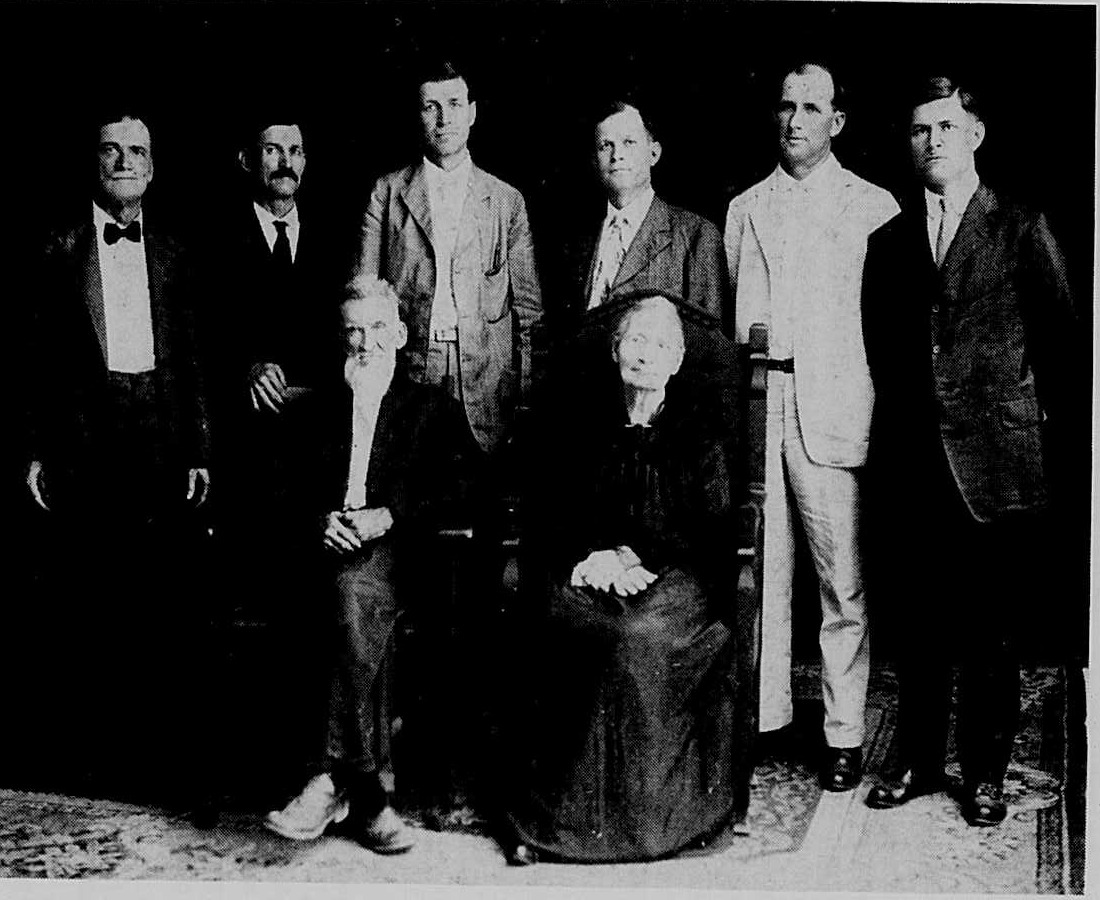
The family on July 3, 1916, at the sixtieth wedding anniversary of the parents. Front row: Buck and Susan. Back row: Will, Jim, Bascom, Marvin, Mack, and Hub.
For a while the family lived in a rented house on Ross Avenue, before buying a two-story frame house on Lindell St. Two of Bascom and Minnie's three sons entered the fledgling Southern Methodist University and subsequently graduated there. Their oldest son, however, had already made plans to enter Southwestern University in Georgetown, Texas. The circumstances of his going there may be noted. Because of a shortage of family funds, Bascom, Jr., the oldest son, had planned to teach school for a year to earn money for college. During the first summer after high school graduation he attended a "summer normal" course operated in the Sulphur Springs High School building. After a crash course there, he obtained a teaching certificate and contracted to teach during the following year at the little rural village of Arbala, some 11 miles southwest of Sulphur Springs. However, that summer Susan Thomas had inherited some funds, consequent upon the settlement of the estate of Captain William R. Buford. Her step-father-uncle had died on March 29, 1910. She provided $300 which financed the first year of college education for her grandson.
At first, Bascom practiced law in partnership with Judge Callie Connor, an old friend from Sulphur Springs. Later, he practiced in partnership with Will Pierson, a graduate of the University of Texas Law School. However, he continued his political activity, usually speaking on behalf of candidates he favored. By 1918 he was ready for another try at public office. Undoubtedly, he was, by this time, widely known to the Dallas electorate. In 1918 he ran for District Attorney against Willis Pierson, brother of his former law partner. He was defeated by Pierson, but in the run-off Bascom threw his support to Pierson rather than to the others who ran in the first primary. Consequently, Pierson gave him a job as an assistant district attorney. Bascom's salary was $150 a month.
Bascom resigned from the District Attorney's staff in about 1921. At that time he practically retired from the active practice of law. He had some property in the form of rent houses and these helped financially. The family reports that he retired because of health reasons. However, the health problems are not specified and Bascom continued in relatively good health for another 12 or 14 years.
Bascom had always been a nervous, excitable, or high-strung person. He continued in later years to pursue the same personal approach to politics he had demonstrated in his early tenure as State Senator. He was not skilled in the art of compromise, nor in the tactic of "go along and get along."
His personal approach won many friends and supporters but also a sizable number of opponents. Some of the latter were vitriolic and even combative. He was a fighter to the end. Perhaps, by these later years he had begun to develop the high blood pressure that laid him low a few years later.
His health was not so bad as to prevent his taking an active part in politics during the 1920's. He spoke widely from the public platforms of his County as well as throughout the State during the Statewide elections. His special target during these years was the Ku Klux Klan which played so prominent a part in the political life of Texas (and of the Nation) between 1921 and 1927. During the State elections of 1922, '24, and '26 the Klan captured many of the Statewide offices and elected nearly every official in Dallas County during 1922 and 1924.
Bascom was chairman of the speakers' bureau of the Anti- Klan forces during the years of the Klan's political ascendancy, years when the opponents of the Klan risked life and limb by their opposition. On one occasion he scheduled a public speech on the public square in Garland (on the outskirts of Dallas) but could not find any local figure who had the courage to introduce him. So Bascom climbed atop a mule-drawn wagon on the dusty square that summer afternoon. At first he lectured about the U. S. Constitution and its Bill of Rights. After a crowd had gathered he then started his denunciation of the Klan. On another occasion he lectured on a Sunday afternoon from the front steps of the City Hall, denouncing both the Klan doctrines of white supremacy, anti-semitism, anti-catholicism, and their tactics of white-hooded, torch-burning forays against those who got "uppity" in their opposition. On another occasion he was arrested because he spoke without a permit; when he came for a hearing, the Lieutenant Governor of the State defended him and obtained a quick dismissal of the charge.
By 1931, Bascom had completely retired, though he continued for a few more years to take part in politics. His wife, Minnie Little Thomas, died in April, 1935. Some two or three years later he married again. Soon after this marriage he suffered a stroke which eventually left him totally paralyzed. He remained at home and his wife took good care of him. After his death in April, 1942, he was buried in Oak Grove Cemetery in Dallas, alongside his wife, Minnie.
By 1910, Marvin Thomas had been living in Ennis, Texas, for 9 years. Some of his first years in Ennis as the owner of his family shoe store had been difficult, but by 1910 his business was well established and beginning to be consistently profitable. A half-dozen years earlier he and Luella had bought an imposing two-story frame house which was one of the show places of the community. It had been built during the 1890's in the ornate architectural style of that day—with the generous use of "gingerbread" that has about disappeared by now. For a while, he and Luella took in roomers to help pay expenses, especially during the 1908 period when a serious fire destroyed his store and several business houses nearby.
It took Marvin some years to recover from the heavy loss incurred at that time.
After the fire, Marvin's first business partner, named Walker, sold his interest in the store and moved from Ennis. Thereupon, Carl Hill, who was a brother-in-law of Marvin's wife, bought a one-fourth interest in the store. During 1914 and 1915 Marvin and Carl Hill entered upon an interesting and successful entrepreneurial activity. Although the town was beginning by this time to install modern utilities, it did not have a sewer system. Marvin talked at length with a friend from Terrell, Texas and learned how a sewer system had been built in that town. Thereupon, he and Carl Hill undertook to build a city sewer as a private venture. They persuaded 100 citizens to invest $100 each, as an advance payment on monthly sewage charges which all customers would pay after the system began to operate. With $10,000 cash and possibly with money borrowed from the bank, they were able to dig the ditches, install pipes, and to operate the system. After its initial success, public sentiment began to favor public ownership by the City. When Marvin was approached about the matter, he said, "I don't want to stand in the way of progress. I started the system only as a public service. If the City wants to buy it, I will sell. Let the City engineers examine the enterprise and determine the fair replacement value; whatever figure they come up with, I will accept." They proceeded on this basis and Marvin sold out at the price they named. He won much good will from the citizens on this account. At the same time he made a nice profit because of the increase in construction costs since the system was installed. With his additional cash, he bought several town lots and built small houses for renting, mostly in the Negro section of Ennis.
In either 1917 or 191914, Marvin was elected mayor of Ennis. He presided with distinction over the Commissioners Court as it considered the many projects then current as the little town moved into the modern era. In 1919, when the army demobilized after World War I, he sold a one-fourth interest in his shoe store (formerly owned by Carl Hill) to Hubert Rogers, then a young man of 25 who had worked in the store since about 1914.15 He "tended the store" during this period when Marvin was so busy in public affairs.
On November 5, 1923 Marvin resigned the mayorship and prepared to move to Dallas. He formed a partnership with the Jolesch family who owned retail stores in Dallas, Ennis and elsewhere. The Jolesch-Thomas Shoe Company (a wholesale company) was located in Dallas, which was rapidly becoming the wholesale center, the distribution center, for the Southwest. In addition to this company, which was located on the lower end of Commerce Street, they owned some nine retail stores - in Ennis, Dallas, Fort Worth, Corsicana, Wichita Falls, and possibly elsewhere. However, the Thomas and Jolesch families were not compatible; differences arose on a personality or family basis, sparked at least in part by antagonisms between the sons of the Thomas and Jolesch partners. In 1927, Marvin sold his interest in the company and established his own firm, under the name of Thomas Shoe Company, which operated in competition with the reconstituted Jolesch Shoe Company. He operated this company until 1934, when under the adversity of the great depression he was forced to close his wholesale business. However, with his son, he continued to operate two retail stores in Dallas until his retirement. This came officially in about 1938, as soon as he qualified for Social Security benefits. He, thus, became one of the earliest beneficiaries of the Social Security program which was authorized by the New Deal Congress in the summer of 1935.
Marvin continued in good health for some years and was employed in the store on a part-time basis until he was about 75 years old. His wife died much earlier than he. After Luella died, her sister, Bertha, came to Dallas to take care of her brother-in-law. Not much later, Marvin's son and daughter said to their father and aunt, "Why don't you two get married?" Bertha answered, "I have always loved him, but I've never thought of loving him that way." Before long, however, they weré:married and lived together for 18 years before Marvin's death in May 1961. He is buried in Oak Grove Cemetery in Dallas.
In 1910, Mack Thomas was 36 years old. He had been operating his family shoe store, in partnership with one of his brothers, for more than a decade. Although doing well in Sulphur Springs, he was thinking of moving to the high, dry climate of West Texas. For some time he had been bothered with malarial fever and he believed that the west Texas land—high and dry, and with no mosquitoes—would be better for him. In November, 1909, he traveled to the area to look it over. He took the train from Sulphur Springs to Dallas, and from there went by Interurban car to Fort Worth where he made connection to Wichita Falls. In Wichita Falls he met his nephew, John W. Thomas, Jr., who had been living there for at least four or five years. They walked all over town, looking at various sites. Probably also he talked with a half dozen or so other Sulphur Springs families who had moved to the area during the past decade. At that time he must have decided to move; at any rate, he wrote his wife, "I like the looks of things out here."
Instead of operating a retail shoe store, Mack decided to enter the real estate and insurance business. He opened his own agency and slowly began to build a clientele and a reputation for good judgment and fair dealings. He may from the start have been associated with J.M. Bland in this business; at any rate he and Bland were partners for some years during his active business career. Being in the real estate business turned out for Mack to be a good choice, primarily because it gave a good opportunity for him to benefit from the fast-developing petroleum industry when oil was discovered a few years later on the outskirts of Wichita Falls.
Opportunities to make money in the oil business came thick and fast after the first oil well was discovered in Burkburnett, Texas, on July 29, 1918. In just three months, 200 oil wells were completed in the little town, jumping its population overnight from 1,500 to 15,000. Beneath the forest of derricks, throngs of people walked the streets day and night. Hotels, rooming houses, and private homes were filled to overflowing. Out of sheer necessity, much of the business in buying and selling leases, of organizing oil-drilling companies, spilled over into Wichita Falls. Hundreds of people commuted to Burkburnett each day, traveling an unpaved, muddy road that led to the little town 20 miles to the north of Wichita Falls.
Mack Thomas moved easily from his normal work as an agent j for buying and selling property and land to that of leasing the land for oil-drilling purposes. The oil companies that drilled for oil did not buy the land on which they planned to drill. Instead they bought the mineral rights and only leased the topsoil for drilling purposes. Mack Thomas moved naturally to serving as agent in the buying and selling of such leases. In time, he participated,at least tentatively, in the speculative purchasing of oil leases for his own account. For example, he might lease ten acres here, ten acres there, and still other small plots. These could be resold to other buyers who held them in anticipation of a quick rise in price before they were bought by a drilling company that wished to gather up many small leases, combining them into a plot large enough to drill on.
Throughout the oil-boom period Mack remained basically a real estate man. He was, however, closely involved with oil activity, so much so that at one time he and his partner, J.M. Bland, and their friend, James I. Harvey, organized a separate company to serve as the vehicle of their operations. The Green River Oil Company had $30,000 of paid-in capital and was headed by Mack Thomas, Harvey, and Bland who served respectively as president, vice president, and secretary-treasurer. The business was sold for $50,000 on January 15, 1920 and the stock holders were paid off proportionately. A small share went to the widow of Mack's late brother, Hub Thomas of Sulphur Springs. A few months before his death, Hub had sent a couple of hundred dollars to his brother with the request: "Invest it in anything you think will be profitable; I trust your judgment in the matter."
In those hectic days of the oil boom, things got completely out of hand. Conditions were bad on at least three fronts. First, the town was in bad shape. People inundated the place, sleeping in tents or hastily constructed sheds. Schools, police, health, and other city services could not keep up. It got so bad that all fire insurance in the town was canceled, so great was the possibility of fire. The "flu" epidemic of 1918 broke out at this time and took a terrible toll of the town's population. And second, the oil business itself. New oil companies were formed on the sidewalks or in the streets. Most were legitimate, of course, but stock promoters and fleece men were everywhere. And thirdly, the drilling methods were chaotic. Wells were drilled side by side, often on a town lot too small for one rig, much less two. Business disputes arose on all sides and the legal system could not respond to the demand. Finally, the United States Government stepped in and ordered all wells stopped until a more orderly plan of drilling could be worked out. Under the aegis of the government representatives, a committee was appointed. After many meetings, a more orderly plan was slowly worked out. Along with a dozen or so other prominent citizens, Mack Thomas was appointed to this committee, a clear indication of the reputation for good judgment and integrity he had developed during his first eight years in the community.
Mack Thomas continued his association with the oil business for at least another decade, but his main activity continued to be the real estate business. Because of the rapid increase in the town's population and prosperity, one would assume that this was a period of much real estate activity. As he made good profits during this period, he invested in real estate. Even before the boom he had owned a lot in the center of the downtown business section of the city; on this lot he built a two-story brick building. It was during this boom period, likewise, that he built on Tenth Street a modern, two-story frame house with some four bedrooms upstairs.
The house was none too large. It teemed with a happy, active family life. Mack and Mary welcomed their sixth and last child in March of 1919, about the same time that their oldest was ready to graduate from the newly established Southern Methodist University. The other four older children were spread in different schools— high school, junior high, elementary, and nursery school. But all of them attended the First Methodist Church, nearby on their same street, a few blocks toward the center of town. The family took special pride in the handsome new structure because of the leading role Mack had played as a member of the Building Committee that had supervised its design and construction.
At the end of the 1920's, when business declined and later almost came to a halt in the depths of the great depression, his business declined and he merged into a period of retirement. During this period, Wichita Falls elected a mayor on a reform ticket (to reform, that is, the assessments and tax rates on local property). Mack accepted appointment as the City Manager and inaugurated a get-tough policy of making assessments and collections on a fair basis, with no favorites getting exemptions from City officials. His tough but even-handed approach was widely supported but also caused much acrimony and bitter controversy. In this heated atmosphere, he suffered his first heart attack. Shortly thereafter, he resigned; he continued to manage his own properties but was not otherwise employed.
At this stage in his life, the burden of health and business problems was of little significance compared to the sorrow of losing two of his sons—one accidentally and one tragically—one in the summer of 1932 and the other the year following. Mack and Mary were disconsolate. It was at this time that they began to go each year to Colorado Springs staying the entire summer season in the high, cool altitude while the scorching heat of summer was nearly unbearable in Wichita Falls. For perhaps twenty years they rented the same apartment, near the neighbors who likewise came to escape the heat of their own home towns. In those years Mack loved to play dominoes in the shade of a huge tree near his apartment. His domino partners were those neighbors, like himself, who for many years had made Colorado Springs their summer home.
After he became too old and frail to make the annual trip to Colorado Springs, Mack lived at home with his wife, with some of his children close by. He died on October 24, 1963, just short of his 89th birthday. His wife, Mary, was laid at his side, after she passed away on September 12, 1967.