← The Thomas Family in 300 Years of American History
Chapter V
HOPKINS COUNTY
The Ninth Generation
Although we have no documented information on the boyhood of Buck Thomas, we may assume that his life as a child and a teen-ager was happy and productive. The years between his tenth and twentieth birthdays (1846 to 1856) were a period of great prosperity for the Thomas family. His father was financially successful and his father and mother were active both socially and politically. From the standpoint of material comforts, they lived as well as any family in the State. They were intimates of the most powerful families, as well as the most cultured and best educated.
During those years William lived with his family in the center of the little town of San Augustine. His father's store was across the street from his home, so we assume he often helped by clerking in the store and probably learned some of the art of buying and selling, both locally and with the wholesalers and importers in New Orleans. He undoubtedly attended the local academies which his father helped to establish and manage in his home town. The family farms were six miles west of town on the road to Nacogdoches and he undoubtedly rode there often. He probably carried messages to the plantation overseer and did other chores for his father. In those days of slave labor, it is doubtful that he ever picked a row of cotton or guided a plow behind the mule. Indeed it is doubtful that he even saddled the horse he rode, since he had his own personal slave to attend to his personal wants.
It is likely that, as a young boy, he was given the nickname of Buck, one that stuck with him all his life. His father probably gave him the nickname early in life to designate him a "young buck" or a chip off the old block. We know that I. D. Thomas gave nicknames to all his children: Allie for Almedia, Polly for Mary Jane, Buck for William, Tode for Victoria, Nep for Penelope, Lonie for Loena, and Jim for James Edwards.
Some of Buck's grandsons remember stories in the family, mostly by their Aunt Nora (Mrs. W. B. Thomas), which trace the nickname to his early days in Hopkins County when the young man reputedly killed two bucks with one blast from his rifle. The story claimed that he shot one buck through the neck and the bullet went on to kill another that was directly behind the first one. Probably this story was fashioned more to amuse than to enlighten. One reason for so thinking is that in 1866, when I.D. Thomas was accidentally killed, the letter back home mentioned that "Buck" was on his way to New Orleans. When I.D., Jr. wrote his mother and referred to his brother by this nickname, we may be sure that the nickname was one which Buck had been given early in life.
As to Buck's social life and his courtship of Susan Jane Buford, we have no direct information. The Buford and Thomas families were among the leading families of Nacogdoches and San Augustine, respectively. Although these towns were 30 miles apart, there was much contact between them in social activities as well as in business and political affairs. It is likely that, for at least some of the years when they were growing up, the Thomas and Buford families lived not more than eight miles or so apart. The Thomas plantations were six or seven miles west of San Augustine (on the road to Nacogdoches); meanwhile, Susan Buford often lived with her mother on a plantation owned by her mother's parents, John J. and Jane Simpson. Oak Forest Plantation, owned by the Simpsons, was considerably east of Nacogdoches, on the road to San Augustine.
William (Buck) Thomas and Susan Jane Buford were married on July 3, 1856. This was shortly after Buck's 20th birthday, which had been on February 2, 1856. Susan was not quite 19; she had been born on September 26, 1837.
Susan's father was Thomas Young Buford. However, he died when Susan was less than two years old. Her mother then married her late husband's younger brother, William Ragsdale Buford. Susan's mother had four children altogether, two girls by her first husband and a boy and a girl by her second.
Susan's paternal grandparents were Miles Buford and Catherine (Young) Buford. They were living in Chester District, South Carolina when Thomas Young was born, August 5, 1814. Ten years later they moved to Fayette County, Tennessee. Afterward, they moved to Louisiana and then on to Nacogdoches during the Mexican regime. In addition to Thomas Young, their children included William Ragsdale, Christopher Young, Letitia and Susan H.
Susan Buford's grandparents on her mother's side were John Jordan and Jane Simpson. John J. Simpson came to Nacogdoches County in about 1829. He came from Kentucky where he had been born in about 1788, the son of William Simpson.
John Simpson must have had some capital for buying land in Texas. The first tax rolls of the Republic of Texas, in 1837, listed him as owning 27,631 acres, with a valuation of his aggregate holdings put at $22,595.50. He endured the hardships of the pre-Revolutionary Days, and quickly became recognized as a man of importance in the community. According to Roberts, he was "a member of the Methodist Church, a man of the highest integrity and staunchly religious convictions, and he reared his family in this faith."
Just prior to the Texas Revolution when he was just 21 years of age, Thomas Young Buford became actively engaged in the speculative buying and selling of land around Nacogdoches. More accurately, he bought and sold land certificates. These would have been the certificates offered for sale after the Mexican Legislature authorized the disposal of more than 400 leagues of land in March of 1835. Most of the certificates issued at that time were bought and quickly sold by owners who never saw or went near the land which they presumably owned. However, much of the land bought by Thomas Young Buford was not sold. It remained in the possession of his widow and some of it was later inherited by Susan (Buford) Thomas.
With the outbreak of the Revolution, Thomas Y. enlisted in Cavalry Company 1, 2nd Texas Volunteer Regiment and participated in the Battle of San Jacinto. For this service he was issued two donation warrants for 640 acres each in Van Zandt County. One warrant was for military service in the Revolutionary Army and the other for participation in the Battle of San Jacinto. He was also granted a headright league (4,428 acres) in Red River County. The latter was by virtue of his being a citizen of the Republic at the time of independence. (This particular land was sold 20 years later and helped Susan and her new husband to establish a business and a home in Hopkins County.)
After discharge from the army, Thomas Y. returned to Nacogdoches and was married on December 23, 1836, to Mary Brooks Simpson. The marriage probably took place in the "Planters Hotel", on Main Street in Nacogdoches, north of the Court House. The hotel had been founded and was then operated by the bride's father who lived there with his family, as well as on his plantation, Oak Forest.
After his marriage, Thomas Y. engaged in farming, probably in the Oak Ridge Community, but not on an extensive scale, since his estate included only one slave (a man), two horses and one yoke of oxen for work animals, one stock horse, and some hogs and cattle.
On August 23, 1839, Thomas Y. died and was buried in Oak Grove Cemetery in Nacogdoches. Because of his service in the Revolution, his grave is marked by a large and imposing monument erected by the State of Texas and placed there by the Texas Centennial Commission in 1936.
At the death of her husband, Mary Brooks (Simpson) Buford was left with two little girls under two years of age. She probably moved in with her parents, living either at the Planters Hotel or at their Oak Forest Plantation. However, on June 17, 1841, she married William Ragsdale Buford, the brother of her late husband. If for no other reason, she would have been in frequent touch with her brother-in-law since he had been appointed as administrator of the estate, consisting of about 50,000 acres of land, of his late brother.
Apparently William Ragsdale Buford was an adventurous, speculative fellow, always on the go, always trying something new. He was three months past his 23rd birthday when he married the young widow of his older brother. Eight years later, with a wife and 4 young children at home, he took off for California in search of gold. Within a year he returned home, by ship and across the Isthmus of Panama. Later, he made a second trip to the gold fields. This time he returned overland, traveling the southern route through Arizona and New Mexico and bringing his very considerable gold collection with him in a small trunk.8
While in New Mexico he met up with some adventurers who told him of a buried treasure on the Isle of Pines, off the coast of Cuba. Upon returning home, he organized a treasure hunt to the Isle of Pines. While there he encountered rousing adventures, including a pitched battle with a small army of natives. During this time his wife and children probably lived with her parents at their - hotel in Nacogdoches or at their plantation. If they lived at the plantation, it may have been during this time that their daughter, Susan, first met Buck Thomas.
After their marriage on July 3, 1856, Buck and Susan probably lived for a while at the home of their parents, since that was the custom in those days when there were no homes or apartments for rent or purchase. It is likely that they lived in the I. D. Thomas home in San Augustine and that Buck worked for his father, in the store and helping to manage the plantations. Just 10 days before the marriage, Buck's father had bought lots #1 and #24 in the town of San Augustine and deeded them over to his son. At that time, it may have been thought that the young couple would continue to live in San Augustine.
We assume that William Ragsdale Buford was the moving force in the decision to make the move away from San Augustine. He was the older man, just under 40 years of age at the time. he had' traveled extensively; he "knew his way around". Undoubtedly it gave him no pause that he had had no experience in the mercantile business. Undoubtedly also, he had enough capital to finance the move. He owned at least six or eight slaves,sone farm lands (not extensive) in Nacogdoches, thousands of acres of unimproved land, and he may still have had some of the gold he brought back from California. Moreover, his wife had just inherited more land and some slaves from the estate of her father.
When John J. Simpson died on May 28, 1855, his son-in-law, William Ragsdale Buford, was one of the executors of his estate. Simpson's daughter, Mary B. Buford, inherited several slaves and her share (along with seven other children) of her father's hotel and other properties in Nacogdoches, plus more than 10,000 acres of land, mostly unimproved, throughout Texas. Jane Simpson died just two years later — on June 2,1857— and that portion of the estate which was left to her was also divided among the children.
It seems clear that when Buck and Susan were married, the parents on both sides were well-to-do folks for that day and time. At least a considerable portion of the holdings by Susan's parents had been inherited by her mother, either from her first husband or from her own parents, the Simpsons. The land which Mary B. (Simpson) Buford inherited from her first husband was kept separately, since the Republic of Texas Tax Rolls for Nacogdoches County in 1845 listed both William R. Buford and "William R., as agent for the heirs of Thomas Y. Buford." When they moved to Hopkins County, he was listed on the tax rolls there both in his own name and as William R. as agent for the heirs of Thomas Y. Buford." About 1860, however, the title to these lands was transferred to Buck Thomas, and he was listed on the tax rolls of Hopkins County as late as 1877 as "William Thomas, agent for the heirs of Thomas Y. Buford."
So far as we know, Buck Thomas had no assets of his own when he married. Perhaps his father gave him a thousand dollars or so for an initial investment. In addition, he probably helped him to establish a line of credit with the New Orleans importers and wholesalers who shipped goods up the Red River to Jefferson and then overland to Hopkins County. This assistance, when combined with funds derived from the sale of land which his wife had inherited from Thomas Y. Buford, was enough to finance their new business and new home.
As Buck and his father-in-law began to discuss the possibility of establishing a mercantile establishment in some new part of the State, it would not have been difficult to find people well acquainted with the Hopkins County area and its growth possibilities. Several people in San Augustine and Nacogdoches had sat in the first session of the Legislature after Texas was admitted to the Union in 1845, and voted for the proposal to create Hopkins County. Some of their neighbors had visited in the area; the local newspapers carried political and business news from the area; and land merchants regularly advertised the sale of certificates for the surveying and ownership of land in that area.
The counties just south of the Red River, stretching westward from Texarkana to the Denison-Sherman area had been settled as early as the East Texas area. In the early 1820's American settlers from Arkansas and Missouri had pushed into northeast Texas at the same time they were entering East Texas via Natchitoches and San Augustine.
In the years between 1810 and 1818, a frontier outpost had been established in Hempstead County, Arkansas (Missouri Territory at that time). This post was about 30 miles northeast of Texarkana, and from there new settlers had pushed down to the Red River area. During the years before 1840, however, no settlements had been made south of the Sulphur River which runs parallel to the Red River, some thirty miles south of it. In those days American settlers were not sure how far United States territory extended, since the Red River (which was the boundary) was not clearly defined. Some claimed that what today is recognized as the Sulphur River was actually the main channel of the Red River and hence the international boundary.
The Hopkins County area was originally occupied by the Indians of the Caddo confederacy. Each fall and winter they came into or through Hopkins County in search of buffalo meat and robes. The well marked trail which they had followed from their village near Shreveport to the big prairie passed through Hopkins County. This route was known as "the main Caddo Trace". Because of the Indians, this extensive area _ south of the Sulphur River had had no permanent settlers until after 1840. The bottom lands of the Sulphur River were especially dangerous, as a trackless wilderness. The more open lands to the south of the River lowlands were too exposed, too isolated from the permament settlements to the north.
Sam Houston, as the first President of the Republic of Texas, took a lenient approach in dealing with the Indians. But when Mirabeau B. Lamar became President in 1838, he took a far more aggressive stance. In effect, he ran the Indians out of the area, especially the Cherokees who had come to the area after they had been dispossessed of their homes in the eastern States after the campaigns of General Andrew Jackson.
When the Texas Revolution was over, the Republic of Texas sold large amounts of land scrip to get money with which to pay its debts, including the money owed to citizens for military service. This scrip was bought and sold speculatively. In fact, I.D. Thomas of San Augustine bought 4,428 acres of such land in 1845, paying $1,500 for it and this scrip was still a part of his estate when he died in 1866. Colonel James Reilly bought much of this scrip and located surveys in what later was laid out as Hopkins County. At one time Reilly owned 100,200 acres in the County. These surveys were made from 1841 to 1845. He sold much of the land during his life and his widow sold the remainder after his death.
The first settlement in Hopkins County was in 1842, in the area of Sulphur Bluff, in the northeast corner of the County. The first permanent settlement in the County was made by William Hargrave and his six children in February, 1843. Within a short time there were scattered villages all over the County. By 1845 there were enough people to request organization of a county. The new county, created by the first Legislature of the newly admitted State of Texas, was carved out of Lamar and Nacogdoches Counties. By 1850, when the first Federal Census was taken in Texas, 2,623 people were counted within the borders of the County.
The act that created the County provided that a county seat should be established in the exact center of the County. Two sites were found within a few miles of the center. One was called Hopkinsville and the other called Tarrant in honor of a prominent Texan who had taken an active part in the military campaigns to subdue and remove the Indians from the central Texas area. A vote was taken to determine which was to be the county seat and the majority vote was given to Tarrant. It remained the county seat jee Reconstructions Days, following the end of the Civil War.
From the start, the new town of Tarrant suffered major handicaps. There was a lack of a good water supply, and even more important, it was isolated from the main line of communications, which then started at the navigation head at Jefferson, which in those days was a port on the Red River, and stretched westward through Sulphur Springs to the frontier.
The present site of Sulphur Springs, on the other hand, was ideal. Along the wagon trail going west from Jefferson no spot equalled the beauty and convenience of the campground in Hopkins County. There were a hundred bubbling springs on more than four acres covered with lush grass. This campground first came into use in 1845 and within a year an enterprising pioneer built his one-room cabin and laid in a stock of staples to meet the needs of the teamsters' trade.
On May 17, 1854, the United States Post Office recognized the little settlement, established a station there, and gave it the name of Bright Star. This event is generally recognized as the birth date of Sulphur Springs. Despite the name given by the Post Office, the people continued to call the little town "the sulphur springs" and that name persisted. Finally, in 1871, when the town was legally incorporated, the Post Office yielded to custom and changed its name to Sulphur Springs.
In all likelihood, Buck and his father-in-law made a trip by horseback from San Augustine to Hopkins County to look at the location and appraise business prospects there. If they did travel there in the fall of 1856, they found a little town with a population of about 200 persons. Eighteen to twenty small store buildings were clustered in the vicinity of the campground which was about 200 yards west of the intersection of the two principal roads, one from east to west and the other from north to south. The principal east-west road was called Mill Street (now Main Street); it was the route by which the teamsters carried freight from the Red River to the Texas frontier which stretched roughly between the present-day cities of Wichita Falls to San Antonio. The north-south road (now Davis Street) came into town from the County seat at Tarrant, five miles to the north.
As they walked around the town, they counted eight grocery and dry goods stores, three rather large general merchandise stores, several saloons, two hotels, and a planing mill. They noted that the town had a newspaper, the Independent Frontier. Its proprietor, William Wortham, told them he had moved to the town the preceding year when he had bought out the Texas Star which up to that time had been published for a few years at Tarrant. Wortham told them he estimated the population of the county to be about 6,000, nearly three times what it was in 1850. The visitors asked about the
church congregations in the town, noting that they had observed the "beautiful little white sanctuary of the Methodists" which adjoined the campground at the sulphur springs. Wortham told them it had been built in 1852. Both the Methodists and the Baptists had thriving congregations but only the Methodists had a Meeting House; they shared it with the Baptists.
After visiting in Bright Star,the two men would have ridden their horses the five miles north to the County Seat at Tarrant. The village of Tarrant was only slightly larger than the one around the campground at the sulphur springs. They entered the small, wooden, two-story building that served as the Court House. They talked with the County Clerk and the County Surveyor regarding the procedure for buying and selling land, surveying it, and recording the title.
At the time of their visit, the land business and the status of land titles were especially in disarray. In early 1856 the Land Office Building in Austin had burned, destroying the records of land ownership all over the State. Thereupon, the State Legislature passed a law on September 1,1856 requiring that within the next two years eyery land certificate must be resubmitted and re-validated. With the county officials, they reviewed thoroughly all types of land titles, including the headright grants which had been given by virtue of residence in the State at the time of independence from Mexico; bounty grants for service in the War of Independence; donation grants for participation in the Battle of San Jacinto, in the storming of Bexar, or for those who died under the command of Travis, Bowie, Ward, or Fannin. It was even more important to review the status of the land scrip which had been sold by the Republic and the State of Texas — good for either 320 or 640 acres — to raise money for the ordinary support of the government or for the support of the army. This land scrip had been widely bought and sold all over the State. Much of the scrip was fraudulent, and lawyers made a ' fortune in settling the claims. Most of the problems arose because some land speculators issued more scrip than was actually contained in a particular land survey.
The visitors were much impressed with the evidence in Hopkins County of rapid growth. At that time, new settlers were pouring into Texas in great numbers. Most of them moved to the areas where they could buy cheap land, as yet untouched by the plow. Much of this land was in central Texas; the northern border of this area was a line running east to west, from Sulphur Springs through Denton, Texas, and from that line southward down through the heartland of the State, all the way to Austin. Seeing the opportunities for growth in the area, our guess is that they anticipated the buying and selling of land as much as the buying and selling of store goods. From the start it was anticipated that the new firm of Buford and Thomas would deal in land as well as in groceries, hardware, and clothing. Buck would "keep the store" and his father-in-law would handle the outside interests.
We may be sure that on this trip to northeast Texas, the visitors did not look merely at Hopkins County. They looked at the entire area before making the final decision as to where they would locate. They surely stopped in the neighborhood of Daingerfield (Morris County) and looked over the 4,428 acres of land owned by the estate of Thomas Young Buford and controlled by William Ragsdale Buford, as administrator of the estate of his late brother. They may also have inspected the two 640 acre tracts still owned in Van Zandt County by the heirs of Thomas Y. Buford.
Family stories indicate that the first exploratory trip took them as far as the little village of Dallas, on the Trinity River. At that place they could find no way to get across the swollen River, so they turned back, undoubtedly deciding on Hopkins County as the most attractive area.
Some stories in the family indicate that Buck on this trip was accompanied by his wife. However, this seems unlikely in view of the fact that their first child was born on April 12, 1857.
We are not sure how long it took them to get their affairs in order actually to move their families to Hopkins County. The move probably was in the spring of 1857. At any rate, in November, 1857 Buck Thomas and William Buford met with a group of friends on the upper floor of the only two-story building in town and organized the Bright Star Lodge of the IOOF (Independent Order of Odd Fellows). Buck Thomas was one of the petitioners and his father-in-law was elected an officer. Because of their leadership role in this group, we can assume that Buck and William had been living in the community at least long enough to become well acquainted, six months or so. (Although there were three chapters of the Masonic Lodge in the County in 1856, this was the first for the Odd Fellows. The chapter has continued; a century after its organization, it still carried the name of Bright Star, by then the only surviving memento of the early name given to the town we now call Sulphur Springs.)
Moving the two families to a distant part of the State and establishing homes and a business in that community was undoubtedly a complex operation. It is possible that Buck and his father-in-law, on their earlier trip north to look over the community, had bought a town lot which might or might not have had a store building on it. After that was done they may have carried two or three wagon loads of basic merchandise from San Augustine to Bright Star, or they may have gone to New Orleans to buy merchandise, going with the shipment by boat to Jefferson and the rest of the way by wagon.
When they went with their families in their final move, they probably had as many as four wagons with their essential supplies. They would have had several slaves with them, probably driving the livestock behind the wagons. At least one of the slaves would have been skilled in carpentry work, qualified to add a room to a house, or to build necessary furniture such as chairs, bedsteads, and chests of drawers, or to build store furniture such as tables and shelves for storage or display of merchandise.
¥ By 1857 the road from San Augustine to Bright Star was well marked and heavily traveled. These sections of Texas had been settled for two decades or more. Towns were a day's travel apart, and farm houses and country stores dotted the roads. From San Augustine they would go 90 miles almost due north to Jefferson, and from there 80 miles more west-north-west to the campground at "the sulphur springs".
They would have gone first to Shelbyville, about 25 miles north of San Augustine. For many years, San Augustine had had much intercourse with this village. This town had been the scene of the famous Regulator-Moderator feud back in 1844 when 600 citizens of San Augustine County were called to duty in the Militia and rode to Shelbyville to declare martial law for a time, putting a stop to the armed feud that had involved as many as 150 men on each of the opposing sides. The next night the two families probably stayed in the little town of Teneha which was settled as early as San Augustine, though it never attained equal prominence. The following night they would have slept in Marshall, a town even larger than San Augustine. They may have paused a bit to take a look at the new railroad being built there. On February 15, 1857 the Southern Pacific had completed its first 25 miles of track, from Lake Caddo to within 5 miles of Marshall, which would eventually cross the entire State. The next day took them to Jefferson where they might have stopped for at least a day to take care of business matters. The stop was probably more than welcome to the young wife, for the trip was either shortly before or soon after the birth of her first child, little Mary. The final 80 miles from Jefferson to Hopkins County were not difficult, by the standards of travel in that day. By then, the heavy wagons had been using the route for twelve years, and there were houses along the way where they could find shelter, food, and fresh water.
* * * * * * * * * * * * * *
The fifteen-year period from 1857 until 1872 was a significant period in the life of William and Susan Thomas. It was during these years that Buck was in the mercantile business with the Bufords, first with his father-in-law, William Ragsdale Buford, and later with the son and the son-in-law of the older Buford. Also, this was the period of the Civil War and reconstruction. And lastly, 9 of their 13 children were born during this period in town. Most of their boys were born in town but grew up on the farm.
The mercantile business established by William Thomas and his father-in-law was known as Buford and Thomas. It was one of the largest of the two or three such firms in the town. Existing accounts indicate that it was similar to the one owned by I. D. Thomas in San Augustine. For several years the U. S. Post Office for the little town of Bright Star was located in the store. The store stood on the south side of what is now Main Street (Mill Street then), on the little triangular block which has Davis Street as its base and the City water tower at its apex.9
Their store was typical of the establishments of that time. It was loaded with many types of staple merchandise, stored or stacked in hit-or-miss fashion. Alongside the barrels of brown sugar and flour were bolts of calico and stacks of cast-iron pots and kettles. Lumber, drugs, nails, coffee beans, buttons and thread, ox yokes and ready-made shoes and clothing were also available. An account book of 1859 gives the picture. On March 24th, a bill of goods was sold on credit which included wool sacking, sheep shears, shirting, a dress for the "old woman", nails, drilling, and several feet of dressed lumber. In April of that year was sold one of the largest bills ever sold on one day. This included 7 pounds of coffee ($1.30), 7 pounds of sugar ($1.00), 4 pounds of shot and ½ pound of powder, 98 pounds of flour ($3.41), 1 bushel of meal (75¢), and a plug of tobacco (25¢). In May the same customer bought a pair of shoes ($2), a set of plates, knives, and forks and spoons ($2.65), a set of teacups (75¢), and a "vile" of a patent medicine called Bateman Drops.
For several years, Buford and Thomas owned a large warehouse on the corner of the public square. On December 18, 1865, this property was sold by the Buford and Thomas owners to Richard B. Clark of New Orleans for $2,000, of which $1,000 was in cash and the remainder in a promisory note, with interest at 10 percent. The property was described as a town lot on Gilmer Street and the Square, containing a one-story frame house and warehouse annexed.
From their first year in town, both William Buford and William Thomas began to acquire blocks of land, both farm land and town lots. One of the earliest Thomas entries in the Hopkins County Deed Books was on November 30, 1859 — the Gaines deed to I.D. Thomas for one league of land (4,428 acres) in Rusk and Harrison Counties. Although recorded in 1859, the date of the deed was March 31, 1845 when I.D. Thomas bought the land for $1,500.
One tract of land owned by the heirs of T.Y. Buford was sold in 1858 to John Boyd of Chambers County, Alabama. The land was described as being one league (4,428 acres), situated in Titus County (now Morris County), about five miles south, south-west of Stephenson's Ferry across the Sulphur River, located by virtue of certificate No. 384, issued by the Board of Land Commissioners of Nacogdoches County on the 3rd day of March, 1838. The land adjoined the survey by William Wheat. On April 13, 1858, the deed transfer was signed by W.R. Buford and his wife, Mary B. Buford, and by William Thomas and his wife, Susan Jane. Later that year, Susan Thomas's sister, Mary Tom Edwards, and her husband, Robert T. Edwards, came to Hopkins County and notarized the deed on December 1, 1858. At that time their home was in Austin County, on the Brazos River, not far from the town of Hempstead. The land sold for $10,000 and under Texas laws of inheritance, one half this amount went to T.Y. Buford's widow, Mrs. W.R. Buford, and the other half was split between the two children, Susan Jane Thomas and Mary Tom Edwards.
On June 16, 1858, Susan Thomas sold two tracts (of 640 acres each) in Van Zandt County. This was the land her father had obtained by virtue of his military service during the Texas War of Independence. (Hopkins County Deed Book E, p. 84)
A sampling of the tax-roll lists from 1857 onward indicates the scope of their operations. The Buford and Thomas partners are included first in the 1858 list. Buford listed himself as one taxpayer, and himself as agent for the heirs of T.Y. Buford as another. He listed no acreage owned within the county but showed ownership of eleven slaves at a valuation of $11,900. William Thomas, in that year, declared no lots or acreage within the county but listed one slave and thirteen cattle, valued at $800 and $100 respectively. William Buford listed ownership of some 5,500 acres outside Hopkins County, valued at $8,000. This land was an original grant by the Republic of Texas to T.Y. Buford and was owned in 1858 by William Buford as agent for the heirs of T. Y. Buford.
The 1859 tax rolls for the first time listed Buford and Thomas as owning Town Lot #1. The value of the lot was $1,000 and the amount of tax paid was $1.25 to the State and $1.00 to the County. William R. Buford that year declared nine Negroes at $4,300 and one horse at $500. William Thomas and wife rendered one town lot at $200, two Negroes at $1,800, and fifteen cattle at $100. In a separate listing of properties outside Hopkins County, William R. Buford declared ownership of eleven tracts of land, totaling about 10,000 acres. William Thomas and wife showed ownership of some 1,500 acres of land in Henderson and Van Zandt Counties. This was clearly a part of the land that had originally been granted to Thomas Y. Buford. From 1839 until 1859, William R. Buford held this land as agent for the heirs of Thomas Y. Buford. In that year he apparently deeded it over to Wm. Thomas as agent for the heirs of T.Y. Buford.10
The indications are that, although the new firm was successful in its early years, it ran onto hard times after the beginning of the Civil War. Business was greatly disrupted during the War. Cotton could not be sold because of the blockade; steep taxes had to be paid, not only in currency but in actual farm produce; and debts could not be collected, especially after all debts were suspended by the Confederate Government for the duration of the conflict. In addition to these general conditions, the standing of this particular firm may have been hurt somewhat by the fact that Wm. Thomas chose not to volunteer for armed service, legitimizing his abstention by his status as a lay preacher of the local Methodist Church. These factors probably were significant considerations in the decision by William Thomas to sell his business in 1872 and move to the farm at 2½ miles from town.
At that time he was only 36 years old and had been in the mercantile business for only fifteen years.
It is likely that during the Civil War, Buck Thomas ran the business almost alone as his father-in-law was heavily involved in military affairs. When the War began, leading citizens in every county in the State immediately began to organize, outfit, and train companies of men. Buford, by his own report, organized and outfitted four companies or men during the first year of the War. Outfitting a company meant the furnishing of the basic supplies for camping in the field.
The fifth company organized by Buford was provided with the following items, according to a requisition in July 1862.
| 18 tents | 1 wash pot |
| 18 sets of tent poles | 14 skillet lids |
| 115 canteens & straps | 3 tea kettles |
| 115 haversacks | 13 water buckets |
| 69 knapsacks | 6 spoons |
| 70 tin cups | 9 pr pot hooks |
| 43 tin plates | 12 knives |
| 24 earthen plates | 12 forks |
| 11 coffee pots | 2 spades |
| 1 coffee mill | 3 shovels |
| 12 pans | 1 hatchet |
| 6 oven lids | 4 axes |
| 1 dinner pot | 1 camp kettle |
On April 23, 1862, Buford entered on active duty when he was sworn in as captain of his company which became a part of Ochiltree's Regiment of Texas Volunteers. William B. Ochiltree who commanded this Regiment of Texas Volunteers was probably a long-time friend of Buford. Ochiltree's home town was Nacogdoches where he served with distinction as a lawyer and public official. However, he had also lived and practiced law in San Augustine. At one time he was a member of their Thespian Society and participated in several of their dramatic productions. Shortly before the War began, he had been appointed to a district judgeship at Marshall, Texas. From that headquarters he presided at court in many East Texas ' towns, including Sulphur Springs.
After Buford's company and Ochiltree's Regiment were assigned to duty they became, respectively, Company E, 18th Regiment Texas Infantry. On January 8, 1863, while in camp near Pine Bluff, Arkansas, Captain Buford penned the following note to his superior officers:
To Colonel William B. Ochiltree
Commanding Regiment InfantryColonel—
The undersigned Captain of Company E Ochiltree Regiment Texas Infantry with respect states that he is now over the age of 45 years and is fast failing in physical strength. He would state that in the spring of 1861 he placed upon a plantation near Hempstead in Texas about twenty valuable slaves under the charge of one Robert Edwards - said plantation being about two hundred and fifty miles from the homestead of the undersigned - he would further state that he has been informed within a few days past, that said Edwards has abandoned said slaves and joined the army himself, leaving no white person to care for or control said negroes. The undersigned says that he has but one son, a young man but 18 years of age - who nearly 18 months since joined Maxcey's Texas Regiment and participated in the Battle of Shiloh - he was after that affair discharged and has again joined the army - leaving no one at home whom the undersigned can call on to take charge of his interests . . . . He respectfully asks leave to resign his office and pray that the same be accepted to take effect immediately -
W.R. Buford
I have knowledge of the facts stated by Captain Buford and respectfully recommend the acceptance of his resignation.
W.B. Ochiltree - Colonel
Buford's resignation was accepted on February 23, 1863, and presumably he returned to his home and business in Bright Star. We do not know how active he was in running the business day by day. We guess that he was not too active, since about four years later he retired completely from the business and turned over his interest to his son and his son-in-law. Buck's partners thereafter were Capt. Buford's son, John Christopher Buford, and Ira Hubbard Harrison, the new husband of the Captain's daughter, Betty Buford.
When the war started in 1861, John C. and Betty Buford were in Clarksville, Texas, attending McKensie Institute, a residential academy operated by the Methodist Church. John Christopher was at first not permitted by his father to enlist, but he went anyway to Mt. Vernon and enlisted with Captain Leftwich's Company, taking his Negro body servant with him. After a few months he was forced by illness to return home. A little later, the Governor of the State commissioned him to guide wagon trains across the State, carrying loads of cotton to the Mexican port of Matamoras, where shipments could evade the Federal ships that blockaded the Confederate coasts. He was engaged in this work until the War was over.
Shortly after the end of the War, John Christopher married Elizabeth Askew, a daughter of Mr. and Mrs. John Askew of the Bethel Community. She had come to stay in Captain Buford's home while attending the school run by Mrs. Georgia Avery. She and John C. Buford were married on November 7, 1867 and for a while they made their home with Buck Thomas and his wife.
Ira Hubbard Harrison came to Hopkins County at the end of the Civil War, looking for a place to find a job and a home. He had enlisted on January 2, 1862 at Henderson, Texas. He served throughout the War and was surrendered with the forces of Lt. General R. Taylor at Meridian, Mississippi. As he rode through the countryside looking for a place to open a business and to make a home, he passed the home of Captain Buford. The captain's "beautiful young daughter, Betty" was leaning against the gatepost as young Ira passed. Then and there he decided to stay in Bright Star. They were married on August 6, 1866. They continued to live in the Buford home.
From 1857 until 1872 Buck and Susan lived in their house on Gilmer Street, only a hundred yards south of the public square. The Tapp Funeral Home now stands on the spot where the house once stood. When Buck Thomas's oldest 4 living son, Will, died in 1950, his funeral service was held in that funeral home, and the man who gave the eulogy commented on the fact that Will Thomas was being buried in the same spot where he was born nearly 91 years earlier.
Their original lot was large; on it to the north Buck Thomas and his partners built a large warehouse. To the east, at the other end of the lot, the J.C. Bufords built their home. The Harrison home was on Gilmer Street just a few yards to the south of the Thomas home. The families visited together often, and helped one another when children were born — or died.
For some unknown reason Buck and Susan lost most of the children born during the first decade of their marriage; five of their first eight children died at an early age. Of their last five children, only one died before reaching adulthood. Listed below are the names of each child, by order of birth, and with the date of death shown for those who died in infancy or early childhood.
| Mary | April 12, 1857 | died Nov. 11, 1858 |
| Iredel Divison | Aug. 19, 1858 | died Oct. 30, 1858 |
| Wm. Buford | Oct. 13, 1859 | |
| Penelope Jane | April 13, 1861 | died Nov. 4, 1862 |
| John Wesley | Dec. 11, 1862 | |
| James Edwards | Sept. 3, 1864 | |
| Iredel Divison | Dec. 4, 1866 | died Aug. 11, 1868 |
| Robert Young | Oct. 15, 1868 | died Feb. 7, 1870 |
| H. Bascom | March 16, 1871 | |
| E. Marvin | Feb. 27, 1873 | |
| McTyeire | Dec. 16, 1874 | |
| Thomas Young | Oct. 30, 1876 | died Apr. 22, 1881 |
| Hubbard H. | Dec. 3, 1878 |
Of the eleven boys and two girls born to the couple, seven boys grew to adulthood and married.
All of the children were named either for members of the family or for leaders in the Methodist Church. Mary obviously was named for Buck's sister, Mary Jane, and Susan's sister, Mary Tom. Buck's sister, Mary Jane, was just two years older than Buck; she had married at the age of nineteen and just a few months later (in 1853) both she and her husband died of yellow fever. The first son of Buck and Susan was named for Buck's father (as was the sixth child who was given the same name, after the first I.D. had died). William Buford was named for Susan's father (really her step-father and uncle). Little "Penny" was named for Aunt Nep, and James Edwards was named for Buck's younger brother, James Edwards. (The Edwards name came, of course, from I.D.'s wife, Penelope Edwards.)
The first child to be named for a Methodist leader was John Wesley, born in 1862. Bascom, Marvin, and Mack were all named for Methodist bishops who presided in the Hopkins County area at one time or another in the two decades following the Civil War. Enoch Marvin and Holland N. McTyeire (pronounced: McTeer) were both elected bishop at the annual conference in New Orleans in 1866.
Hub Thomas, born in 1878, was named Hubbard Harrison for Buck's one-time business partner and Susan's brother-in-law, Ira Hubbard Harrison. Family tradition has it that shortly before Hub was born, Buck Thomas had been seriously ill with typhoid fever. Ira Harrison rode his horse every day for more than a month to the farm two and a half miles out from town. He visited and cared for his brother-in-law in so regular and conscientious a manner that the next son was named for him.
We do not know for whom little Robbie was named.
Little information is available about Susan Thomas during these early years. From accounts that have come down in the family she was a warm, caring, peace-making individual — the typical mother's role. She bore thirteen children in the first 21 years of her marriage, raised them, looked after them, and gave them a sense of belonging within the family. It was always a closely knit family, with parents helping the children to get ahead and the brothers help- each other.
When Buck and Susan moved to Hopkins County in 1857, they found a small Methodist congregation already in existence. It had been organized in 1850 by Reverend Phineas B. Bailey. A small church building had been constructed in 1852 or 1853 on the campground near the springs for which the community was named.
It is clear that the church in Sulphur Springs had less than full status during the first 15 years of its existence. Annual conference records for the Methodist Church during those years list a church in Hopkins County for the first time in the church year 1858-59. For that year, the Clarksville District included in its jurisdiction a church at Tarrant, the county seat five miles north of Sulphur Springs.
It listed 114 members, 463 white probationary members, 122 "colored" members, and 34 "colored" probationary members, and two local preachers. It was not until 1866 that Sulphur Springs was listed as having a church, this time as a member of the Jefferson District. In that same year, the Methodist Conference in New Orleans approved a proposal to split the East Texas Conference into two, creating the Trinity Conference which would include all churches in northeast Texas. The first session of the newly formed Trinity Conference (now called the North Texas Conference) was_held the following year at the new church in Bright Star.
It was not until 1860 that the little church had a half-time preacher assigned to it. Before that date the itinerant preacher assigned by the Bishop to the little congregation Breached there perhaps once a month or once in six weeks. In the interim most of the worship and study sessions were led by the "class leader" or by one or more locally licensed preachers. Apparently, the little church grew consistently during the decade of the 1860's, for in 1870, or possibly a little earlier, they left their original location and bought an acre of ground for $200. This was 100 yards southeast of the public square, where the Baptist Church now stands.
They stayed there until 1892-93 when the congregation moved to its present location, one block north of the public square on Church Street.
Although we have few details regarding his pastoral role, there is no question but that Buck Thomas was a life-long dedicated, and active leader in the early days of the Methodist Church. He had grown up in the church, and had often heard his Uncle Offie and Uncle Shadrach, if not his father, give public testimony to their faith. He undoubtedly served during his first years in the community as a class leader and as an exhorter, these being stepping stones to licensing as a local preacher.
We can safely guess that he was licensed prior to April, 1862, since this was the date when the Confederate military conscription law was passed in Texas, and Buck Thomas used his ministerial status as a basis for exemption from the draft. We can also safely assume that he was the leading force that persuaded the itinerant preachers and the Bishop to hold the first session of the newly organized Trinity conference in his home church. In later life, he held these years of church leadership among the most satisfying memories of his life. He named one of his sons for John Wesley and three more for the Methodist bishops whom he served under. Even at the end of his life he was deeply touched when his earlier accomplishments were remembered. In 1923, when the North Texas Conference had its annual meeting at the First Methodist Church in Dallas, he and the Reverend Dr. John McLean were publicly honored as the organizers of the Trinity Conference in 1867. Although he was 86 years old and a bit frail, he eagerly made the trip to the Dallashome of his son, Bascom, who escorted him to the meeting.
We do not know how many years he functioned as a licensed minister. In those days the lay preacher did not serve under the Bishop, subject to his appointments. He was licensed by his church conference for one year at a time, the license being renewed each year. It is likely that Buck Thomas, after a number of years, did not request renewal of his license. As the churches grew and full-time ministers, rather than traveling circuit riders, were available, the need for local preachers declined.
To the end of his days, however, he thought of himself as a proclaimer of the Word. His older grandsons well remember him as an old man, gray headed and with full white beard, who sat on the front row at church, punctuating the sermon with loud, enthusiastic "amens" at appropriate intervals. When the minister called on "Brother Thomas" to lead the congregation in prayer, his praise of the Lord poured forth in volume and enthusiasm. One of his grandsons, remembering his reactions as a young boy, thought in those days, "When Grandpa starts praying, he can just go on forever!"
In addition to his work as a merchant and in the church during his first 15 years in Hopkins County, Buck Thomas adjusted in his own way to the turmoil and tragedy of the Civil War. He had just passed his 25th birthday when the War broke out. He and Susan had two little children. (Their first two babies had already died.) In most instances, young men of his station and circumstance volunteered immediately for duty. The vast proportion of the population were in favor of secession and the cause of the South, and in fact a huge proportion of the male population quickly volunteered for service. Buck Thomas did not.
The approval of secession by Texans was, however, not unanimous. About 2,000 men actually left Texas for service in the Union armies, and about 10 percent of the population were neutral and avoided direct participation one way or another. The attitude of this group is typified by the actions of General Sam Houston, the revered old Hero of San Jacinto.
General Houston had been a Union man all his political life. Before he came to Texas he had been a Congressman and then a Governor of Tennessee. He served two terms as President of the Republic of Texas. After annexation, the State Legislature elected him to the U. S. Senate where he served two terms. In the Senate, he consistently voted against other southern senators. In the end he cut his own political throat for his convictions. In 1848 he voted for the entrance of Oregon as free territory, the only senator from the south to vote this way. He refused to sign Calhoun's manifesto on "aggression by the free States." He debated vehemently against the Kansas-Nebraska bill of 1853, which in effect abrogated the old Missouri Compromise. The final straw was when he voted against the bill that would have admitted Kansas as a slave state. The State Democratic Party turned against him completely, and purged him from the party.
Thereupon, Houston ran for the governorship as an independent. He was defeated in the 1857 election but ran again in 1859. Although opposed by the entire political structure, he got significant support, especially from the planters and other men of economic power and influence. He staged a rip-roaring campaign. He traveled Texas in a buggy. He wore an old linen duster; on hot days he orated without his shirt. He slept in great plantation houses and in the dog-run shacks of plain farmers. He exploited to the full his immense personal popularity and he finally won by nearly 9,000 votes — 36,257 to 27,500.
In his first message to the Legislature on January 13, 1860 he emphasized internal problems, especially the protection of the frontier, and declared firmly that "Texas will maintain and stand by the Union." Things came to a head in January of 1861, when the State convention met and also the State Legislature was called into session. The convention passed an ordinance of secession. Houston indicated he was willing to go along with the ordinance, only if it was voted on in a State-wide election. Such election was called for February 23, 1861. On election day the secessionists won 76 percent of the total votes. Nineteen counties, however, voted against secession. Eight of these counties were in the northwest frontier, comprising all counties immediately south of the Red River and stretching westward from Paris to Wichita Falls. Eight more counties were in the central Texas area around Austin where so many Germans had settled; and two counties were in the hill country west of San Antonio.
It is likely that Buck Thomas was greatly influenced by Sam Houston who had long been a friend of the family of I.D. Thomas. From the early days in Texas when he lived in San Augustine, Houston had often visited in the I.D. Thomas home. During the turbulent 1850's when Senator Sam Houston had already taken his firm stand in opposition to secession, he sat for the portrait of himself painted by Penelope Thomas. Her brother, Buck, was there while she painted and the General and her father probably talked politics.
We imagine that the conversation went something like this: "I love the South," the General said, "and I love Texas, too. But I love the Union. I have spent my whole life in strengthening and expanding this Nation. There's no need for the Union to be split apart on account of slavery. I'm not opposed to slavery; in fact, I favor it. But we can't make slavery the basic principle of national sovereignty. If only the Southerners would indicate some slight willingness to compromise. For example, if only they would agree that 20 years from now, the slave trade would end, or begin to end."
I.D. Thomas replied, in effect, "I'm a slave holder and I can see what great good it has done, in developing our southern economy and opening up prosperous areas like our County here. But I've also seen other parts of the Country. I've been to New Orleans, New York and Philadelphia, and I know something of the strength and greatness of the northern States. I've not only visited the wholesale houses there; I've been in some of the factories and mills where they make so many things that we simply don't have in the South. Cotton has made us rich in the South, but I'm not sure it has made us strong."
Just before the War began, Buck Thomas probably talked again with Sam Houston when he brought his campaign to Old Tarrant, the county seat of Hopkins County. This time Houston brought news of the home folks in San Augustine where he had campaigned just thirteen days earlier. He brought news of the family and friends there, but he would have declined an invitation to drive into Bright Star to spend the night at the Thomas home. "I really can't take the time," the General would have said, adding "It will be nothing new for me to spend the night on the ground under my blanket. On an average I sleep three nights out of four under my buggy. On this swing around East Texas — starting in Nacogdoches, on to San Augustine, and northward through Shelbyville, Henderson, Marshall, and to Jefferson; and then westward to Fort Worth and back to Dallas, before heading south again — on this swing around, I'll cover 1,500 miles in 67 days. Each day I make one or two long speeches and drive 25 miles or so to my next engagement, so you can see I have little time for the sort of leisurely talk I'd like. But, stay with me, Buck; give us all the help you can. The Union must be preserved!"
Texas seceded from the Union shortly after the electorate voted for secession in February 1861. Houston gave up the governorship voluntarily after he refused to take the oath of allegiance to the Confederacy. He returned to his home at Huntsville where he lived quietly and obscurely until his death in 1863. He remained a Union man to the end.
During the early years of the struggle, Buck Thomas continued to operate the store and participate in affairs of the family and of the little Methodist Church next door to his store. During this first year of the War there was much euphoria in the South. Early victory was assured, the Southerners thought. President Jefferson Davis in some instances declined the offer of the regiments from Texas to serve on the Virginia front.
This sentiment changed, however, by the beginning of 1862 after the South had suffered badly in several large engagements. The need for additional manpower became evident and the Confederacy enacted a conscription law in April of 1862. This move caused a great deal of internal dissatisfaction. By the time the law was passed, all the men who wanted to fight, or who felt they could leave their families, had already volunteered.
The first law applied to all white males between the ages of 18 and 35. Soon after, the age limits were raised to 50 and dropped to 17. There was much dissatisfaction in the way the law was administered. It was both poorly drawn and poorly executed. Discrimination was rife. Office holders, even petty ones, were exempt. Most men of property and affairs were considered "indispensable" to the home front. Substitutions were permitted in the South as they were in the North. A poor man could be hired by a wealthy man to go in his place. For these reasons the law was bitterly regarded, and resistance to the law was immediate. The Confederate Military Governor of Texas put all of Texas under martial law in May, 1862. The draft was ruthlessly prosecuted, as was also the law which permitted the confiscation of property in the case of objection to the War.
When resistance developed even in small degree, the military officers were prone to declare a whole county 'in rebellion" and to send troops to control the population. There was considerable violence in north Texas, in the counties adjoining Hopkins County. Often in these areas the "Unionists" were hauled before people's courts, really hardly more than Kangaroo Courts, and "justice" was promptly dispensed. One such court in one day convicted 40 men in Gainesville, Texas; they were promptly hanged. Forty more were sentenced to hang in Sherman, Texas, but fortunately these men were saved by big General Throckmorton who protested the proceedings and demanded that the men be given a proper hearing. After such hearing, all but one of the condemned were set free.
In view of the temper of the times, it is not surprising that Buck did not depend on a marginal or doubtful basis for his avoidance of conscription. Unquestionably, his status as a minister was stronger than a claim to be indispensable for family or business reasons. We assume that he was licensed as a minister at about the same time that the draft occurred. Although he gave dedicated service as a minister, it is possible that the motivating factor in his licensing was to escape the draft. We know that he strongly opposed Texas's secession from the Union, and on more than one occasion he demonstrated great courage in following his convictions.
Family tradition reports that Buck's business suffered in those years because of his neutrality. Undoubtedly this was directed to him personally, as well as to his business. To some extent, according to tradition, the resentment was alleviated during the reconstruction years, when the town was occupied by a detachment of Union soldiers who directed the reestablishment of Government.
In 1868 a garrison of three officers and 52 enlisted men was stationed in Bright Star. A stockade fence ten feet high, made of poles ten to twelve inches thick, surrounded the buildings which the soldiers occupied. They were stationed on the lot bounded by Main, Connally, Davis, and T.J. Streets. These troops not only kept order in the community; they were the government, handling routine matters that normally went to the County Court House for action. In carrying on their military government, naturally they turned to selected local citizens for advice and assistance. One such individual was Buck Thomas who was known in the community as an anti-secessionist who had not fought in the War and who had a measure of respect and acceptance by his neighbors.
One day, while Captain Thomas M.Tolman, the military commander, was discussing local problems with a handful of advisers (undoubtedly including Buck Thomas), he told them in effect, "We simply can't function with all the county records over in Tarrant. It's only five miles, but the roads across White Oak Creek are impossible, even on horseback, much less by wagon. Beside that, there's no water in Tarrant. It's an impossible place."
One of the local advisers told him, "Why don't you go get the records, bring them here. This is where the county seat ought to be anyhow. We are on the main route from east to west; and remember that the fast mail route, that brings your military orders to you, comes through here." Captain Tolman thought it a good idea and acted immediately to make Bright Star the county seat. Local knowledge that Buck Thomas had been instrumental in this move did much to increase his acceptance, if not popularity, among his fellow citizens.
Two years later when the soldiers departed and true local government was restored, the irate citizens of Tarrant descended on Bright Star, loaded the records in a wagon, and returned them to the official county seat. But it was not for long. The citizens of Bright Star petitioned the legislature to make their town the county seat. This was done by the first session of the Legislature, after self-government was restored to the State.
Buck Thomas probably helped to achieve another civic goal which the local citizens strongly supported. The U. S. Post Office had maintained a station in the community since 1854 when the name Bright Star was first given the little town. During the Reconstruction period the citizens began to petition Washington for the establishment of a first-class post office, as opposed to the station maintained in one of the stores in the community. Since the post office had been for some years in his store, Buck Thomas was in good position to endorse the move. Captain Tolman who commanded the Union military force may also have been asked to approve the move. At any rate, in 1871 the petitioners were successful. The first-class station was established and the name of the town was changed from Bight Star to Sulphur Springs.
In another way, however, Buck Thomas in those days bucked the currents of the times. He was openly opposed to the role of the Ku Klux Klan in putting the Negro "in his place" in those difficult Reconstruction days. He spoke openly in opposition to the more violent tactics of the Klan. On one occasion, according to a retelling of the story years later by a eulogist at Buck's funeral, a black man ran screaming to the Thomas residence, trying to avoid the men chasing him. He climbed the fence at Buck's home just off the public square, and while hollering to Buck for help, he crawled under the front steps to hide. Buck came to the door with his shot-gun and ordered the pursuers to stop. Raising his gun, he defied them, "The first man that comes through that gate, I'll blow his head off!" They turned and left.
There is no doubt this was a period of great testing for Buck Thomas. There were many who disagreed vehemently with his actions, but admired his courage. One of Buck's daughters-in-law, a yankee-hater till the end of her days, told her children years later: "I could never forgive him for not joining the army, but he had real courage, and he was a good man."
* * * * * * * * * * * * * *
In 1872 Buck Thomas sold his interest in the mercantile firm of Buford, Thomas, and Harrison and moved to a 400-acre farm about 2½ miles northeast of town. His land was on the south side of White Oak Creek and east of Town Branch which flowed north from Sulphur Springs to empty into White Oak. The mainstay of his farming operation was an 80-acre apple orchard, but he also raised supporting crops such as corn and vegetables and various kinds of livestock. The apples were his cash crop.
One might ask why Buck gave up his business to move to the farm. As he well knew from his father's experience, the business men, along with lawyers and doctors, were the respected and influential leaders in the community. He had 15 years of business experience and was only 36 years of age.
It is true that business conditions had been perilously bad for the past decade. The Country was then in the depths of the "panic of '72" which was so disastrously bad for business all over the Country. But business was on the verge of more prosperous conditions. From 1873 on, business in Texas was much more prosperous, largely because social unrest subsided after the end of the Reconstruction era. Another reason was that the South developed a new method of using liberated blacks in useful work. This was a system of tenant farming known as "share cropping", a system that persisted in the South until the start of World War II. It appears that Buck Thomas quit his business just before the return to prosperity.
For ten years, Buck had been the senior member of the firm. He had pretty much run the business alone during the War years; and during the years from 1867 to 1872 he was still the senior member, having recently been joined by his two younger brothers-in-law, after Captain Buford retired. During this period he made at least one trip to New Orleans (when his father died in 1866) to buy merchandise, and at least one to New York City. When John W. Thomas, Jr., was a boy living with his grandfather, he heard an account of this trip which, reputedly, was made with $25,000 in gold carried on his person for his purchases. (Probably this estimate of the amount of gold is greatly exaggerated.)
Why then did Buck move to the farm? Was there hard feelings or strained relationships between him and the Buford family because they had served in the War and he had not? Possibly, but not likely; there is much evidence that the families remained close. Five years after Buck's move to the farm, Ira Harrison went far beyond the call of duty in looking after Buck Thomas during a serious illness in that year. Was business so bad that Buck concluded no money could ever be made in the mercantile business? That possibly was a contributing factor, but we believe, not decisive.
We suspect that Buck's reasons for moving lay more in his personal preferences as to life style. Buck Thomas's grandsons have often heard their fathers say that Buck Thomas was easy-going, even to the point of being a bit lazy. They explained, "after all, he was raised in luxury, with a personal slave to do his work for him. . ." Then, too, he loved most of all to hunt. All his life he had been at home in the saddle. He had ridden long distances, slept in the woods, and provided large quantities of wild meat for his table.
In contrast, the life of a store keeper was demanding. Stores were kept open at least 60 hours a week, and although business might be slow, the owner had to be on hand. There was no opportunity for a week-long trip to the prairies to hunt buffalo or for the shorter sorties nearby in search of deer, wild turkeys, and bear.
One other factor was important. By the time of his move, Buck and Susan had four boys. Will was 13, John Wesley was 10, Jim was 8, and Bascom was a baby in arms. On the farm the boys would be a great asset. There was work for them to do, far beyond their usefulness in a store. Buck's grandchildren, remembering the accounts their fathers told of their boyhood, put it this way: "Grandpa never did work very hard, but he sure made his boys work hard." But they recognized that his motivation was not financial. "Grandpa hated whiskey, and he didn't like for his boys to live and work next door to a half dozen saloons." The farm was clearly a better place in which his boys could grow into hard-working men, sober and God-fearing.
Numerous transactions on record in the County Clerk's office foreshadowed the move. It may be noted first how Buck Thomas came into possession of a portion of the E. P. Gaines Survey. I. D. Thomas in 1845 had bought the entitlement to this tract of 4,428 acres for the sum of $1,500. This land was a part of his estate when he died in 1866; it was sold from the Court House steps in San Augustine in 1872 when I. D. Thomas, Jr., as Administrator, settled the estate. The only bidder, and the buyer, was Stephen W. Blount of San Augustine, a long-time friend of the Thomas family and the father-in-law of Buck's younger brother, James Edwards. First, 500 acres of the land was deeded to Thomas Thurmond of Arkansas, in settlement of a lawsuit brought against I. D. Thomas relative to payment for a slave. The remaining land which was bought by Blount was in turn sold to his Thomas relatives. He sold 269 acres to his daughter, Mary (Blount) Thomas, for one dollar, and 300 hundred acres to Buck Thomas for $300. Land from the E. P. Gaines survey remained in the possession of the Thomas family for at least another 20 years.
On June 4, 1872, Buck Thomas bought from S. B. Maxey 80 acres of land on White Oak Creek, 2½ miles north east from town. Apparently this was the apple orchard, and since the purchase price of about $6.50 per acre was well above the current price for corn and cotton land, it is assumed that the trees were in place and ready to start bearing. Another tract of general farm land in the same area was bought from Samuel A. Roberts.
In April of 1872 William Thomas sold to David Hankins a town lot for $120. This was a portion of land from the William Thomas residence. In early 1872, J.C. Buford, I.H. Harrison,and William Thomas had sold, for $400, a parcel of land on White Oak Creek, two miles north of Sulphur Springs, part of a league and a labor of land; it was sold to Mr. F. Kramer.
On August 2, 1872, William Thomas sold to J.C. Buford and I.H. Harrison, for $600, a tract of land on White Oak Creek (now known as Town Branch), about an eighth of a mile west of the southwest corner of the public square, and lying on the south edge of the street running west from the public square and known as Mill Street (now Main Street).
Judging from these transactions, it is likely that Wm. Thomas and his family moved to the farm in the early fall of 1872.
Taking over a new apple orchard in 1872 was something of a pioneering move. It marked the beginning of Hopkins County as a developing fruit-and-truck-growing county. During the next 25 to 30 years the county became a prominent area for growing apples, peaches, and melons. By the end of the 19th century, large quantities of every kind of fruit were shipped from the county. Growers often shipped from one to four railroad cars of apples, Elberta peaches, cantaloupes, and watermelons. However, such fruit never did constitute the major acreage of the county. Twenty years after Buck Thomas started growing apples, the total apple orchards in the county totaled only 488 acres, with a declared value of $8,678. In contrast, 40,000 acres were planted in corn, 35,000 in cotton, 10,000 in oats; peas and hay were the next biggest crops.
Nevertheless, money was made in growing apples. Some years later, one expert described the apple business in these terms:
There are broad expanses of apple orchards along the Red River from Texarkana to Henrietta. But you should not be indiscriminate in planting orchards. You should have a sandy loam, 10-12 inches deep, underlaid with porous red or yellow subsoil; it must be free from cotton blight. Lands worth $20 to $30 an acre, when occupied by a bearing apple orchard will safely pay a good dividend, above ordinary expenses, of $200 to $400 an acre or more. I know of no crop more profitable or reliable.
During the 20 years following 1872, Buck and Susan's family life centered on the farm. That was when the boys grew up and helped with the farm chores. During the decade from 1872 to 1882 the main helpers were Will, John, and Jim (born respectively in '59, '62, and '64), while during the decade from 1882 to 1892 the helpers were Bascom, Marvin, Mack, and Hub (born in '72, '73, '74, and '78).
About 1882 three of the boys moved from the farm to town. The oldest boy, Will, was first. In October 1881, on his twenty-second birthday, he was married to Nora Rebecca Askew. They undoubtedly lived in a house on the same location where his parents had lived, since on January 1, 1881, his parents had sold to him, for $350, a town lot on Gilmer Street, described in the deed as "a part of the home place" of Buck and Susan Thomas, and further described as being 187 feet south of the public square.
When Will and Nora were married, Will's next younger brother, John Wesley, was just short of his nineteenth birthday. At that time he probably lived with Will and Nora. On October 12, 1883, he married Mary Frances (Mollie) McKechney of San Augustine. Mollie may have been in Sulphur Springs visiting relatives or possibly she was a boarding student at the Sulphur Springs District High School. Immediately after their marriage in San Augustine, John and Mollie moved to Sulphur Springs, and a few months later they moved to their own home there.
Jim was 18 years of age when his brother, Will, married in 1882. At that time he probably moved into town, and may have lived with Will and Nora. He, like his brothers, probably attended the Sulphur Springs District Conference High School, which was operated by the Methodist Church. Later, this school developed into Central College, and still later (in the 1890's) it became Eastman College.
During this period the boys in town continued the practice of going to the home of the parents each Sunday for a big family dinner. This had been a tradition in the Thomas family since San Augustine days, just as it was also in most of the "cotton planter" families of the Old South. One day late in 1883 was typical. Will hitched up his wagon and the five of them—Will and Nora, John and Mollie, and the younger brother, Jim—-drove to the farm for the usual Sunday dinner.
There was much to talk about that day. The Hopkins County Agricultural and Mechanical Fair had been held in Sulphur Springs during the preceding week. The main topic of conversation was the first prize that Nora had won at the Fair as the most accomplished equestrienne. Will brought with him a copy of the weekly Gazette which had been distributed the day before. The paper described the young rider as follows:
"The rider, a slender young woman, 5 feet 2 inches tall, and weighing 120 pounds, merry blue eyes, sunny brown hair, and cheeks that needed no rouge, had been riding since a tiny girl. Riding side saddle, her right knee over the saddle horn, her left foot in the stirrup, holding the reins in her gloved hand, she was a model of perfection in the art of riding. Her princess style riding dress of bright blue velvet had a flowing skirt that draped gracefully over the saddle as she rode. The afternoon sun glistened in the brass buttons that fastened the opening from neck to hem on the left side of the dress. The little blue velvet hat with a trailing white ostrich plume sat jauntily on the soft brown hair that was gathered in a bun at the back."
They all agreed that she was indeed the center of attraction and a worthy winner of the prize. But her husband added that her mount, Orion, was also a center of attraction. He said, "Orion was easily the best looking horse in the race. His coat really shined! It ought to; I bet I'd brushed it a dozen times. And Orion did himself proud. I've raced him many times and he's won a lot, but I don't think I've ever seen him run so fast or hold his head so high."
As they laughed, Susan put in a rejoinder, "He may be as good as you say, Will, but why can't you teach that horse to behave? Why, he went dashing off just when Nora was supposed to receive her trophy. What happened anyhow, Nora?"
Nora replied, "Oh, how that horse loves to run! We had just run the half-mile course, and when we came in the winner, I headed him to the front of the grandstand to get my blue ribbon. Just as I was reaching for the ribbon, the drummer in the bandstand sounded the drum for the start of the next race.
That crazy horse knew that meant another race, so he dashed off to the track. I just let him go and he ran the full half mile before I could bring him back to the stand."
There was much discussion of the other aspects of the Fair, of the exhibits of livestock, the homecrafts, and the manufactured goods displayed at the 4-day event. Cash prizes were awarded to the racing winners, ribbons to the industrial displays, and gifts to the winners in the homecrafts division.
It was a great loss to the community when the fair buildings were destroyed by a tornado two years later. The racing interests were moved to Dallas after the tornado; there they were immediately promoted and grew into what is known today as the Dallas State Fair. The race track established at that time was the same oval in which the writer watched harness racing with his father in 1915 and with his own son watched the New Year's Day Cotton Bowl contests some 50 years later.
Of course, the Fair was not the only social occasion that brought the neighbors together. The circus was equally popular. By the beginning of the 1880's there were more than 40 traveling circuses in the United States and many of them toured in Texas. One of the most famous was owned by James A. Bailey who later was associated with P. T. Barnum. Bailey first brought his circus to Texas as early as 1874, the same circus which he took on a world tour in 1876.
The railroads were greatly expanded between 1875 and 1885 and their availability contributed to the wider popularity of such entertainments as the circus and the agricultural fair. The first train entered Sulphur Springs in 1879 when the East Texas and Red River Line began to serve the city. Wagons and carts came in from all over the County, leading to one of the biggest crowds ever to assemble in the town. The railroad ticket window did a land-office business, selling tickets for short rides up and down the line. Construction of the railroad had started in 1876 when the first link, from the Louisiana line to Jefferson, had been completed. Reaching Sulphur Springs in 1879, it was extended thirty miles more to Greenville the following year. At first, wood burning engines operated over narrow-gauge tracks, but about 1892 the track was widened to standard gauge and coal, burning engines were put into use.
Being only two and a half miles from the center of town, the Thomas family members could go into town, not just once a week (on Saturday) as most rural families did, but on any day, whenever they wanted to attend a revival meeting, church picnic, or a performance of the local singing club, dramatic club, band, or a meeting of the Odd Fellows Lodge. Undoubtedly the boys rode into town to play in the local baseball games. John C. Buford may have helped to introduce the game locally. He may have learned the game in Matamoras, Mexico, when he went there during the War to dispose of his wagon loads of cotton. The northern soldiers who were stationed there at the outbreak of the Civil War had introduced the game to both Texans and Mexicans.
Routine life, however, centered on the farm, rather than in town. The mainstay of the farm, of course, was the apple orchard. If the trees were planted in the usual fashion, they were spaced 35 feet apart in one direction and 20 feet in the other. This would provide for about 710 trees in an 80-acre plot. The main job was, of course, in spraying and in picking the apples, and then in marketing the produce. Some apples were sold immediately for eating purposes, but most were processed. Behind the family residence was a large shed for processing the apples. Here they kept the presses for crushing the apples, and the casks, vats, and bottles for storing cider and vinegar. On the tin roof of the shed, the cut-up apples were laid out to dry, before being shipped as dried apples.
In those days, before ice was common and long before the era of the bottled drinks such as we have today, apple cider was a popular drink over much of the country. Vinegar, the slightly fermented form of cider, was widely used as a condiment and a preservative. If the fermentation process was carried a bit further, the liquid became "hard" cider, rather than apple cider. This was an apple wine, definitely alcoholic. Under the Thomas shed, such products were strictly forbidden. However, according to stories still current, some of the boys strayed from their father's strict prohibitionism, and let the fermentation go into the hard cider phase, without their father's knowledge, of course.
The months between the annual harvest seasons left much time for other chores, for trips into town, or for hunting and fishing. However, there was plenty of work for the boys to do. There were horses and mules, cattle, and hogs in those years and these animals had to be cared for daily. In 1883 William Thomas paid taxes on 400 acres, plus 3 carriages (or wagons), 10 horses (or mules), 20 cattle, 1 jack, and 20 hogs. In 1887 he rendered 480 acres, 1 wagon, 12 horses or mules, 25 cattle, and 3 jacks. In 1889 he rendered 535 acres.
All this acreage during these years was in the Elizabeth Melton Survey.
In 1885 four boys were still at home. Bascom was 14, Marvin 12, Mack 11, and Hub just 6. The boys were old enough to look after the cattle and hogs which were fed mostly by turning them out to pasture. The hogs expecially rooted for acorns and nuts in the brush and forest growth in the bottom lands along White Oak Creek, just to the north of the Thomas home. Apple picking time was a time of hard work for every member of the family, from sun-up till dark. In the months following the September harvest, Buck marketed some of his crop by peddling it by wagon to the towns throughout northeast Texas and even into Indian Territory or Arkansas.
The boys at first went with their father, but by the time they were fifteen years of age they were old enough to go alone. Rose (Thomas) Phillips recalls the stories told by her father, Marvin, of his trips north to the Red River area, selling apples in the years from 1885 to 1892. The practice must have continued for many years, since John Jr. tells today of similar trips which he took with his grandfather in the years from 1897 to 1902. He recalls that the favorite place to sell the apples was in the black-land areas, Since no apples were raised locally on black lands. A sandy soil, such as that at Sulphur Springs, is required for apples.
The trip was not an easy one. The roads were rough, and in rainy periods almost impassable. In the towns the young boys had to act as smart salesmen, getting the most money possible for their produce. At night they took their wagon to the wagon yard where the mules could be unhitched, fed, watered, and bedded down. The boy slept as best he could — in the wagon if there was room, or under it if not.
After moving to his apple orchard farm in 1872, Buck Thomas had built for his family a large and comfortable house. It was a modified dog-run house, patterned after the smaller houses then commonly used by poor farmers in the area, rather than after the more stately homes built by the prosperous planters in San Augustine in the years of Buck Thomas's boyhood. As shown by the accompanying photograph, the house had five rooms downstairs and a big attic across the entire house. There were three chimneys which provided for five fireplaces. There were two dog-run passageways instead of the usual one. The entertaining and dining was done in the center room. This was the parlor, where the best furniture and dishes were kept.
John Thomas, Jr., who lived in the house until he was fifteen years old, remembers that the rooms were 20 feet square. A careful examination of the photograph indicates, however, that the rooms probably measured 14 feet square. The house also is reported to have had the first "store bought" shingles of any house in the community. William R. Buford's house, which had been built in town some 15 years earlier, had been the first house in town to be built of sawed planks.
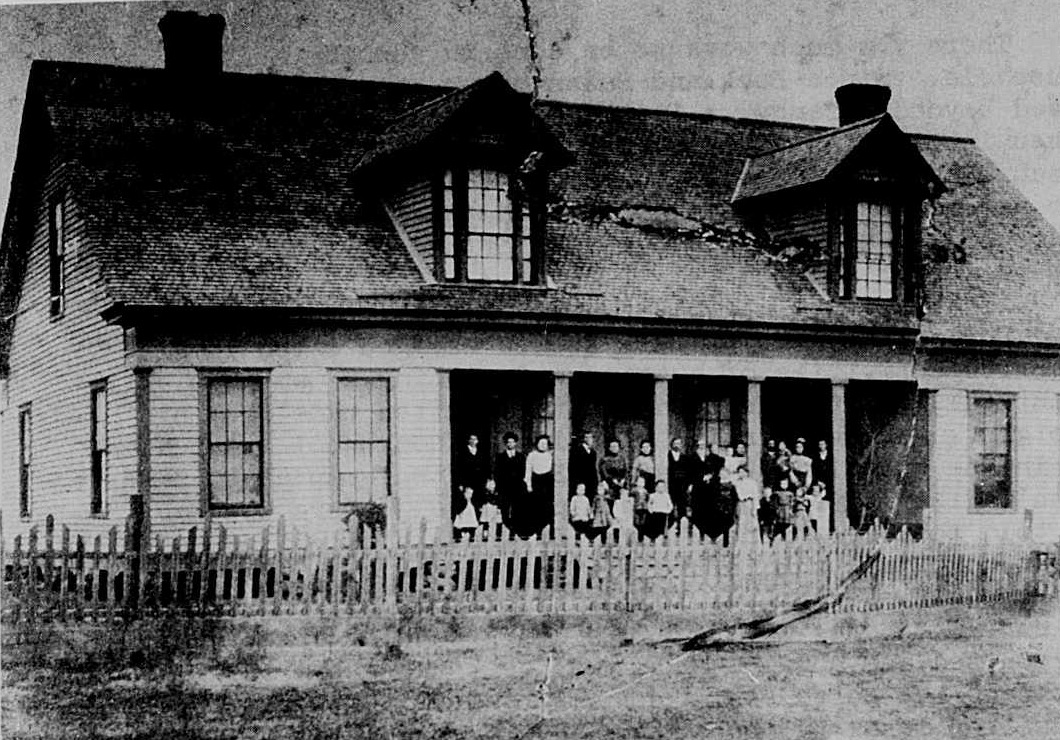
Family reunion at the home of Buck and Susan Thomas, Christmas holidays, 1902. From left to right, in back row: Mack Thomas, Marvin and Luella, Bascom and Minnie, Nora and Will, Buck and Susan, Hattie (holding John) and Jim (holding Lillie), and Virgie and Hub Thomas. Front row: Junius and Mary Lou Thomas; Billie and Rose Thomas; George, Bascom, and Julian Thomas; John and Mollie Lee Thomas; William B., Flora, and Elsie Thomas; and Marvin Thomas.
There was much work to be done in running such a household. Since Buck and Susan never had a daughter who lived beyond infancy, a little orphan girl named Annie was taken into the home to live with the family and to help Susan with the household chores. Annie was about the same age as Will Thomas; thus in 1885 she was about thirteen years old. She lived as a member of the family, although she was never adopted.
During the 1880's, Buck Thomas engaged often in his favorite activities of hunting and fishing. Game was still plentiful, and the meat on the table often came from his shotgun. Deer were still plentiful, though not as abundant as in the pre-Civil War days. Buck often complained that it wasn't like it was in the "good old days" before the War.
He told the boys, "Uncle Perry Hargrave still likes to tell about that day back in the winter of 1845 when he was riding along the Clarksville Road just a couple of miles west of our farm here; that day, in a distance of eight miles he counted one hundred and sixty deer along the road." Although the buffaloes, panthers, and wolves were about gone from Texas by the 1880's, bears were still available and they were Buck's favorite target. The bear hunt was his specialty.
On some occasions his hunting trips were long and distant. One such trip got him in trouble at home, so much so that stories of the episode were still being told in the family years later. One of his more ambitious bear hunts reportedly took him all the way to Old Mexico. When finally he returned, he found that one of his little sons had died during his absence. This probably was in the spring of 1881 when little Tommie died.
There is no question but that hunting was a major activity in Buck's life. Many stories persisted into the 20th century of his trips and his skill. One story relates to his gun. He was reputed to have owned the first breach-loading shot-gun in the County. It was said that he had bought it in New York, presumably on his buying trip to that City prior to his leaving his mercantile business.
As far as we know, however, Buck's sons never accompanied their father on his hunting trips. At any rate, none of them developed similar interests. In their adult life, none of them ever owned a gun or a single fishing line.
* * * * * * * * * * * * * *
Family tradition reports that Buck and Susan Thomas made several trips back to San Augustine to visit relatives and to sell off some of the land they had inherited. Such trips as were taken — and it is doubtful that they numbered more than two or possibly three — probably occurred between 1875 and 1895. They could have gone all the way in a wagon or buggy, but more likely they took the train about half the way, to Marshall. From there they would have gone the remaining 90 miles or so in a rented horse-drawn conveyance.
Many of the family members were still living in San Augustine in those years. Buck's sister, Mary Jane, had died of yellow fever even before Buck had left San Augustine in 1857. But his other four sisters were still there, having married into prominent families in the community. His oldest sister was Almedia. She and her husband, Samuel H. King, had three children. One of them, William King, moved to Oklahoma and was later reported to have had several children.
Buck's sister, Lonie, came next. In 1856 she had married George W. King, a younger brother of Sam King who had married Almedia a few years earlier. By the time of Buck's visits, Lonie and George had moved to Houston.
His next sister was Penelope. She had married William Hardin Crouch in 1867, when he was about 23 and she was 18. William H. Crouch was a member of a typical pioneer family that had moved west in search of better lands. His father had been born in Virginia in 1807. By 1830 when his first child was born, he was living in North Carolina. Two years later, his next child (William H. Crouch) was born in Tennessee; five years after that the next child was born in Mississippi. Between 1842 and 1845 he moved to San Augustine. William and Penelope Crouch had six children. The oldest child, Maude, married Edward E. Smith and they lived in San Augustine. Their two daughters were Azalea (Azzie) Penelope Smith and Maude Edwards Smith; they married Robert Cade Downs and Rudolph Knoll, respectively. Azzie Downs died in 1973 but her sister, who is known as "Pudon" Knoll, still lives in San Augustine. These two sisters have been heavily involved in establishing and maintaining the Cullen House Museum in San Augustine, and especially the S. Seymour Thomas Room at that Museum. The Cullen House contains many mementos of I. D. Thomas, including a portrait of him painted by S. Seymour Thomas, a photograph of his early home in San Augustine, and the wedding dress worn by Penelope Edwards when she and I. D. were married in 1830.
Victoria (Tode) married Charles I. Polk about 1860. They had three sons, Harry Kinsey Polk, Iredell Drew Polk, and James V. Polk. The first son, Harry K. Polk, married Ella Burleson who was a sister to Joe Burleson who married one of the daughters of Almedia (Thomas) King. Three of the daughters of Harry K. and Ella Polk still live (in 1976) in the Polk home that was built in 1839 and has been continuously in the family. The home is owned by Kate (Polk) Gilleam, a widow of Chief Justice William C. Gilleam. Her two sisters who live with her are Jamie (Polk) Gombert and Hallie (Polk) Hendricks.
Buck's brother, I. D., Jr., may or may not have been still living in San Augustine when Buck and Susan visited there. For a while after the Civil War he served as County Clerk of San Augustine County but in the years between 1880 and 1895 he did not do well financially, partly on account of the serious injuries he incurred during the War. In 1899 when he obtained his Confederate pension from the State, he described himself as unable to work and totally without savings or investments. His only child was a girl; she married her first cousin, the son of her Aunt Nep and William Hardin Crouch.
Buck Thomas's youngest brother, James Edwards, was still living in his father's home when his first son was born in 1868, two years after his father's accidental death. James Edwards (Jim) did rather well financially. In 1881 or 1882, he became a sales representative for the Singer Sewing Machine Company and moved to San Antonio. During the decade of the 1870's the sewing machine had been introduced into homes and factories all over the Nation and the world. Undoubtedly, Jim Thomas saw at first hand the part played by the Singer Company in revolutionizing the clothing industry in this Country. Jim's wife was Mary Landon Blount, the daughter of Col. Stephen W. Blount. Unlike I. D. Thomas, he was nat wiped out by the Civil War. Much of his holdings were in land, rather than slaves, and he managed to hold on to it. We have already noted that he bought the remainder of the I. D. Thomas estate and that he gave some of the land to his daughter and her husband.
Stephen Seymour Thomas was the first child of James Edwards and Mary B. Thomas. He became the first member of the family to attain sufficient eminence for listing in Who's Who in America. This distinction came to him in recognition of his painting which hung in the Salon of the Academy of Fine Arts of France. It established his reputation on an international basis. The painting was six feet wide and five feet high, of heroic size and theme, as were many works of the masters of that day. It depicted a battlefield at twilight, with two Sisters of Mercy ministering to a soldier fallen on the battlefield. The painting was highly acclaimed both in France and in this Country where it was exhibited at the Chicago World's Fair in 1893; it also was widely reproduced and even was used on posters during World War I. It now hangs in St. Vincent's Hospital in Los Angeles, appropriately so because the headdress worn by the Sisters in the painting is the same as that worn by the Sisters of St. Vincent de Paul.
By the time of his initial success in 1892, young Seymour had already been studying and painting for six years, two years at the outstanding art school of New York City and four years in Paris, which was considered the art capital of the western world. As a young boy in San Antonio, his parents had recognized his unusual artistic ability and had encouraged him in his early efforts and his determination to get the best instruction available.
The year following his initial success in Paris, he painted the huge equestrian statue of General Sam Houston. This painting, fourteen feet high and ten feet wide, shows the General on a fractious horse, leading his troops in the engagement at San Jacinto. After it was shown at the Chicago World's Fair in 1893, it was hung in a place of honor at the French Salon. It now hangs in the Museum at the San Jacinto Battleground, just outside the City of Houston.
For twenty consecutive years Seymour Thomas exhibited portraits at the Salon in Paris, receiving every honor the Salon could offer. In 1905 the French Government decorated him with the cross of the Legion of Honor, the highest tribute that could be paid an artist. Not wishing to remain in France permanently, he began dividing each year between Paris and New York City. While in New York he painted eminent Americans. On three separate occasions he painted Woodrow Wilson. The first was while Wilson was President of Princeton University, and this portrait was his official portrait while campaigning for the Presidency. He painted Wilson again while he was serving as President. This portrait was hanging in the Oval Office of the White House during the Nixon Administration. (Every President chooses any two previous presidents, one democratic and one republican, whose portraits will hang during his administration in the Oval Office.) Nixon chose the portraits of Wilson and Lincoln for his tenure.
In 1915 Seymour and his wife, the former Helen Haskell, moved permanently to LaCrescenta in southern California. During the next 30 years he portrayed leading figures in the business, academic and professional worlds. His works are in art galleries, public buildings, and private collections on two continents, with perhaps a dozen at Cal. Tech alone.
A particularly outstanding one, "The Big Three", occupies the main wall of the Athenaeum Club there.
He died in 1956 at the age of 88. He and his wife, who was his helper, best critic, and inspiration, had no children.
Seymour Thomas had two sisters and one brother. His sister, Mary, married William Raymond and they had three children: Margaret, Landon, and Richard. The other sister, Emily, married Herbert Augur and had no children. Seymour's brother, James Edwards Thomas, Jr., married Daisey Spooner and they had four children: Marie, Seymour, James, and Violet. James died in early childhood. The other boy, Seymour Spooner Thomas, had two daughters and one son. The latter is Seymour Richard Thomas and he lives in Bowie, Maryland. His son, Scott Richard Thomas, born March 29, 1967, is the only male descendant of James Edwards Thomas to carry the Thomas name. A chart of this branch of the family may be found in the appendix.
* * * * * * * * * * * * * *
The retirement and final years for Buck Thomas really began about 1896, when he was 60 years old and Susan 58. All their seven sons had left home —gone into town to start their business careers. Only their 10-year-old grandson, John Wesley, Jr., was still at home.
Buck and Susan had helped each of their boys to get started in some kind of business in town. Family tradition has it that they gave each son $1,000 to enable him to enter some business operation. Apparently they gave each son about one-half this amount in the form of land, selling off a portion of their farm. The other half may have been in the form of apples, cattle, horses, and other personal property not recorded in county records; or from the sale of land outside of Hopkins County, land inherited by Susan from her father, T. Y. Buford.
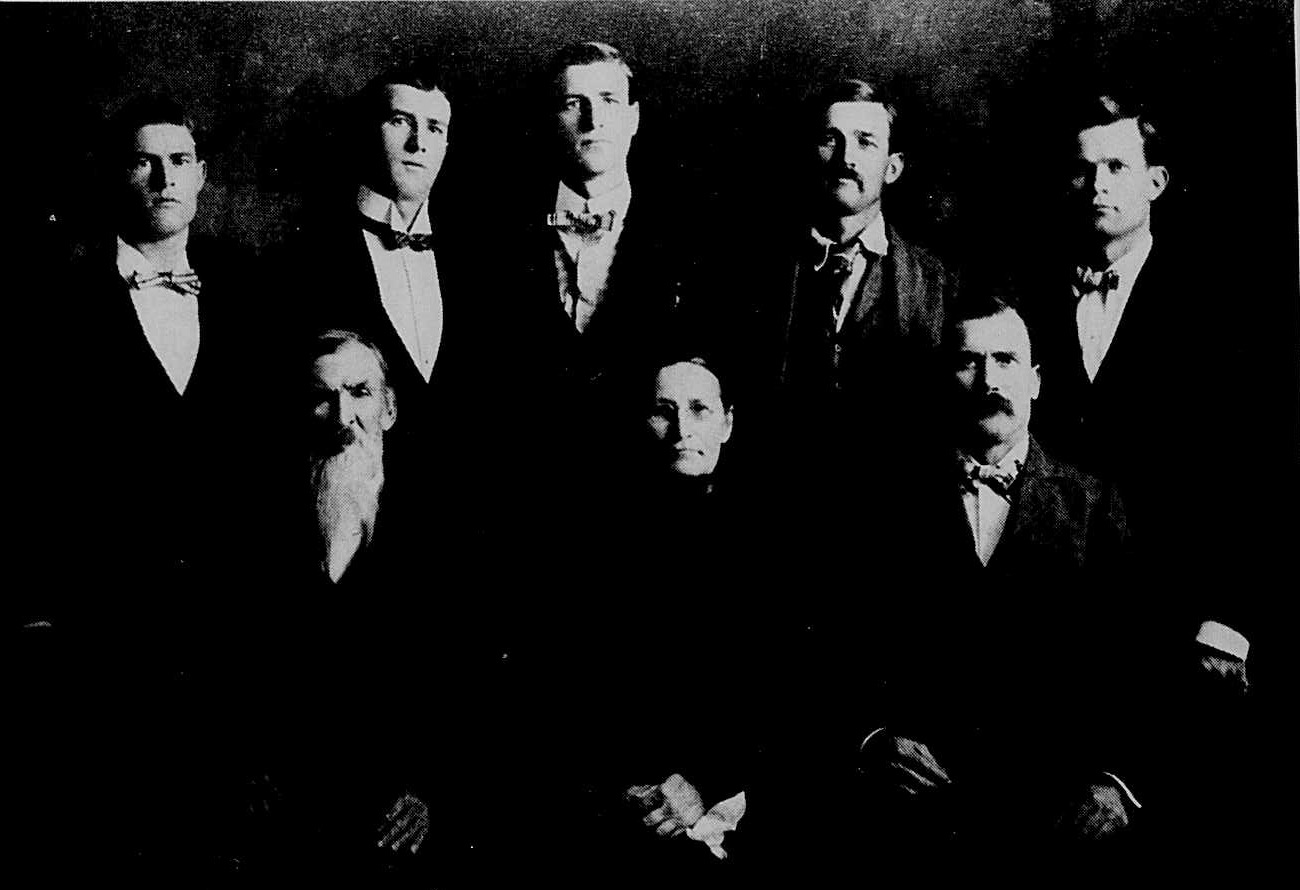
The family in 1896. The picture was probably taken on July 3, at the celebration of the parents' fortieth wedding anniversary. Front row: William, Susan, and William Buford. Back row: Hub, Mack, Bascom, Jim, and Marvin.
On January 1, 1881, the parents sold to W. B. Thomas "a town lot, a part of our ex-home place," for $350. The lot, described as being 187 feet south of the square, undoubtedly included the home where the family had lived from 1857 until 1872. In 1893 Buck and Susan sold 24.65 acres to James E. Thomas for $1.00 and "love and affection." This was a portion of the home place in the Elizabeth Melton survey. (Book 24, p.495)
Some of the transactions are difficult to understand, since the record of transfer of deed does not necessarily contain full information on all money or other personal property involved. For example, on August 6, 1895, Buck and Susan sold to E. M. Thomas blocks 46, 47, and 39 which were parts of the Elizabeth Melton Survey. (Deed Book L, p. 7) The sale price was $3,000. On January 13, 1899, Marvin sold one-third interest in these lots to his brother, McTyeire, for $600. On October 25, 1897, Buck and Susan sold to their youngest son, Hub, 55½ acres from the Elizabeth Melton Survey. In locating the land, the surveyor started "two miles north of the public square and then north 880 varas (815 yards) to Town Branch and thence southeast along the branch."
In 1900 Buck and Susan were still living on the farm and carrying on the usual operation. Even though they had sold some of the land, they still harvested their full output of apples. Only their grandson, John Wesley, Jr., was living with them; it now fell his lot to peddle the apples from town to town.
Although the boys were not at home, they were nearby, and the family was growing. All the boys were now married and the grandchildren were coming along. In 1900, Will and Jim, the oldest boys, had returned from their six-year residence in Sterling County where. they had been in the cattle and mule business. While in West Texas, Jim had married Hattie Tweedle and their first three children had been born. On their return to Sulphur Springs, Jim and his family lived in a small house on his father's land, so ne was in close contact with his parents and was available to assist, when needed, with the work on the farm.
During this first decade of the twentieth century the family dinners on Sunday were a memorable occasion. With twenty or more people in attendance, it was necessary to set two tables for the mid-day dinners. The "grown-ups" always ate at the first table and the children at the second.
Buck Thomas was 70 years old in 1906. The farm was getting to be too much for him. The apple orchard required long and sustained work during the harvest season, and even on a day-to-day basis the care of livestock, especially in the winter months, became more and more onerous. And there was less help from his family. Jim had moved his family in to town in 1902 when his oldest two children were old enough to enter public school. In 1905, Buck's grandson, John Wesley, Jr., had left home to go to school (and a year or so later, to move to Wichita Falls, Texas). They began to look for a buyer for the farm.
Plans for selling the farm were probably discussed at a big family reunion on July 3, 1906. The entire family came together at that time to celebrate the Golden Wedding Anniversary of their parents. Their six living sons—Will, Jim, Bascom, Marvin, Mack, and Hub—were all there with their wives. Also present were relatives from the Buford clan: Capt. W.R. Buford and his wife, John C. Buford and wife, Mrs. Ira H. Harrison, and Mrs. Mary Tom Watson of Muskogee, Oklahoma. The dinner that day was prepared completely by the children, toasting and honoring the parents who were not permitted to "turn their hands" in preparing or serving the feast. The table had to be extended its full length to hold the enormous supply of food and to accommodate twenty chairs for the grown-ups who ate at the first table. Nineteen grandchildren ate at the second table.
It was a great time for family stock taking. As the boys and their wives went home after the long festive day, they must have realized how much they owed to their provenance. They were a close-knit family; they had pride in themselves, who they were, and what they stood for in the community. They must have realized, especially on that day, how much of their family identity and pride had come from their parents. These were great gifts they had received.
In other respects, they departed widely from the life style of their parents. None of them ever worked on or earned his living by farming, although two of the older boys were involved in related work. Not one of the boys ever hunted or fished in his adult life. So far as we know, not one of them ever owned a gun or any kind of fishing line. None of them ever turned to the ministry but they all lived Christian lives and most of them were active members of the Methodist Church where they lived.
In 1907 a new five or six room house was built for the parents on Connally Street. This was at number 507 Connally, shown on the City map as a part of block number 12. This block of land had been owned by one or the other of the Thomas brothers since about 1896. Mack already had built for his family a large, attractive two-story frame house on the second lot west of his parents' new home. And Hub Thomas was in the process of building for his family a new house at the far west end of the same block. Their son, Bascom, and his family lived within eyesight of their back porch, one block north, on Van Sickle Street.
Buck and Susan's sons arranged for Mrs. Annie Geer to live near their parents and to look after them. Annie was the orphan girl they had raised. By 1907 she was a widow with three children. On March 26, 1907 W.B. Thomas sold her a house and lot in Sulphur Springs for $350. It was described as facing on Van Sickle Street, just behind the house occupied by Buck and Susan.
Although their sons helped them some financially, Buck and Susan had funds available to them from time to time, from the sale of properties owned by one or the other of them. On January 9, 1913, Susan Thomas, joined by her husband, sold 40 acres of land from the old farm place. W.S. Melton, the buyer, gave them $200 cash and three promisory notes for $1,000 for the balance. The notes were sold to a Mr. Pierce. On March 13, 1914, Susan Thomas, with her sister, Mary Tom Watson, sold their half interest in 254 acres of land "west of north" of Sulphur Springs. Susan and Mary Tom received $1,000 each, and the land was transferred to the other heirs, J.C. Buford and Betty Harrison. This was one of several transactions that followed the death, on March 29, 1910, of William Ragsdale Buford.
Buck and Susan's final years, spent at this house on Connally Street, were a serene and peaceful period. Both were in relatively good health until the end. Susan, however, was considerably slowed down during the last ten years of her life by a broken hip. She broke the hip about 1910 while helping her husband seine minnows from the pond on the back of their lot. It healed slowly and imperfectly and for the rest of her life she carried one crutch, partly to walk on and partly as protection against a possible fall. After her death, Annie Geer and her children moved in to the Thomas home and she cared for Buck until his death on August 6,1927 as a result of generalized old age. He had remained at home and relatively active almost to the end.
In the years between 1910 and 1920 the family gatherings continued but not so often as in the preceding decade. During these years Bascom, Mack, and Marvin had all left Sulphur Springs, but they came back occasionally and all the family assembled in celebration. It remained a close family.
During his later years Buck Thomas was an avid fisherman. He drove his horse and buggy to surrounding pools to catch bass. One of his favorites was the pond on his old home place, the one he had dug and carefully tended during his years on the apple orchard-farm. As he grew older and continued his all-day fishing expeditions, one of his grandchildren often was sent with him, to keep him company and to run for help, in case of an accident or other trouble. As a boy of eight or nine, the writer spent a whole day with him at his old farm place. Grandpa kept five or six poles in the water simultaneously. I must have been quite a distraction to him, always wanting to jerk the hook and cork into the air every time it bobbled. He cautioned me, "Wait, wait 'till he runs with it." I decided then and there I would never be a fisherman. But it was a good day for me as well as for him. He let me drive his horse both out there and back, and as a special treat, my brother and I were invited to come to his house after supper for a game of Forty Two with him and Grandma.
Grandpa kept a small fish pond on the back of his lot on Connally Street. In it he raised shiners which he used as bait for catching bass. The pool didn't have natural drainage, so it tended to dry up during dry spells. During such times he kept it filled by running city water into it, using a garden hose to run from the back yard faucet to the pool. In those days the city water supply was inadequate and there was a local ordinance against using town water for watering rose gardens or filling fish ponds. But Uncle Buck, as he was always called in those days, retorted, "Nobody is going to tell me I can't use the water; my son, Jim, is the water commissioner of this town, and as long as he is in charge, I can do what I want." And he did, not only filling his fish pond at the back of his lot but watering the rose bed which filled his entire front yard on both sides of the center sidewalk which ran from the street to his front steps.
In about 1913, the writer lived with Grandpa and Grandma for some two weeks while our house was being converted from a one-story to a two-story house. I remember that I was fascinated with Grandpa's coffee cups which had a special guard built into them to protect his mustache from being discolored by the coffee when he brought the cup to his lips. He took great satisfaction from his early morning cup of coffee, always with a small hunk of cheese dissolved in the hot liquid.
When Grandma and Grandpa died, their funeral services were held in their beloved First Methodist Church, although the bodies had been laid out in the parlor of their home, and friends had come in to pay their respects before the open coffin. At Grandpa's funeral a special eulogy was said by Professor Sam King who for many years had operated a private academy in the town. He paid special tribute to Grandpa's exemplary life, commenting especially on his courage in living by his convictions. He referred especially to the war-time years; it was he who, on that occasion, told how Grandpa had publicly spoken out against the excesses of the Ku Klux Klan during and after the Reconstruction Days. It was he who told the story of the Negro who ran to Grandpa's house, screaming for help, as he hid under the front steps.