← The Thomas Family in 300 Years of American History
Moving Westward: To Alabama and Texas
The Seventh Generation
Our story of the seventh generation begins in 1810. By then, Major Theophilus Thomas had been dead for seven years. His widow, Mary (Rogers ) Thomas died in April of 1810 at the age of 53. At that time, only two of her eleven children were still teenagers. ‘The other nine ranged from 20 to 38 years of age. Most of the older ones were married, and the grandchildren were coming along. When Theophilus died in 1803, he had divided his five thousand or so acres among his five sons. His daughters had begun to marry the sons of neighboring farmers who had similarly divided their estates. The lands in the smaller family Plantations were both too small and increasingly unproductive.
Some of the Thomas farms had been in continuous cultivation for at least fifty years. Under the primitive agriculture practices of that day, the land had been totally exhausted. Like other Colonial farmers, the Thomases never practiced crop rotation; barnyard manures were not used and leguminous crops seldom planted. The farmers were also unskilled in the care of their lands; they knew nothing of terracing, often plowing their furrows along the slope of the drainage and allowing the top soil to wash away with every heavy rain. Another reason for the poor farming practice was the lack of proper tools; and tools were difficult and expensive to import. Plows were only beginning to be in common use; in the days when Theophilus Thomas began his plantation, they had been especially crude, something like a wooden shovel pulled through the earth.
Even though the land was wearing out, its market price was increasing because there was no more free land in that portion of the State. Land in lower Edgecombe County was selling for from $2 to $5 an acre, depending on its location and the extent of buildings and other improvements. On the other hand, new areas on the frontier were constantly being opened up by explorers, surveyors, and pioneers. One historian, in writing about the period from 1805 to 1815, says that the demand for land was insatiable. The demand for more and better land was universal, little short of a mania. The local papers, both on the frontier and in the towns on the eastern seaboard, advertised acreage for sale in the unexploited sections.
The appetite for fresh land was further whetted by the new emphasis on cotton farming. Eli Whitney had invented the cotton gin in 1793 and this led quickly to an increase in cotton production. Within ten years cotton had replaced tobacco as the principal money crop for southern plantations. By 1810, cotton buyers from England had personally arrived at southern ports such as New Bern, Charleston, Savannah, and even at the river ports such as Augusta. They took up residence there and established their business, buying cotton for immediate shipment to the cotton mills of England. If one wanted to share in the new cotton prosperity, he had to move to the south: that was where the new, fresh lands were waiting.
The obvious direction to move was to the south, to the Cotton Country, through South Carolina and into Georgia, keeping to the east of the Applachian Mountains and keeping one hundred miles or more in from the Atlantic seacoast. Georgia, of course, was one of the original thirteen Colonies, but by 1776 it had been settled only along the Atlantic seacoast and on the rivers extending inland, especially up the Savannah River as far as Augusta. During and after the Revolutionary War, however, settlers had begun to claim the virgin lands to the south and west from Augusta. Members of the Thomas family had moved southwestward into South Carolina and Georgia even before the Revolutionary War. The first to make such a move was Theresa Thomas, a sister of Major Theophilus Thomas. In about 1769 she moved with her husband, Theophilus Hill, to Edgefield district in South Carolina. Theophilus Hill was a prosperous merchant, first in Edgefield and later in St. Augustine, Florida. Their son, Lodowick Hill, remained in Edgefield and left many descendants prominent in that locality.
The next member of the family to move southwestward for new land and new opportunity was the Reverend John Thomas, Jr. (1733-1807). In 1781 he also moved to Edgefield, South Carolina. Six years later, however, he moved another 150 miles in the same direction, locating in Hancock County, Georgia, where he lived for the remainder of his life. Since he had nine children by his first wife (Patience Williams) and thirteen by his second wife (Elizabeth Jones), he left many descendants in that area of Georgia. He was joined in Hancock County by several of the married daughters of his brother, Reverend Jonathan Thomas.
After 1810 more and more Thomases began to consider a move southwestward into Georgia, looking for lands cheap and fertile, suitable for cotton. Benjamin Thomas apparently was one of the first; at least he was the first to sell out his holdings in Edgecombe County. On August 14, 1811 he sold the 100 acres north of Toisnot Swamp, a tract which he had owned since February 28, 1805. On February 12, 1812, he sold to Willie Stanton the 600-acre tract which he had obtained from his father on February 234 1799. For these two tracts of land he received about $3,0007.
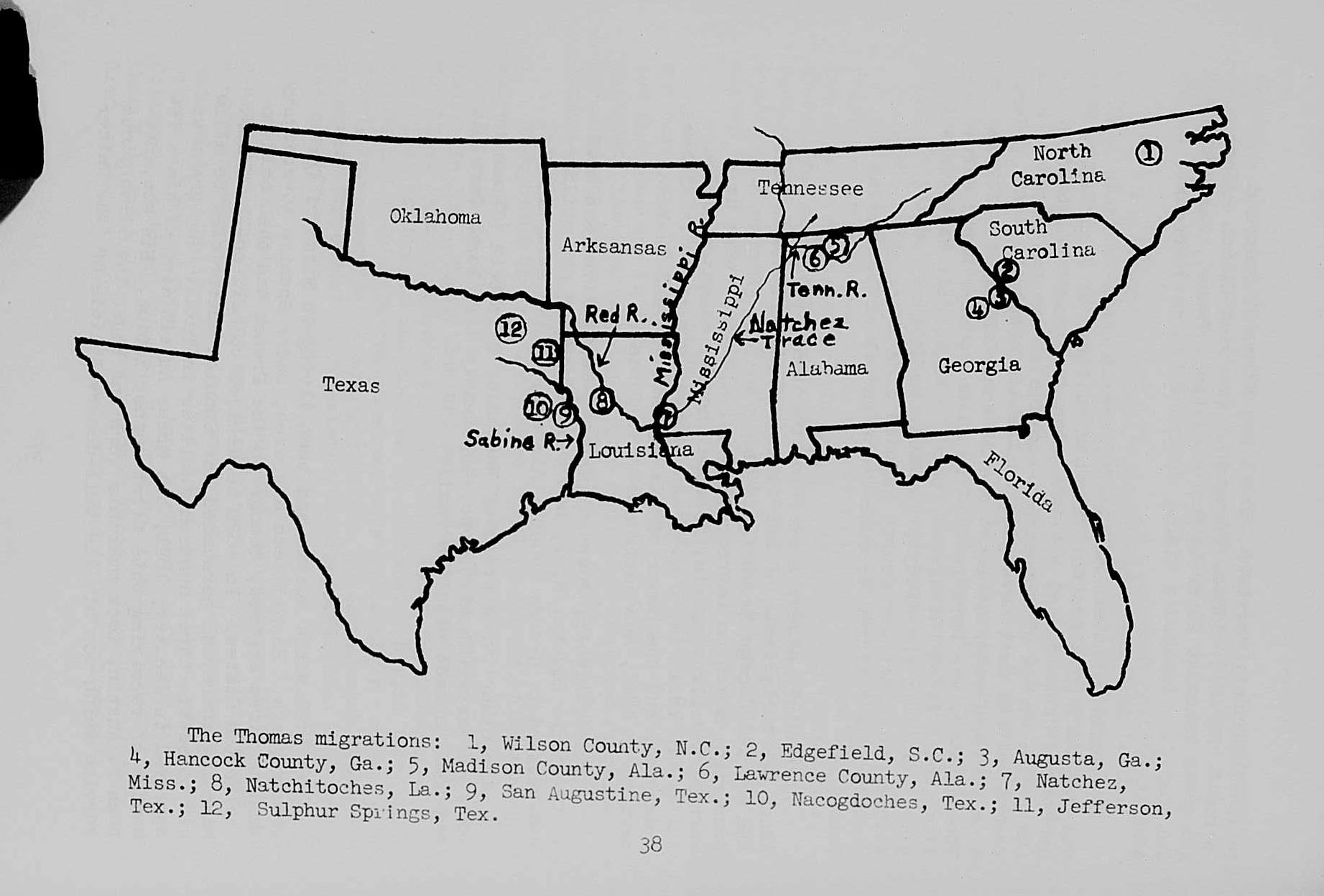
Although we have no record of the exact time or route of Benjamin's move from North Carolina to Alabama, it is probable that he left Edgecombe County shortly after he sold the land in February of 1812. Our guess is that he and his family and his slaves moved first over the 300 miles of well marked and heavily used road that led to Edgefield, South Carolina, and (25 miles further) to Augusta, Georgia. He may have stopped for a while in these busy towns, or he may have headed on another 100 miles to Hancock County, Georgia. Undoubtedly, he would have visited with his relatives in these areas while making inquiry, or visual inspection, of lands that might be available.
He may have been in this area when he first heard about a promising area that had opened up further west. This was on the north side of the Tennessee River, what is now Madison County, Alabama, with Huntsville as its county seat. In 1805 the first settlers had pushed down into this area from Tennessee and found the land bountiful and the Indians peaceable. At the site of fresh water that came from bubbling springs a small community gradually came into being. It was named Twickenham, in honor of Alexander Pope, whose Essay on Man was widely read throughout America in those years. Twickenham was the name of Pope's estate in England. However, six days after James Madison was elected President of the United States in 1808, the county (then a part of the Territory of Mississippi) was renamed Madison and the county seat's name was changed to Huntsville.
Except for the Gulf Coast, this was the only part of Alabama available for settlement. The remainder was still held by the Indians. At the turn of the Century, nine-tenths of the Territory of Mississippi had been occupied by the Indians—Cherokee, Chichasaw, Choctaw, and Creek. After the War of 1812, Spain no longer controlled the Gulf Coast, and in the years from 1812 to 1816 the Indians were driven out or removed from the Territory. During these years there were a number of military campaigns against the Indians, several led by General Andrew Jackson who cemented his status as a hero of the frontier by his campaigns against "the savages."
By 1812, Madison County, Alabama was becoming well known. Reports about the County had surely been carried pack to Georgia and North Carolina, and probably to other areas in the east. On January 14, 1811, the County had come into national prominence when the National Intelligencer had reported that Madison County, with 22 square miles, had doubled the cotton production of any county of its size in America. In that year, 48,463 acres of land in the County were listed under private ownership. 606 families lived in the County and 29 percent of them owned slaves. By 1813 the County had 1,125 families and 32 percent of them owned slaves (1,272 slaves in all). In 1814, another 27,644 acres were sold to homesteaders, and in the two years following, an additional 43,000 acres were sold. Eighteen cotton gins were reported in operation in 1814.
We cannot be sure when Benjamin Thomas and family reached north Alabama. It may have been as early as the latter months of 1812 or as late as the early months of 1816. The first official documentation of his residence in the State was in 1816. In that year the Territory of Mississippi (which also included what is now Alabama ) counted the inhabitants of the Territory. The Census reported the names of all heads of families, but no other data. Benjamin Thomas was listed as the head of a family and living in Madison County. Another family was headed by a Mr. John Thomas, who may have been a relative who had come with him to Alabama from Georgia.
So far as we have been able to ascertain, he first purchased land in the State in 1816. On December 11th of that year he paid $1,590 to John and Alice Pettus for a deed to the following tract of land: NE/4 Sec 26-3-1E with tenements (houses). Although the abstract of the deed does not show the size of the tract, it probably was in the neighborhood of 800 acres.
By 1820, Alabama was a part of the Union and was therefore included in the Federal census for that year. Benjamin and his family were then living in Lawrence County, Alabama. This County had been created in 1818, one year after Alabama was admitted to the Union. Our assumption is that Benjamin moved to this County --some twenty-five or thirty miles further west and on the south side of the Tennessee River-- in search of cheaper or better land. Current records indicate that Benjamin did not obtain free land He undoubtedly bought land, but it was not cheap. Available land in Madison County was selling for two dollars or more per acre at the time Benjamin lived there.
In 1820, Benjamin Thomas's household, according to the Federal Census, consisted of himself, his wife, six sons and five daughters. He owned seven slaves, counted as part of his household. His oldest son, Geraldas S. (Gary), was listed as a separate household; he was about 22 years old and presumably was living separately from his parents. However, he was unmarried and owned no slaves. In that year, Benjamin was 42 years old and his wife, Mary Ann, was 44. They had twelve children with or near them— the 8 who were born in North Carolina and four more born in Alabama.
Benjamin Thomas apparently liked Alabama and urged his relatives in North Carolina and Georgia to join him there. Two of his brothers--Micajah and Theophilus--were living in Alabama north of the Tennessee River at least as early as June of 1819, at which time they endorsed (i.e., guaranteed) a note given by one of their neighbors for the purchase of slaves (Deed Book E, page 500).
Micajah Thomas (1785 - 1840) lived in Madison County for more than 20 years before his death. He was buried at the New Cemetery in Athens, Alabama. He and his wife had 5 children: the four who lived into adulthood included Cornelia Ann, Treasey Elizabeth, Elisa Hill, and Joseph Van Buren Thomas.
Theophilus Thomas, Jr., also lived in Athens, Alabama, and served for a time as an alderman of the town. However, when he died in 1849, he was living in Greene County, Alabama. In 1815, Theophilus had married Mary Hooker in North Carolina. Almost immediately they left North Carolina, going first to Georgia and then on to Alabama. During the 1830's and 1840's, Theophilus must have been fairly well fixed, for according to county records, he served many times as surety for executors of estates and for officials such as the sheriff and the county clerk.
Benjamin's brothers, Ichabod and John Rogers, both stayed in North Carolina and died there in 1826. After their deaths, however, each man's widow moved to Alabama to join many: of their children who already had moved there, mostly to aoa aa Counties. Jonn R. Thomas left land to the following children: Hymeric H., J.R.H., Elnathan Hooker (Nathan H.), and W.J.R. Mary Hooker Thomas, John R.'s widow, died in 1845.
Ichabod Thomas left land to the following children: Bennet, Morrison, Edwin B., Margaret (married Warren B. Barnes), James, Temperance (married Elijah Price and moved somewhat later to San Augustine, Texas), Wade R., and John J. Ichabod's widow, Susannah (Barnes) Thomas, died in 1838.
Benjamin's sister, Millicent, buried three husbands and then married a fourth. She had children by John Eason, her second husband, and William Eason, her fourth husband (who was a nephew of her second husband). She and her second husband must have gone to Alabama about the same time Benjamin went; at least one of their children, William Thomas Eason, was born in 1814 in Anson County, North Carolina, which is on the direct route to Edgefield, South Carolina. In 1818 she died, presumably in Madison County, Alabama; at least her fourth husband died there about 1836. She had four children by John Eason and three by William Eason.
Benjamin's oldest sister was Obedience (17721 - 1840). After the early death of her first husband, Elnathan Tartt, she married George Brownrigg. Their son, Dr. George B. Brownrigg, moved to Lawrence County, Alabama, where he married his first cousin, Theresa Thomas, daughter of Benjamin. In 1821, the U.S. Census showed him to be in Alabama, unmarried, and the owner of six slaves. He and Theresa married in 1821, and later moved to Texas.
Another sister, Theresa (Thomas) Tartt lived and died in Edgecombe County, N.C., but two or more of her children had settled in Greene County, Alabama, by the early 1840's.
The other two sisters of Benjamin, Elizabeth (Thomas) Cobb and Nancy (Thomas) Pope, apparently left North Carolina and lost contact with the family.
In 1820 Moses Austin had been living in Missouri for twenty years. He had seen his area, under Spanish sovereignty when he first arrived, change to the French and then sold tu the United States. In 1820 he decided to move on--to Texas. Reaching there, he persuaded the Spanish authorities to allow him to settle three hundred families in Texas. The grant was approved in January, 1821, but Moses Austin died within a few months of receiving this first authorization. His son, Stephen F. Austin, took over his work and began the illustrious service which won him the well-deserved title of "the Father of Texas." During the spring of 1821, Austin was in San Antonio for the purpose of getting the grant from the Spanish Government transferred from his father to himself. In August and September, 1821, Austin surveyed the land between the Trinity and Colorado Rivers and located the area in which he would settle his 300 families.
Austin immediately returned to New Orleans where he advertised for settlers. Austin's dispatches went by post rider to all the settled areas to the north and east. Within two weeks his advertisement would probably have arrived in North Alabama where it would have been published in the weekly newspaper which had been in operation in Madison County, Alabama, for several years.
The grants offered by Austin were very attractive. He announced that each head of a family and each adult single man would recieve 640 acres (a square mile, or a "section"). An additional 320 acres would be allowed for a wife. Also, 160 acres would be allotted for each child and 80 acres for each slave. Not only was the acreage large, but it was almost free. There was only a small service charge by Austin for suryeying, establishment of title, and the like. Austin's advertisement attracted great interest, especially from Missouri, Kentucky, Tennessee, and North Alabama.
Benjamin Thomas could easily figure what the offer meant to him. He and his wife would get 980 acres, plus 1,600 acres for his 10 children under the age of 21, plus another 560 aeres for his 7 slaves. His own family would get 3,140 acres and his two sons over 21 years of age would each get 640 a eres for their own.
Austin's announcement could hardly have come at a more opportune time. The United States Congress in 1820 had passed a law which for the first time required a cash payment for the new land being opened up in the Territories. In 1819, the Government had sold 5,110,000 acres of public land; in 1820 they sold only 1,089,000 acres; and in 1821 only 781,000 acres.
It probably was during the winter of 1821-22 that Benjamin Thomas sold whatever land he owned in Lawrence County, Alabama, and prepared to move on to Texas. His first deciSion was, what route should he follow? He had two choices: to put his possessions on a locally constructed flat boat, hardly more than a raft, and to float downstream—down the Tennessee, the Ohio, and the Mississippi—for nearly a thousand miles to Natchez, Mississippi; or to go by land, following the Natchez Trace about 300 miles from the northwest corner of Alabama to Natchez, Mississippi. Floating down the Ohio and the Mississippi was a means of travel for thousands of pioneer families who had pushed westward in the years since the Revolutionary War. The Kentucky boatmen who guided these flat boats or rafts down the Ohio and Mississippi Rivers were called "Kaintucks". When they reached New Orleans they walked back to Kentucky, following the Natchez Trace from Natchez to Nashville, Tennessee. On their return trip these "Kaintuck" boys passed through Alabama within 20 miles of where Benjamin lived. Benjamin may have ridden his horse over to the Natchez Trace to talk with these rough and ready boatmen about the pro's and con's of each method of travel. By building the flat boat (raft) and using it to go down the Rivers, he could take more possessions. He could put a wagon aboard, his horses and oxen, as well as furniture, necessary implements for farming or for blacksmithing. When he reached Natchez, his boat could be knocked apart and the lumber sold. Any additional needed supplies or equipment could be bought in Natchez.
They probably advised him, however, that it would be best to go by way of the Natchez Trace. This road was the straightest and shortest way, and it had been greatly improved during the past few years. The boatmen reminded him that General Andrew Jackson, on three different occasions, had taken his Tennessee Regiment over the trail, once to the relief of New Orleans in 1812, to fight the Creek Indians at Horseshoe Bend in 1814, and to subdue the Florida Seminoles in 1818. Because of these military uses of the road, the Federal Congress was currently engaged in improving the road. Travel on the road had become more feasible by 1822, especially since the establishment of "stands" (inns) about every 20 miles along the road. These "stands" had been established so that postal riders could reach one every night. These “stands” were kept for the most part by Indians who had traditionally lived in the area. They varied greatly in quality; some had blacksmith shops and stables, while others were primitive one room log cabins. Since the establishment of the "stands", outlaws were no longer as serious a menace as they had been some years earlier. During the 1820's the Trace was called the "safest and surest" land route between the eastern seaboard and the lower Mississippi Valley.
As one travels today down the Natchez Trace Parkway and stops off from time to time to inspect remaining portions of the old trail, one ponders over the incredible hardships that must have been endured by the pioneer settlers who traveled this narrow, rough, and often muddy trail. Since it was too narrow for wagons, most of the Thomas party of some twenty or more persons must have walked most of the distance. On those winter nights, especially when it rained, the "stands" must have been a godsend.
When the party reached Natchez, they found a bustling river town where necessary supplies could be purchased — wagons, farming utensils, food, and additional clothing. From there they went westward across Louisiana to the Red River town of Natchitoches, about 105 miles away. When they reached Natchitoches (pronounced Nak-i-tush) they found a thriving river-port town which for several decades had been the jumping-off place for entry into east Texas. For more than a hundred years, this Spanish and French town had been important to the commercial and military activity of a wide area. It was located at a spot where the water and land trade routes converged. The Red River served the entire area from New Orleans northwestward to what is now Paris, Texas. A well-established trail led westward across the Sabine, reaching Nacogdoches and extending all the way to Mexico City. Another trail, over which they had just arrived, ran eastward to Natchez, Mississippi. Still another trail extended southward to Opelousas, Louisiana.
Much merchandise cleared through the town of Natchitoches. Pack trains from the west arrived regularly, bringing furs and hides and dried buffalo tongue from the Indians, and silver from the mines of Mexico. Docked at the River front were clumsy river rafts from New Orleans which had been rowed - or "cordelled", i.e., pulled by ropes - northward against the current; they brought tobacco, medicine, spirits, farm tools, and other products of civilization for the Spanish settlers and friendly Indians both in Louisiana and in Texas. One of the most precious commodities was the salt which was produced by Indians and white men at Saline Bayou, just 20 miles to the northeast.
While we have no official records of the matter, it is likely that Benjamin Thomas's party fully expected to meet Stephen F. Austin in Natchitoches. Austin had advertised that letters of enquiry should be sent him at Natchitoches. When he returned to Natchitoches, he found more than 300 letters of enquiry. To his colleagues back in New Orleans, he wrote to say, "I am convinced I could take on 1,500 families as easily as 300 if permitted to do so." However, Austin was not there when the Thomases arrived. Austin had gone to Mexico City because Mexico had just won her independence from Spain and he felt he had to re-validate his contract for bringing in American settlers.
The townspeople in Natchitoches, the men who operated the ferry, the trading post, the general stores, the news paper, and the boarding house knew of the efforts of Stephen F. Austin to bring in new settlers. They could have told Thomas that at least 100 families had already passed through the town in the past six months, all headed to Austin's grant between the Colorado and Brazos Rivers. Austin later reported that, in March 1822, there were 50 men on the Brazos and 100 on the Colorado, all of them having come to the area without his knowledge.
We know that the Thomas family was in Natchitoches by the end of February because on March 3, 1822, Benjamin and his wife appeared before Judge John C. Carr to sell a tract of land to their son, Shadrach. The Parish records show that Benjamin and Polly Thomas, both of the State of North Carolina, sold to Shadrach Thomas: "a tract of land on Contentney Creek in Edgecombe County, N. C., Halifax District, consisting of 205 acres more or less. ... being the same tract which fell to the share of Polly Thomas, one of the heirs of Shadrach Dickinson, deceased, at the settlement of his estate... Shadrach promised to pay $1,200 on December 25th next and gave his note.”
Before his note for the land came due, Shadrach sold the tract. According to land records in Edgecombe County, N.C. Shadrach sold the tract, for $1,100, to Jesse Simms of Edgecombe County. Like most land sales in that day, this trans fer was "in the family." Benjamin's sister, Tabitha, had married Benjamin Simms, who probably was a brother or father of Jesse Simms.
When the land was: sold to Simms during July of 1822, Shadrach listed himself as a resident of Natchitoches Parish, Louisiana. From our available data, it seems likely that the Bemjamin Thomas family stayed in Natchitoches for several months, at least from March until July, before moving on to Texas. For one thing, they may have been waiting for Stephen F. Austin to return to Natchitoches to personally lead his settlers into Texas. They may have used the time to reconsider their plans, both the parents and the older sons who were old enough to strike out on their own. We know that Iredell, who was 17 years old at the time, did remain in Natchitoches to work as a clerk or apprentice in one of the larger mercantile firms of the town. Shadrach, in purchasing the land from his mother, may have been contemplating the operation of his own farm somewhere in Natchitoches Parish. However, if any of the family did have such thoughts, they apparently did not act on them, since the available Parish records indicate that none of the Thomas family ever owned land in the Parish.
During their months in Natchitoches, Benjamin and his family must have waited impatiently for Stephen F. Austin to meet his incoming settlers. We know now why he did not come. When Benjamin and his family arrived in Natchitoches, Austin was on the Texas Gulf Coast, searching for his ship Lively which sank off Galveston Island, bringing great loss to Austin and the settlers in his Colony. In March 1822, Austin traveled hurriedly to San Antonio to negotiate with the Spanish Governor there regarding the restrictions that had been placed on Austin's authority as an empresario. From San Antonio he went on to Mexico City, to confer with the Mexican authorities, since Mexico had just won her independence from Spain. It was more than a year before Austin would return to his Colony in Texas.
Benjamin and his family undoubtedly decided to proceed into Texas on their own initiative, as other families were doing. Perhaps they thought they would find Austin or his representative in Nacogdoches, a village of about 500 persons which constituted the eastern outpost of the Spanish (ar Mexican) government. They probably were advised to go on to Nacogdoches and, if they did not find Austin there, simply to settle on any good land that was unoccupied.
There was no question of the road to follow. For many years there had been a well-marked road to the ferry across the Sabine River and on to Nacogdoches. Once they crossed the Sabine, the new settlers traveled on the Camino Real, the King's Highway, which led to San Antonio, and from there through Laredo and Monterrey and on to Mexico City. Practically all families who came into east Texas between 1821 and 1823 traveled along and settled near to this well marked but primitive road.
As the settlers traveled to Texas, many families settled in the Ayish Bayou area. The Ayish Bayou (creek) flows through the center of the present town of San Augustine. It drained an attractive area, with gently rolling land, good fresh water, and a suitable mixture of pine forests and open pasture lands. Those who stopped there, rather than pushing on beyond the Trinity River, simply occupied their land and then began the process of trying to validate their titles.
We assume that Benjamin Thomas settled in the area adjacent to the present Thomas Cemetery, which is five miles west of San Augustine, on the highway to Nacogdoches. (A small highway marker designates the dirt road that leads to the cemetery, 100 yards south of the highway. For a hundred years after his arrival, this area was known locally as the Thomas Community. We have not searched the State Archives for records that indicate the exact location of his land. It probably was just south of the Camino Real and may have been bounded on the west by Attoyac Creek, which is the present boundary between San Augustine and Nacogdoches Counties.
Many of the new settlers who came into Texas at that time simply occupied a tract of land and claimed squatter's rights until they could obtain a valid title through regular governmental procedures. We believe it likely that Benjamin Thomas simply settled on unoccupied land, as the other new arrivals were doing. However, he may have bought some land from older settlers who did have a valid title. We know that he had funds for such purpose and by buying his land he could obtain a more desirable location, land with improvements such as houses and barns, and with better opportunity to use his slaves immediately and profitably. Moreover, Corcket tells us that the Red Land farm which I.D. Thomas owned during the period of the Republic of Texas had formerly been owned by Don Juan Ignacio Guerrero, who was a son-in-law of Captain Gil Y'Barbo who had been for some years the Governor of the Province for the Spanish Government and Y'Barbo did have valid title to thousands of acres. His title had been issued by the Spanish Government long before the political turbulence ushered in Mexcio's bid for independence. Lastly, we know that neither Benjamin Thomas nor any of his sons was the original or "headright" owner of any land in San Augustine.
If Benjamin Thomas came to the Ayish Bayou area in 1822 (as we think he did), he was 44 years old and his wife was 46. Four of his sons - Gary, Shadrach, Iredell, and Benjamin R. - ranged in age from 22 to 16. One of his older daughters, Theresa, was not with them. In 1819 she married Dr. George Brownrigg in north Alabama; it was some years later before they moved to San Augustine, Texas. Five children probably were under 12 years of age. (For some of the children the year of birth is uncertain).
Even if the family bought land with some improvements on it, the first months in the new area must have been difficult. Like most settlers, all or some of the family may have had to sleep in or under the wagons until suitable houses could be built using the pine trees nearby for a typical log cabin. With the help of neighbors, a small cabin could be put up in one or two days.
A few months later another cabin, of the same size, was often built to one side of the first, with an open space about ten feet wide between the two units. Later, a common roof was added across both structures, making a covered hallway. With a porch added across the entire front of the house and with a lean-to built on the back of each room, we find the typical "dog-run house". A fireplace was usually placed in each room, one of sufficient size for cooking and heating and the other for heating only. This type of house was common throughout Texas until the late 1800's. Such a house was well suited to the climate of Texas. The summer breezes cooled the open runway through the center of the house during the hot months, and most of the chores of the family were performed in its shaded area. In the winter it offered some shelter, especially on cold rainy days, for those tasks that had to be performed out of doors. In extreme weather it even sheltered some of the animals.
Life must have peen pretty rugged. Supplies for farming and for household necessities were in short supply. It was necessary for the new settlers to bring with them such equipment as plows, axes, rifles, knives, fish hooks, brass kettles, and tin cups. They were fortunate if they brought along at least a two-year supply of clothes for new supplies of cloth were hard to obtain. Coffee, salt, and wheat flour were exhausted, and many families lived for months at a time on corn meal and fresh game killed in the woods.
After 1825-26, however, living conditions became much better. By then, sawmills had been opened for business and many of the unhewn log houses were being finished on the outside with clapboards; the open passage was often made into an enclosed hall; and a deep well replaced the trip to the creek for water. Glass became available for windows, and the floors of packed mud or clay were replaced by puncheon floor-Logs
By the mid-1820's the trail from Natchitoches to San Augustine was improved for the accommodation of wagons. Heavy wagons, pulled by four or more yoke of oxen, replaced the pack horse and the small wagon pulled by one yoke of oxen. The May 8, 1826 issue of the Natchitoches Courier reported that "on Sunday last, the expedition for the Mexican Provinces left town. It composed twelve wagons loaded with goods and accompanied by a number of men, commanded by Mr. Curcier. It moved along the banks of the River in a very handsome manner, displaying the American flag on the foremost wagon." One wonders whether Benjamin and/or his older sons engaged in such hauling, especially since one of his sons remained in Natchitoches and was employed by & mercantile firm there. At any rate, as this hauling continued, some surplus of goods began to accumulate, and small country stores— often in log houses—were established by the more enterprising settlers, ones who were better educated, had some capital, and knew how to figure and to calculate interest.
In the years before 1832 there were only a few towns in all of Texas, and none of the cultural advantages that go with towns. There were no schools, either private or public. Protestant churches were not permitted and Catholic churches and priests were equally nonexistent. Sunday was spent by most settlers in hunting, fishing, and breaking wild horses. Nobody went to church, although a few families observed the Sabbath and tried to live as if they were still in North Carolina or Virginia.
Government was practically nonexistent during the decade from 1822 to 1832. That which did exist was so inefficient as to be almost worthless. Most of the problems originated in Mexico City. When Mexico won her independence in 1822, a period of great turbulence was ushered in. Unlike the English Colonies on the eastern seacoast who had enjoyed a measure of self government for a century before 1776, the Mexicans had had no such experience. The new government was run by successive dictators. They were too busy fighting each other to pay any attention to the needs of Americans in East Texas. Corruption and inefficiency were rife, perhaps even worse in the provinces than in the Capital.
The land policy of the Mexican government was especially haphazard and inefficient. Not long after their revolution in 1822, the Mexican government adopted a policy of free grants of land that was even more generous than the amounts they authorized Stephen F. Austin to offer. The basic offer was one League and one Labor of land. Spanish land measurement was based on the vara, which is 33 and one-third inches in length. A League is 25 million square varas, or 4,428 acres. A Labor is one milion square varas, or approximately 177 acres. The usual grant of "a league and a labor" of land was based on the assumption that the larger area was for ranching and the smaller for farming.
Plenty of land was available. It was freely granted and much of it was available for the taking. The big problem was to get valid titles to the land which had been claimed by "squatter's rights" or had been bought from someone else who may or may not have had a valid title.
Between 1825 and 1827 the settlers' concerns for farming and for validating land claims turned to graver matters. This was a turbulent time and the fate of the early settlers such as Benjamin Thomas was uncertain. Much of the uncertainty had its origin in the adventures of Hayden Edwards, the instigator of the Fredonian War. In 1825 Edwards was allocated a tract of land that included the areas around both Nacogdoches and San Augustine and stretched to the Gulf of Mexico. He was authorized to bring in 800 families to settle the area. However, much of the land around Nacogdoches and San Augustine already had been occupied and the existing settlers considered themselves to have valid ownership of their land. Their legal titles, however, were often nonexistent, largely because of the inefficiency and corruption, as noted above. Most of the settlers around Nacogdoches were of Spanish or Mexican descent, but around the Ayish Bayou District (now San Augustine) most were Americans who had come in during the five years preceding. At first, most of the leading citizens of the San Augustine area were favorable to Edwards but this changed because of his assumption of arbitrary and imperial power in regard to the establishment of valid land titles. He set himself up as judge and jury, and was much too arbitrary in the matter. His manner also angered the Mexican officials who thereupon canceled his contract and banished him from Texas. It was then that Edwards formed his little army and recruited the Cherokee Indians to join his cause. After this turn of events, most of the Americans deserted him.
The American settlers were in a tight spot. They were not willing to join Edwards; yet they were not inclined to oppose him, especially after he recruited the Indians who were of unknown strength and number. When Edwards at one point threatened to confiscate the property of all settlers who did not submit their land claims to him for adjudication, most settlers fled to Louisiana. One settler who later wrote about the affair, said that at the period of greatest danger only two families were left in the District. The two who remained were the Alexander Horton and Edward Teal families, who lived on either side of Moral Creek, west of Ayish Bayou.
The Edwards forces were defeated only a month after this proclamation, so probably the settlers returned soon, before damage was done to their homes and farms. In his history of the County, Crocket does not mention the Thomas family. Our guess is that the Thomases were opposed to Edwards and fled to safety along with most of their neighbors.
Since Benjamin's son, Iredell, later married the niece of Hayden (also spelled Haden) Edwards, we should take note of the kind of man he was. He was a Kentuckian, descended from a prosperous, educated, and politically active family. Crocket described him as amiable and accomplished, but notes that his "chief difficulty seems to have been a lack of practical wisdom in dealing with men, a failure to adapt himself to the conditions that surrounded him." (p.132) Although Hayden Edwards was and still is honored as a patriot of early Texas, it seems clear that his arbitrary and highhanded manner as an empresario did not endear him to many of the American settlers in the San Augustine area.
Hayden Edwards had two brothers in Texas in those years. One of them, Benjamin W. Edwards, was his lieutenant in the Fredonian War. His other brother, Amos Edwards, was not involved in the Fredonian "affair" since he did not come to Texas until 1828 when he moved with his family from Louisiana to the Galveston Bay area. When Benjamin's son, Iredell, married Penelope Edwards in 1830, the two families became permanently estranged. It is possible that the antagonism between the two families went back to the 1826-27 era of the Fredonian War when Colonel Hayden Edwards threatened to confiscate the lands of the American settlers in the area.
We know practically nothing of the activities of Benjamin Thomas after his arrival in the Ayish Bayou District in 1822-23 and his death in probably 1834, or the early months of 1835. There are many references to his having been a resident there in the mid-1820's, but we find no record of his involvement in civic or political affairs. We know that during those years he lived about 5 miles west of San Augustine in the area of the Thomas Cemetery, the area known during the 19th Century as the "Thomas Community." Although he was putatively a land owner, it seems clear that at the time of his death he still had not obtained legal title to the land he had been living on and farming for more than 10 years.
The decade from 1824 to 1834 was a period when governmental affairs in all of Mexico were in total disarray. Mexico had won her independence from Spain in 1822. Their Constitution had been adopted in 1823 but the first presidents of the Country in those years tended to rule more as military dictators than as upholders of the Constitution. Turmoil prevailed in Mexico City and neglect and inaction prevailed in the States at long distance from the Capital. Texas in those days was a part of the State of Coahuila and Texas, with the State Capital in Monclova. For years the State Government took no action to issue land titles. Finally, in 1834 when it looked as if President Santa Anna would assume dictatorial powers and would dissolve the State Legislatures, the legislators passed precipitous and reckless legislation to dispose of much of the public land — much to their own financial gain, some historians believe.
On March 14, 1835 the Legislature authorized the government officials to sell 400 leagues of land without being subject to the Colonization Law of 1825. The land was quickly disposed of, even though the act of March 14th was abrogated by the General Congress of Mexico the following month. The government officials were supposed to require that the persons who received the land would pay for it by providing a militia which would guard the settlers against the Indians. They agreed to provide a force of 1,000 men, but not a single soldier was ever equipped and put into the field. Nevertheless, the firm of speculators issued to 40 men the certificates to the full 400 leagues. A few months later these grants were reviewed by a special constitutional committee and some of the grants were nullified, but others were validated; some of the latter probably had no more merit than those nullified.
Late in 1834 land commissioners were appointed for the purpose of issuing or validating titles to land. A separate commissioner was appointed for the colonies established by Stephen F. Austin and the other empresarios, and there was also a commissioner for what they called "the frontier settlers east of Austin's Colony."
Benjamin Thomas died before these grants were made, but other members of his family obtained sizable grants during 1835.
Grants:
-- On September 23, 1835, 4,428 acres to Mary Thomas (the widow of Benjamin), on Big Sandy Creek which is in Polk County, on the east side of the Trinity River.
—- On September 12, 1835, 4,408 acres to I.D. Thomas on the West Bank of the Trinity River: ineludes land in two surveys.
—- To Wiley S. Thomas, 1,476 acres, on November 25, 1835: land adjoins that granted to Mary Thomas.
—- On March 2, 1835, 4,428 acres to Geraldas S. Thomas.
These early grants also went to other families to which the Thomases were connected by marriage. Amos Edwards, the father-in-law of I.D. Thomas, got 4,428 acres on the west shore of Galveston Bay and George B. Brownrigg, who married Benjamin's daughter, Theresa, got a league (4,428 acres) on Big Sandy Creek in Polk County. The following grants were made to men later connected with the Thomas family by marriage: Elisha Roberts got one league (4,428 acres) and his son, Noel G. Roberts, got a league and a labor (4,428 plus about 177). Elias K. Davis, who married the oldest daughter of Benjamin Thomas got a league of land in Erbe rey, County, near the grant awarded to Gary (Geraldas) Thomas.
Most of these standard grants of 4,428 acres were not in San Augustine County, the reason being that much of the good land in this early-settled county had been spoken for years earlier. For example, four leagues were granted in 1800 to Edmund Quirk, who came to the area about that time. To get land in San Augustine County, or to get grants for more than one league, one undoubtedly had to be a "wheeler and dealer". For example, Elisha Roberts had been the alcalde of San Augustine in the early years, the highest political office in the area. Both he and his son, Noel, got a league within San Augustine County. But the champion was Phil Sublett, the able lawyer who was the long-time friend of I.D. Thomas. He got res leagues in San Augustine County. Haden Edwards got 11 leagues (nearly 50,000 acres) in the colony established by Stephen F. Austin. Although he had been banished from the State after the Fredonian Rebellion, he came back in short order and during his long life was a man of accomplishment and distinction. Another "wheeler and dealer" was Thomas Y. Buford who obtained grants of 10 leagues in the colonies settled by the empresarios, Grant, Durst, and Williams. This Thomas Young Buford was the great-grandfather of the present writer. His daughter, Susan Jane Buford, married the son of I.D. Thomas.
Other members of the family got title to their land a few months after the Texas Revolution, so that their titles were issued by the Republic of Texas. These included:
— Shadrach Thomas, granted 4,428 acres in Upshur County, between the Big and Little Cypress Bayous.
— Jackson Thomas, 1,476 acres in Upshur County, land being south of the Little Cypress.
— Benjamin R. Thomas, 1,476 acres in Colorado County, on the waters of the San Bernado.
In addition to the above, Benjamin R. Thomas obtained special grants, totaling 1,600 acres, for service in the Texas army during the months of the Revolution and on into 1837. Gary Thomas also received 320 acres for his 3 months of service from March until June of 1836.
We estimate that Benjamin Thomas died late in 1834 or in the early months of 1835, near his 57th birthday. His wife, Mary (Dickinson) Thomas, died some two or three years later.
We assume they are both buried in the Thomas Cemetery but we have no proof of this.
Our estimate of the deaths of Benjamin and Mary Thomas is based partly on the early records compiled by Marion Day Mullins. She reproduced the "Muster Roll of Ayes Bowe District", dated 1835. This is a list of 32 men, divided into four platoons, each consisting of a sergeant and seven men. Shadrach Thomas was listed as a first sergeant, Wiley S. Thomas as a private, and Benjamin Thomas was listed as a private in one platoon and listed again as a private in another platoon. We assume that this was Benjamin and his son, Benjamin R. The elder Benjamin must have been alive until 1835—or, assuming the muster list might have been not kept up-to-late— until at least 1834. Apparently he died before September 23, 1835 when his wife, described as a widow, obtained a grant for one league of land (4,428 acres). Also, in a census taken sometime during 1835, Mary Thomas was listed as a widow.
She must have died before 1840, because in that year a census taken by the Republic of Texas listed Benjamin R. Thomas as living in Colorado County. He declared himself to own two horses, to have title to 500 acres, and to be liable for paying one poll tax. He listed himself again as "Admr for B. Thomas, dec'd" whose estate included 1,476 acres which had been surveyed but for which final title had not been obtained. We assume that Benjamin R. was appointed administrator of his father's estate after the death of his mother.
There is one additional indication that Benjamin Thomas died about 1834. In March of 1858, his son, Shadrach Thomas, learned that the Texas law permitted him and his brothers to apply retroactively for land as the heirs of Benjamin Thomas. Accordingly, Shadrach was appointed administrator for such claim and he engaged the prominent lawyer, Henry W. Sublett, to draw up the necessary papers. The statements by Shadrach and three character witnesses throw some light on when Benjamin came to Texas and when he died.
Sublett said that Benjamin "emigrated to Texas in 1826 or '27" and remained in San Augustine County "until 1834, in which year he died". Shadrach testified that his father "emigrated to Texas in or about 1825". Burwell J. Thompson said that he knew Thomas in San Augustine County “about the year 1821, and knew him all the time afterward until the year 1832, soon after which time he died... at his residence in San Augustine County." Another testimony was given by General Harrison Haden Edwards who first came to Texas in 1825 or '26 with his father, Hayden Edwards. Gen. Edwards said, "I knew Thomas .....in the year 1826. He lived where I first knew him in San Augustine where he resided until his death. I knew him residing there for about 7 or 8 years. He performed all the duties of a good citizen and I never knew of his receiving any land as a headright or otherwise."
The last statement was by Matthew Cartwright, a wealthy merchant in San Augustine,in 1857. He said he “knew Benjamin Thomas as an excellent citizen of what is now San Augustine County from the year 1825 until his death which I think occurred about the year 1832."
In March 1859, valid title was obtained for one league of land in Tarrant County. This land was located within the present boundary of the city of Ft. Worth, about nine miles north of downtown Ft. Worth. However, the land was not kept. It was sold immediately, to the highest bidder at an auction on the steps of the Court House in San Augustine, on March 1, 1859. San Augustine County probate records, which are fragmentary, show that $25 payments were made to each of two of Benjamin's sons and two of his daughters, as follows: Shadrach, Theophilus, Martha (Thomas) Davis, and Maria (Thomas) Roberts. The land was sold for $750, so apparently additional payments were made to other heirs. The record shows also that an unspecified amount was paid for legal services, undoubtedly to Henry Sublett.