← The Thomas Family in 300 Years of American History
Chapter II: North Carolina
The Fifth and Sixth Generations
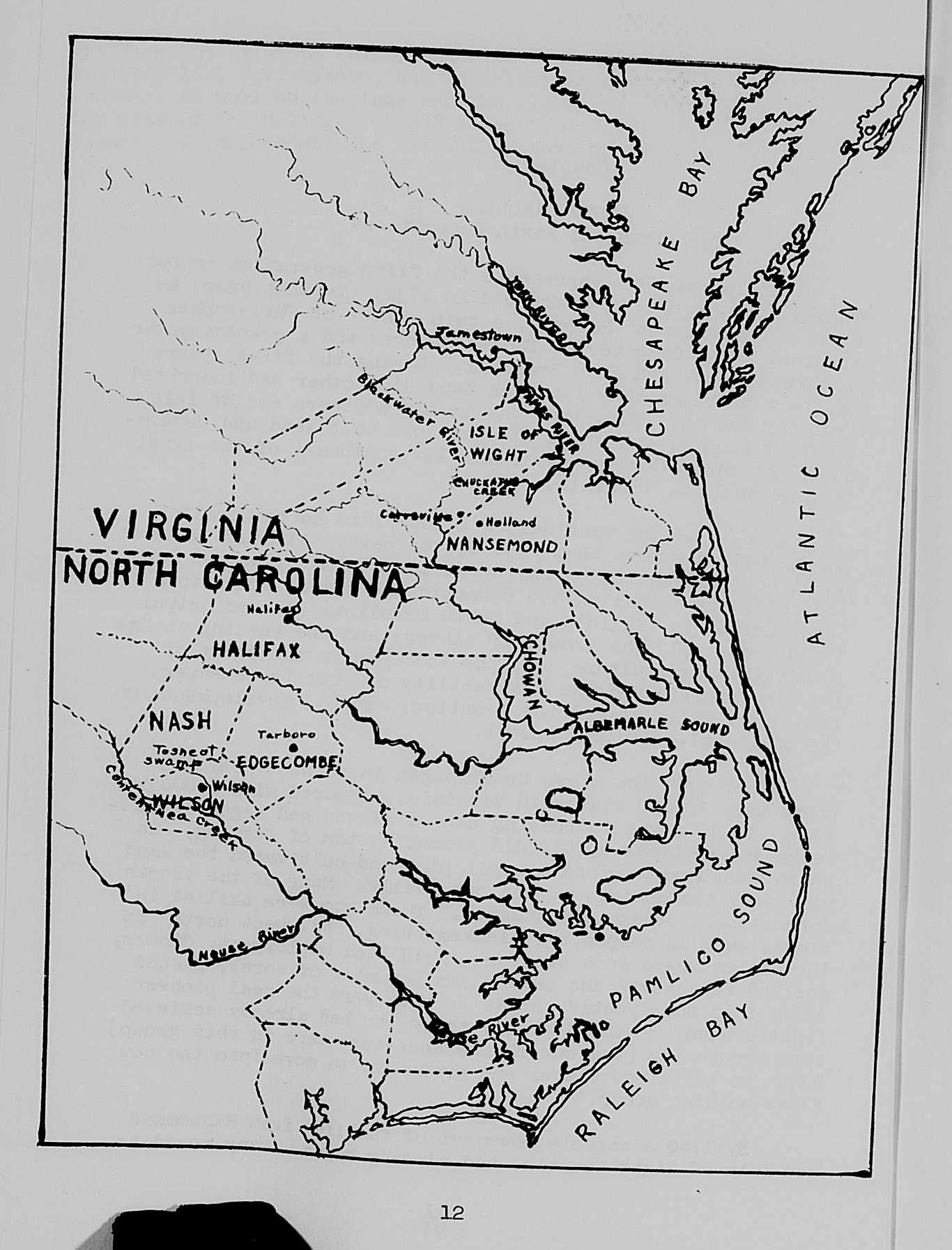
John Thomas, who represents the fifth generation in our Thomas history, was 27 years old in 1732. In that year he married Christenator Roberts, a twin sister of Christopher Roberts, and a daughter of Thomas Roberts and a granddaughter of John Roberts and Jane Braswell. During the first years of their marriage they lived on land his mother had inherited from her father. This land was in the southern end of Isle of Wight County, but about 1736 he sold that land and returned to Nansemond County, several miles southeast of the little town of Holland, Virginia.
By 1740 he was considering a move into North Carolina, and he made the move that year or the next. Although we have no direct information on why he decided to move, we get an indication by examining the economic and social conditions then current in Virginia and North Carolina. The principal trends were: (1) the growth of slavery and the ensuing change in Virginia agriculture, (2) the increase in the value of land in Virginia and the availability of free (or cheaper ) land a few miles toward the frontier, and (3) developments in the political-religious sphere.
After 1700 the slave trade began in earnest. By 1730 there were 30,000 slaves in Virginia, compared with 6,000 in 1704. By 1730 the increasing use of slaves had begun to challenge and to break up the old yeoman system of farming, in which each farmer owned a small plot and cultivated the land with only the members of his own family. Many of the yeoman farmers had to make adjustments. Those who were skilled in trades such as carpentry, blacksmithing, etc. went north to the cities where such artisans could find employment. Others, who had few assets and only a small number of acres, pushed early into the frontier areas -- they were the real pioneer frontiersmen. A third group, those who had already achieved some prosperity (and our Thomas ancestors were in this group) began to buy a few slaves and gradually to move into the new Slave-holding group.
By 1740 a sizable movement of families from Nansemond and Isle of Wight Counties had already begun. Many moved to northern North Carolina. The movement south had started as early as 1723. By that year there were 20 families on the Tar River alone. By 1730 the first sawmills had been built in what is now Edgecombe County, so that new settlers built the kind of houses they had had in Virginia. The year 1740 was the beginning of a great migration into lower Edgecombe County. During this year the North Carolina Assembly distributed over 50,000 acres of land to new settlers. At that time, virgin timber lands could be bought at a very cheap price. These potential farms, on which the land had to be cleared and at least some buildings constructed, were especially attractive to new settlers who owned several or many slaves. They wanted land on which they could immediately put their slaves to profitable work. An epidemic in Isle of Wight County in 1741 or 1742 is reported to have caused an especially large number to move at that time.
A factor of considerable influence in the migration from Nansemond and Isle of Wight Counties to Edgecombe County, N.C. between 1732 and 1742 was the issue of religious liberty. In Virginia the established (or Anglican) Church was supreme. Although the Act of Toleration (enacted in 1689) applied in the Colonies as well as in England, it was not given much support in Virginia. Only a Church of England minister had full rights to preach. A dissenter who wished to preach had to obtain local sponsorship, and local sponsors were hard to find, especially by itinerant preachers. However, the Church of England priests usually were not able men. They were sent to this country by the Bishops in England, and only the less competent ones were sent. Their preaching was dull; their sermons were read and delivered completely without conviction. Worst of all, they were "gentlemen", in league with the ruling aristocracy.
In North Carolina the Church of England had been established by law in 1701 but it was even less successful there than in Virginia. Early in the Colonial period North Carolina gained a reputation as an asylum for the religiously Persecuted. This reputation was widely advertised in England as well as in the colonies. Lumpkin says that before the end of the proprietary period (in 1729) dissenters came in larger numbers from Nansemond County, Virginia, than from any other area of similar size. They usually arrived in small companies.
Although John Thomas was reared an Anglican, and although he did not change over to the Baptists until 1748, it is possible that he was influenced by current preaching to make the move into North Carolina.
These years just before he left Virginia saw the start of what American historians call the "Great Awakening."4 This was a series of religious revivals which Swept the American Colonies, resulting in doctrinal changes and influencing social and political thought. Chief among those who galvanized the "Great Awakening" were Jonathan Edwards with his revivalist preaching in Massachusetts in 1734, and even more import ant, John Wesley and George Whitefield who came from England. Wesley was in Georgia in 1738-39, while George Whitefield—a preacher of unusual eloquence and conviction—traveled throughout the eastern seaboard in 1739-40, preaching the new doctrines. On December 14, 1739 he reached Williamsburg, the metropolis of Virginia. It is possible that John Thomas heard him there or in Nansemond County.
The Baptists had maintained a strong toehold in Isle of Wight County and Nansemond County since about the time that John was born in 1705. They were a group known as the General Baptists, a denomination not as Calvinistic and not as revivalistic as the later Baptist groups. Nevertheless, they were dissenters and this undoubtedly contributed to their moving to North Carolina, especially after Edgecombe Precinct was created in 1732. Originally the Precinct, and later the County, comprised most of the land between the Neuse and Roanoke Rivers, an area from which 10 modern counties have been formed.
Regardless of the exact reasons for the move, it undoubtedly was made in 1740 or 1741. In the latter year, John Thomas obtained his first known grant of free land. It came from King George II of England and was from the huge block of land allocated in 174) to the Earl of Granville.
The trip undoubtedly was overland, covering by wagon the 110 miles from Holland, Virginia, to lower Edgecombe (now Wilson) County. John Thomas was about 35 years old at the time. He had his wife and four small children with him, and he may by that time have owned one or two slaves. Having sold the land he owned in Virginia he would have had sufficient funds to buy necessary supplies and equipment and to make a successful start in farming in his new area.
During the decade from 1740 to 1750 John Thomas worked almost exclusively to develop a successful farming operation. In addition to his original patent, he acquired several others in the North Carolina Colony, totaling 1,351 acres. Counting an additional 523 acres which he purchased, he eventually owned a total of 1,874 acres. All the land was on Toisnot Swamp, White Oak Swamp, and Buckhorn Branch. Except for 340 acres lying south of Toisnot Swamp which he sold to Simon Daniel in 1744, all this land remained in his possession until he passed it on a little at a time to his three sons.
In the early days of operating his plantation the principal crop would have been corn. This was always the first crop to be planted by any new settler, since it was the staple crop on which both the family and the livestock lived. Every farm included various kinds of livestock. Cattle, swine, oxen horses, sheep, and fowl contributed greatly to subsistence of their owners. Some were even exported, especially hogs. After the 1740's great numbers of hogs were driven overland from North Carolina to Virginia, just as cattle were driven north from Texas more than a century later.
One of the the principal money crops was tobacco, as it was in Virginia. Unlike Virginia, however, North Carolina developed other important products for export. Export products were floated, during periods of high water, down Toisnot Swamp, Contentnea Creek, and the Neuse River to the wharfs that accommodated ocean-going ships.3
North Carolina exported great quantities of naval stores, consisting of tar, pitch, and turpentine; also exported were wood products, consisting primarily of shingles, staves, and sawn lumber. These products provided a means whereby the settlers could make good use of the extensive forests throughout the State of the long-leaf pine, a tree which yielded prolific amounts of resin and hence was greatly sought after by tar burners and turpentine collectors.
All three classes of "money crops" required large amounts of labor and hence these enterprises were engaged in on an increasing scale as each planter acquired a larger number of slaves. The use of slave labor in these industries was complementary, in that in good weather the slaves worked in the tobacco fields and in wet or inclement weather they worked in the forests to produce naval stores and/or wood products.
The only direct information we have on the nature of John Thomas' farming operation is the inventory of his estate which was taken a few days after his death in December, 1788. It indicates his usual farm operations during the 1770's. The inventory listed 700 pounds of tobacco and 200 pounds of cotton. Since these were the "money crops", undoubtedly considerable quantities of each commodity, in the months immediately preceding his death, had been floated down the Toisnot Swamp and Contentnea Creek to the Neuse River for shipment to England from the busy ports of New Bern and Beaufort.
At the time of his death he owned 58 hogs, sheep, 22 cattle, and 4 horses. Apparently the Baptists of that day were not opposed to liquor since he operated a still and had on hand 90 gallons of brandy and 8 barrels of cider. The status of the plantation as a self-sufficient operation is indicated by the inventory of 9 1/2 sides of leather, 3 spinning wheels, a cloth loom, 2 hackles (for flax), and a small crop of flax.
Mostly his plantation was farmed by slave labor. Although we do not know the number of slaves he owned, he and his sons must have had in the neighborhood of thirty-five to forty-five by the time he died. Shortly before his death in December of 1788, he willed 9 slaves to his son, Theophilus, and one to his granddaughter, Millicent Horn. Since Theophilus had two older brothers, we can assume that his father had already given at least an equal number of slaves to these older sons.
If the family held slaves in that number, they rated among the more prosperous members of the population. From 1755 to 1767 the Negro population of North Carolina increased by 89 percent, mostly from natural increase. During this period they constituted about 50 percent of the population in Edgecombe County and adjacent areas. Such data as are available indicate that, in the Edgecombe County portion of the State, about one-half the households owned one or more slaves. Of those who owned slaves, about half owned from one to 10, a fourth or more owned from 10 to 20, and perhaps no more than 8 to 10 percent owned more than 20. It seems clear that the Thomas plantation was among the top five percent of all plantations in the value of its land and slave holdings.
By 1750, when he had been in his new home for 10 years, John Thomas had established himself as a successful planter and undoubtedly was a well known and respected member of his community. In that year he was 45 years of age. He and his wife had seven children, all of whom were still at home. His two oldest sons, John Jr. and Jonathan, were 17 and 15 years of age, respectively. The oldest daughter, Obedience, was then 13 years old. The third son, Theophilus, who had been born just before or just after the move to North Carolina, was then 10 years old. The two youngest girls, Millicent and Theresa, were 8 and 6 years old, respectively.
By 1750 he probably had already built a comfortable frame house with several bedrooms. When his estate was inventoried in 1788 it included 8 bedsteads and 8 feather beds and furnishings. Among the other items listed were: 12 chairs, a safe, 19 pewter plates, 9 pewter basins, 8 dishes ,3 plates, 6 punch bowls, glass tumbler, 13 cases of knives and forks, 20 table spoons, and a large lafling spoon. The kitchen, with its large fireplace for cooking, contained among other things, 5 iron pots, 4 pairs of pothooks, 2 iron pot racks, iron baker, pair of flesh forks, pair of hooks to roast meat, 4 large jugs, 2 large butter pots, honey pot, sugar box, candlestick, and a pair of money scales.
From 1750 until about 1780, when failing health forced him to relinquish many of his usual activities, John Thomas was heavily involved in public affairs. He was both a public official and a minister of the Baptist Church, having accepted his first political appointment in 1749 and having been ordained in 1756. The quarter century of his active involvement in public life was as turbulent and full of change -- and as historically significant -- as any quarter century in our history. It was the quarter century that led to the American Revolution in the political sphere, and to the spread of the Protestant denominations in the religious sphere. In the eastern North Carolina area he played an important and influential role in both spheres.
His first political appointment was on October 11, 1749 when Governor Gabriel Johnston and His Majesty's Council in session in New Bern named him to be Justice of the Peace for lower Edgecombe County (now Wilson County). The Justices of the Peace, all appointed by the Governor, constituted the County Court at that time. This court controlled almost every phase of local government and administration. After Halifax County was formed in 1758 and the town of Tarboro was founded and made the County seat, he began regularly to ride the 30 miles or so from Wilson to Tarboro. He served regularly on the Bench of Judges at Tarboro from June 27, 1758 to October 18, 1775. The surviving Minute Books of the County Court indicate his participation not only in the formal sessions but also in a road or bridge commission nearly every year during this long period.
Most of his service before 1776 was by virtue of appointments by the Royal Governor at the time. After the Declaration of Independence he was reappointed under the laws of the State of North Carolina. However, he served very little after 1776 because of failing health. He restricted his public work in his later years mostly to the ministry. Before the American Revolution, the Governor of the Province had broad appointive powers. He named all the county officers, the sheriff, the constable, and jurymen. Those not appointed by him were appointed by his appointees. The "Court House Ring" was self perpetuating. There was no appeal for grievances. There was much discontent, especially among the poorer farmers and especially those living in newly settled frontier areas. There were many causes for antagonism between the prosperous office holders and the poorly educated and economically struggling frontier farmers. Not the least of the causes of discontent was the fact that office holders received no salary, but were paid by means of the fees they collected. The proper fee for various actions was not clearly defined and this led to disputes and general discontent.
John Thomas was definitely a member of what today we call "the establishment"; yet he was a prominent leader in a dissenting church, in a day when the principle of separation of church and State had not yet been accepted, when in fact some Baptist groups were looked on as incipient, if not actual, revolutionaries. The historians, Lefler and Powell, pointed out that Baptists were among the most active opponents of the Established Church in the Colony, and Royal Governors on many occasions condemned the whole denomination for the opposition expressed by some individual members. They then added that "not a single adherent of the Baptist faith is known to have held an office of importance at the local or the provincial level before the Revolution; but it was from the members of this church that much of the leadership of the early Revolutionary movement was to emerge". This statement is significant, even though it is obviously wrong. Not only did John Thomas hold important offices on the local level; his close friend and associate, Elisha Battle, served as Moderator of the Kehukee Baptist Association. Battle was born in Nansemond County, Virginia and is believed to have migrated to North Carolina in the same year that John Thomas did. Battle served with distinction as a member of the Provincial legislature and participated in the Convention that wrote the Constitution for the new State of North Carolina after the Declaration of Independence.
In looking at the possible conflict between his political and religious activities, it may be noted that he did not assume leadership in the church until after he had already established himself as a local public official. Although he may have heard some Baptist preaching as early as 1740, it was not until 1748 that he was converted to the doctrines of the Baptist denomination. In the summer of that year, Dr. Josiah Hart preached the doctrines of the Baptists in the Edgecombe County area. John Thomas, along with several members of his family and several neighbors, was baptized into that faith. A new congregation was formed but it was 8 years before they had a regular pastor. In 1756 John Thomas was ordained by Elders John Moore and George Graham and made the pastor of the congregation.
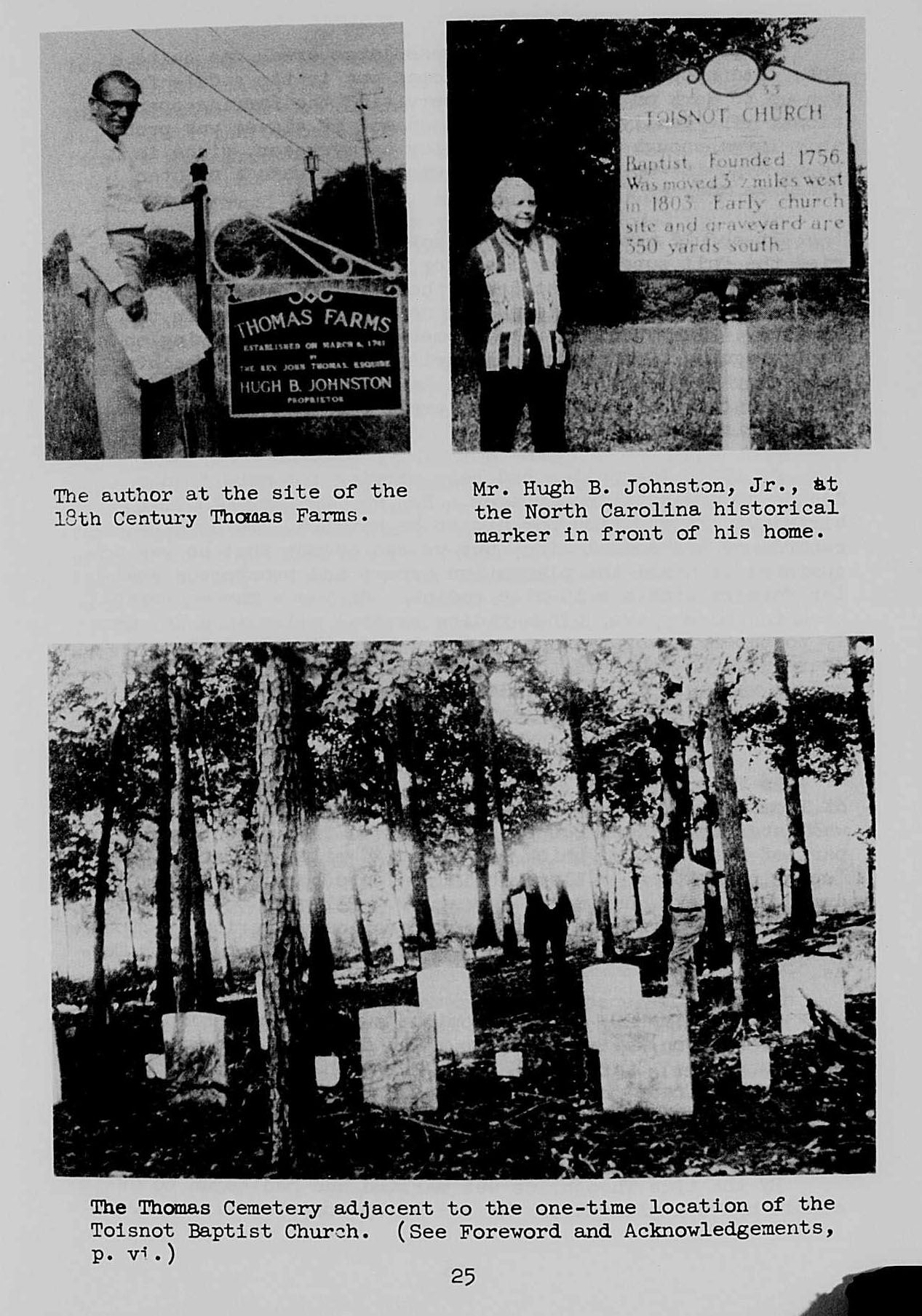
For a year or two, religious services were held in various private homes in the area, both in the Thomas home and those of several neighbors. However, on September 24, 1759, the Rev. John Thomas deeded to his son, the Reverend Jonathan Thomas, a square acre of land on his plantation for the erection of a Meeting House. Morgan Edwards described the building as measuring 16 by 28 feet. At the time it was built, there was no other church within 18 miles. A small pond was made by damming up the waters of a small brook, thus providing place for baptizing the new members of the church. A graveyard was established adjacent to the church.
The little church building has long since vanished and its exact location is not known. However, the graveyard still exists and the grave of the Reverend John Thomas, along with those of his wife, his sons, and numerous other members of the family, are marked by attractive headstones, put there in later years by descendants. The pond has been enlarged and today constitutes a beautiful area near the graves that lie under the pine trees.
A word about the Baptist denomination is appropriate. In 1756 John Thomas was ordained; two years later his home church, Tosneot Baptist, was reconstituted according to the Calvinistic interpretation of the "Plan of Salvation." During these years North Carolina was filling up rapidly with new settlers from Virginia. Most of the new settlers in the frontier counties further west listened to the traveling evangelists and became adherents of the Baptist faith. The Baptists grew very rapidly as a denomination during this period.
There was a great emphasis in that era on the niceties of doctrinal interpretation. The differences centered mainly on the degree of emphasis placed on Calvinism — that is, on predestination and on the time and method of baptism. Another point of great importance was the particular style of worship. Generally speaking, the Baptists in eastern North Carolina (that is, Edgecombe County) were formal and orderly rather than emotional and given to exhortation and other forms of religious fervor. The latter group was dominant in the western settlements, now the central part of the State.
At that time there was no national organization of the church. Churches tended to develop in better populated areas and then an association was formed. which brought together those churches which were geographically accessible to each other and which shared a common interpretation of Scripture and doctrine.
Unless one is trained in church and theological history it is difficult to trace the successive doctrinal affiliations of John Thomas and his sons. He seems to have started his career in affiliation with the General Baptists but he changed over soon after his ordination to the Particular Baptists, a much more Calvinistic group. Toward the end of his ministry the rivalry was between the Particular Baptists in the East and the more emotional and evangelical Separatist Baptists who appealed more to the frontiersmen in the western provinces of the State. It should also be noted that these Separatist Baptists on the western frontier were usually classed as politically radical—that is, they opposed the "eastern establishment" both in the religious sphere and in the sphere of government.
In the late 1750's, Dr. Oliver Hart, who helped to establish the Particular Baptist group throughout eastern North Carolina, established an association of the Baptist churches of his persuasion. It was established in Charleston, South Carolina, and in 1760 Reverend John Thomas and his two sons — Rev. John Thomas, Jr. (then age 27) and Rev. Jonathan Thomas (age 25) — mounted their horses and made the long and difficult journey to Charleston in order to bring Tosneot Church into the Association. However, the distance was so great and the travel so arduous that they decided, in 1762, to withdraw from the Association. By 1769 there were a sufficient number of churches in eastern North Carolina to justify the formation of an association there. On November 6, 1769, the Kehukee Baptist Association was formed and held its first meeting in Halifax County. (The lead church was the Kehukee Baptist Church which had been founded on the Kehukee Creek and took its Indian name from that source.) John Thomas represented the Tosneot Church and signed the Covenant that was adopted. His last recorded attendance at the Kehukee Baptist Association was on October 20, 1777, when the membership elevated him to the office of Moderator and also placed under his leadership the special committee that drew up the Articles of Marriage which are still reflected in the ceremonies of the Southern Baptists.
It is clear that for a decade or more Reverend John Thomas did considerable traveling in the adjacent areas of North Carolina and Virginia to spread the Gospel where the people had no regular minister and to assist in organizing new churches. The Baptist historians, Burkitt and Read, report that he was active all through the decade of the 1770's in organizing and reconstituting new churches. Silas Mercer who first lived in Currituck County, N. C., and later in Wilkes County, Georgia, where he became the founder and pastor of several of the earliest churches in that County, as well as in Hancock County, reported: "the first minister of the denomination he ever heard preach was a Mr. Thomas, at that time a successful preacher in North Carolina." John Thomas's last religious act, of which we have official record, occurred on September 17, 1780, when he was near his 75th birthday. He and Reverend John Page constituted the Lower Town Creek Baptist Church on that date.
In those early days before the modern era of the separation of church and State, John Thomas must often have been faced with problems on the relationship of the church and the government. Some examples survive. In 1759 Reverend John Thomas took the precaution of securing legal sanction for his church under the English Act of Toleration. Approval was granted on September 24, 1759. According to Turner and Bridgers, the first reference concerning religion in the minutes of the Inferior Court of Pleas at Tarboro was made in the form of a petition in 1759 by John Thomas and others "of the profession of Ana-Baptists." They reported that a Society of Baptists had constructed a meeting house, and a division of the Society had occasioned a dispute over the legal owners. Consequently, John Thomas, "the leader of the Ana-Baptist element" petitioned for a claim to the meeting house which had been constructed under his supevision. Thomas was one of the leaders of the dissenting element and had forcefully closed the doors of the church to the services of the Baptist Society. The historians add that the records do not show how the issue was disposed of; they offered the guess that the dissenting element would have lost since the Church of England had opposed the dissenting element.4
The next incident, also reported by Turner and Bridgers, came in 1761, soon after a precinct court was established in Tarboro about 1759. In that year, Jonathan Thomas was granted a license to preach, reportedly the first non-conformist legalized in eastern North Carolina. Thomas produced an ordinance in writing, signed by John Moore and George Graham, leaders of the Baptist Society, qualifying him to preach according to their tenets. The Court, according to its power, administered the oath of allegiance, and and issued a permit for Thomas to preach.
A final incident occured in 1772. On September 17th of that year the Kehukee Baptist Association appointed Rev. John Thomas to a committee to present a complimentary address to Governor Josiah Martin at New Bern. Governor Martin had just taken office, having succeeded Governor William Tryon, under whose administration the relationship between the Government and the dissenting churches had been strained. Governor Tryon had placed great obstacles in the way of the dissenting churches, trying, literally, to force them to show more allegiance to the Anglican Church. His efforts had been strongly resisted. There were some disturbance in Edgecombe County, but they were not nearly as serious as in the western counties where a large number of the poorer, frontier settlers were Baptists and where the officials of the Government were often abusive and even dishonest. The dissenters led in the formation of a sort of vigilante society called the Regulators (the regulators, that is, of public affairs). They did so much to challenge the authority of the Governor and his appointees that he called out the militia. On May 16, 1771, the Governor's troops and the Regulators met in pattle at Great Almamance Creek, west of Hillsboro. About 2,000 armed men were on each side, but the militia were much the better armed and disciplined. About 9 men were killed on each side, and about 60 militia men were wounded. The Regulators were routed.
Governor Martin was a far more reasonable man than his predecessor. The Kehukee Baptist Association, desiring to promote a new era of good feelings, sent the following message to the new Governor.
To his Excellence Josiah Martin, Esq., Governor and Commander in Chief of the Province of North Carolina.
The Humble Address of all the Ministers and Elders of the Baptist Society who associate annually in Hallifax County, in the Province aforesaid in behalf of themselves and many hundreds of their Brethren.
May it please your Excellence - - It is with unfeigned pleasure, we acknowledge the Happiness with which we are Blessed in common with the other Inhabitants of this Province, under your administration of Government; But we beg leave, in a more particular manner, to express our Grateful Sentiments of the protection we enjoy in the Exercise of our Religious and Civil Liberties; for which it is our Duty, and shall be our Constant Endeavor, to Distinguish our Selves as Loyal Subjects to our most gracious Sovereign, and usefull Members of Society. We hope this Address will not be Considered as a Customary Complement, But a Tribute of Acknowledgement due to your Merit, from the experience we have had of your publick Conduct. It is our prayer to the Almighty, that as he has placed you in a Most Distinguished Station, he would Eminently guide and Direct you in all your Actions, and Bless you with prosperity here, and Everlasting Happiness hereafter.
Signed at our Association in Hallifax County Sept. 17, 1772. Jonathan Thomas, Moderator Elisha Battle, Clerk.
We appoint our Brethren Jonathan Thomas, Henry Abbott, William Horn, Elisha Battle, John Thomas, and William Burgess To present this address.
In speaking of the political aspects of the letter, Turner and Bridgers describe the Baptist leaders as conservatives. Unlike some conservatives (the Royalists) who were partial to the authority of England, these men held a decided view in favor of the Colonists. But they were not enthusiastic about rushing into political conflict with so powerful a nation as England. Their letter probably helped to calm the feverish spirit of the times. But many of these men, cool and level headed as they were, soon changed their views and entered wholeheartedly in the Revolutionary cause, bearing their full share of the Revolutionary burden.
By 1776, Reverend John Thomas was 71 years old and in failing health. Although he lived for another 12 years, he began gradually to turn over his wealth to his sons who already had been taking over his role in public life.
Theophilus Thomas, who represents the sixth generation in our family history was one of the six children of the Rev. John Thomas. The children were born in the eleven-year period from 1733 to 1744, each of them being about two years apart in age. Theophilus, the fourth child, was born in 1739/1740, just a short time before or after his parents migrated to North Carolina.
We know very little about the home and family life of the children in their early years, but a few general conclusions can be relied on. By 1750, when Theophilus was 10 years old, all six children were still at home with their parents. As an educated man, his father may have personally served part time as the teacher of his children, or a tutor may have been hired jointly by several prosperous planters. There were books in the home, and a thorough grounding was achieved in reading the Bible and also Shakespeare and other leading English writers. He began in those early years to assemble what was described in later years as an excellent library. Most of the tutors employed by successful planters at that time had a thorough knowledge of the classics which they read in the original Greek and Latin. Like the sons of many successful planters of the day, Theophilus studied law in preparation for his expected role in public affairs.
By 1760, Theophilus was 20 years old. At that time his older brothers, John Jr. and Jonathan, were 27 and 25 years old respectively and were active as newly ordained ministers. They understudied their father and eventually took over his role in the ministry, while Theophilus took over his place in public affairs and plantation management, and added an additional role in the military.
During the 1760's, and even more during the 1770's, when his father and at least one brother were riding far and wide to carry on their work in the ministry, Theophilus undoubtedly assumed a major load in managing and expanding the family plantations. The acreage owned by his father and by his two brothers and himself was concentrated in two locations. The earliest grant to Rev. John Thomas, Sr., in 1741, was for land in what later was know as the "lower plantation." This land was along the Tosneot and White Oak Swamps,on both sides of the latter. Much of it was individually owned later by Theophilus Thomas. It comprised about two square miles in the area where White Oak Branch flows into Toisnot Swamp 5. The "upper plantation" dates from 1747; it lay north of Toss neot Swamp on both sides of Buck(horn) Branch. It also lay on both the north and the south sides of what is now designated as North Carolina State Highway No. 42, east from Wilson.
Supervising the work of these large areas was quite a job. Undoubtedly, Theophilus Thomas was in the saddle from sun up to dark on many days, supervising the farming operations. The family holdings of land and of slaves was probably large enough for him to employ an overseer, since in those days it was economical to employ one when a planter owned as many as fifteen slaves.
It should not be presumed, however, that Theophilus carried the full supervisory load for his father and brothers. Ministers at the time, at least those in the emerging Baptist and Methodist denominations, did not work full time in the ministry. They usually were farmer-ministers, carrying on their regular farm operations during the week and preaching on Sunday or special occasions. As a rule they were never paid a salary, although certain small emoluments may have come their way.
By 1771, Theophilus had been serving for more than a decade as a plantation manager. He was nearing his 31st birthday; it was time for him to be married. We have no records of his social life, but we can assume that he was acquainted with all the plantation owners and prosperous smaller farmers within a 15-mile radius. He was a man on horseback in those years, often riding several miles in a day merely to supervise operations on the two family plantations. There were no towns in those days (Tarboro was the nearest and it was only a small village), so most business and so ae visits were to the plantation itself rather than to a own.
In February of 1771 he married Mary Rogers, the daughter of Thomas and Mary Rogers who lived on Turkey Creek in what was later to be Nash County. They lived in the southwest part of Nash County, which was about 18 miles from the Thomas "upper plantation." Eleven children were born to the couple during the next quarter of a century. All grew to adulthood and married; and most left North Carolina at various periods after 1800 to establish new homes in Alabama, Georgia, or Texas.
On February 20, 1771, Theopilus's father gave him 273 acres of land on White Oak Swamp. The deed indicates that it was transferred "for love." John Thomas had originally acquired this tract in 1762 when he had bought it from Jacob Barnes, a nearby neighbor who was “sort of related" since one of Theophilus's sons married Jacob's daughter, Susannah.
By the time Theophilus was married and had begun to assemble his own Plantation, he was fully competent in the farming techniques and procedures for that day. He used his slaves alternately for growing tobacco and for working in the pine forests. He pushed the growing of flax and hemp, especially after the Colonial Government offered a bounty to all farmers who produced these products which were so useful in making linen and rope. He undoubtedly had large herds of hogs which were turned loose into the swamps and dense undergrowth in the bogs. Periodically they had to be rounded up, with each farmer identifying his animals according to his own brand which was notched into the hog's ear. (The County Clerk in each county customarily kept official records of each farmer's marks. On November 19, 1751, Theophilus's father had recorded his private livestock mark: "a crop off the left ear and a half moon under & over the right.") Barns and bins had to be constructed for storing the corn that was so important for both people and animals. Extensive orchards were planted, as well as vegetable gardens. On one occasion Theophilus and his slaves built a ferry in Toisnot Swamp so he would have easy access to the saw mill constructed by his neighbor, Jacob Barnes. On another occasion, he directed that a pit be dug for trapping wolves and other "varmints"-- the chief object being both to protect his own crops and livestock and to collect the bounty offered by the Colonial Government for killing such "varmints". In later years, as his land was sold off, the deeds of sale referred to the ford and the pit as surveyor's marks for various plots of land.
Theophilus Thomas considerably increased his holdings during the decades after he began serving as office holder in the county government. He patented 150 acres in 1768; 1,040 acres in 1778; two tracts totaling 1,140 acres in 1779; one 300-acre tract in 1783; a 100-acre tract in 1790; and five tracts totaling 932 acres in the decade of the 1790's. Altogether he accumulated 5,858 acres of land. He patented 3,708 acres from the State of North Carolina, bought 1,360 acres, and received 790 from his father. By the time he died, however, 1,100 acres had been deeded to Ichabod and Benjamin, his two oldest sons, and the only ones who had reached their majority by the time of his death.
Theophilus Thomas was never a land speculator, nor an absentee landlord. Most of the patents from the State of North Carolina conveyed to him tracts of from 300 to 500 acres. Several, especially in the area of the "lower plantation" (where White Oak Branch flows into Toisnot Swamp) were irregularly-shaped blocks of land that lay entirely surrounded by land already owned by himself or his neighbors. In other words, he obtained the last available free blocks of land in the vicinity of his plantation.
It is likely that he increased his land holdings in proportion to his increased ownership of slaves. In Colonial America land was always more plentiful, and cheaper, than labor. Unless one had many sons, or many slaves, the land was of little value. Slave owners like Theophilus Thomas could use the land more profitably than his less affluent neighbor. This was especially true of heavily timbered land in the swamps and river bottoms; such land was not cleared for tobacco or cotton, but a plantation Owner could put his slaves to work in such areas, obtaining pitch, tar, and turpentine, and staves and shingles, for export to England. As the trees were gradually cut for their wood products, the fields were gradually cleared for farm crops.
It is probable that prior to his father's death in 1788 he owned in the neighborhood of 12 to 15 slaves. He inherited 9 slaves from his father in 1788, and in 1790 the Federal census taker listed 21 slaves as a part of his household. The 1800 census showed him to own 19 slaves. By then he may have given one or more to each of his two oldest sons, Ichabod and Benjamin, especially since he had given 550 acres of land to each of them in February, 1799.
Theophilus Thomas was a Patriot and was actively engaged in the Revolutionary War. We do not know exactly when he became a Captain of a militia company of Edgecombe County, but it was some time prior to June 1781. In that month, shortly after British troops under Gen. Cornwallis passed through Wayne and Edgecombe Counties on the way to Virginia, Captain Thomas marched a company of three-month draftees from Lower Edgecombe County to the town of Halifax, where some of his men were turned over Benjamin Coleman of the United States Continental Line for service against the Tories along the Cape Fear River. He was promoted to Second Major of the Edgecombe County Militia Regiment in 1785, and on January 4, 1787 the General Assembly of North Carolina approved the recommendation by members Elisha Battle6 and Ethelred Phillips that he be appointed First Major, a commission which he held until his resignation in 1795.
Documents on file at the North Carolina Archives show that Major Thomas received a number of payments from Green Hill, Treasurer of Halifax military district. They also show that a number of men established their service under Captain or Major Thomas as a means of documenting their application for a Revolutionary War pension. One of them listed him as Captain "Offie" Thomas, indicating that he was known by that nickname.
After his father retired from public office, about 1780, because of poor health, Theophilus took over in the same capacity and served for a quarter of a century. He became a Justice of the Peace and served regularly as a Judge on the Bench of Edgecombe County Court at Tarboro from August 26, 1778 to February 24, 1800. He also collected the taxes in his District from May 24, 1780 until the year following May 23, 1793, it being then Captain Eason's District (No. 6 in Edgecombe County). The Court Minutes mention his election as sheriff of Edgecombe County on February 2, 1790, but he had so much trouble collecting the taxes for 1789 that he declined to serve after February 11, 1791. The records indicate that on November 1, 1790, he had been able to pay the State Treasurer only 571 pounds in cash and had not yet been able to redeem the certificates for the other 256 pounds and he may have had to guarantee these from his personal resources.
At that time the County Government did not use its own employees to maintain the roads, to build and repair bridges, etc. The County Commissioners contracted with prominent citizens to do each job as it became necessary. Road repairs were basically a neighborhood operation. A "Commission" was created for each job. Usually these commissions were headed by prosperous local planters who used their own slaves for the work. From 1787 to 1799 he headed, or was a member of, a commission to repair a road or build a bridge, usually in the vicinity of the Thomas family plantations. The Court Minutes mention bridges over the Contentnea Creek, White Oak Swamp, and Toisnot Swamp. In all instances he was paid some stipulated price, stated in pounds, shillings, and pence. On November 4, 1790 he was appointed Overseer of Roads in his neighborhood. In this capacity it was his responsibility to list all men of poll-tax-paying age in his district and to call on them from time to time for a specified number of days of free work on the roads each year. He probably did not hold this job long, since drafting men to perform free work on the roads was no less contentious an assignment than the sheriff's job of collecting taxes.
Theophilus Thomas retired from public life in 1800 and three years later he died. On June 25, 1803, he drew up and signed a 9-page will which directed the disposition of his extensive holdings. It is likely that he died in September or October of that year, since his will was probated on November 29, 1803. The will is interesting. It throws light on both the living conditions and the social customs of the day. Some points may be noted. The custom of primogeniture had broken down and now all the sons shared in the estate, especially the ownership of land. However, the wife and daughter did not share equally in this regard. It was expected that the girls would marry and their husbands would take care of them; if they did not, they would live with a brother. Theophilus left to his wife, Mary, one Negro girl for her own use, and he "loaned" her two Negroes and the plantation on which he then lived, along with his still, cap and worm, and stipulated that she should not "be moved off the plantation where she now stands by no person whatsoever till my youngest son comes of age to take it in his possession."
The specificity with which personal property was divided among the family suggests the scarcity and the value of such items. Specific bequests were common at that time. Under most wills, practically every farmer, to the extent his affluence permitted, handed down his possessions with great care. A horse, a bridle, and a saddle were given to almost every member of the family, indicating the extreme importance of horses for travel in an era when roads were hardly more than paths. An affluent household included up to a half dozen feather beds and furniture which were passed down to heirs. The beds all had a canopy over them, and curtains for both above and below the bed went with them.
The sheets and handmade quilts, and even the personal clothes of the deceased were bequeathed. All cotton and wool products were handmade and immense amounts of labor went into such items, both in the spinning and weaving of cloth and the painstaking stitching by hand. All kinds of farm and household utensils were also named. Pewter plates, brass candlesticks, and storage chests were highly valued. Other items often named were the cotton cards, woolen and flax wheels, box irons (hand iron with an arrangement for opening the iron and putting live coals inside for heating), and piggins (a small wooden tub or bucket used for many purposes). Theophilus Thomas named which son would receive his shot mold and the ladle to melt lead. He directed that his books be divided equally between his 3 youngest sons and his two youngest daughters, suggesting that he had already given books to the older children. Two books, however, were specifically mentioned. His son, Micajah, was to get his Law book called Iredell's Revisal and his son, Theophilus, Jr. was to get The Young Man's Companion.
One can well imagine that the Revisal was his pride and joy. It had been published in 1791, authored by James Iredell, a brilliant lawyer from Edenton, North Carolina, who served about that time as Attorney General of North Carolina. During the Revolutionary War period the weekly far and wide printed his scholarly arguments, first in favor of independence from England, and later in favor of the ratification of the proposed United States Constitution in 1788. After the Constitution was adopted and the American Nation came into being, he was appointed to revise all the laws passed between 1776 and 1789 and make them compatible with the new Constitution. His Revisal also contained all the acts of the North Carolina Assembly, a most important tool for a County official responsible for administering those laws on the local level. In 1790, George Washington appointed Iredell as an associate justice of the Supreme Court of the United States. Iredell died in 1799 as a result of exposure during his lengthy and frequent travel to various places where Federal Court sessions were held in those days. Although we have no record of such, it is likely that the judge was personally known to Major Theophilus Thomas and he may even have visited in the Thomas home. At any rate, he must have been greatly admired by the family. Benjamin Thomas named one of his sons Iredell D. Thomas, and this was in 1805, more than five years after the great judge had died.
When Theophilus Thomas died, six of his children were at least 20 years old, and the youngest five ranged from 6 to 18 years of age. Most of these children migrated to newly opened sections in Georgia and Alabama. By 1840, practically all of Theophilus Thomas' holdings in the "lower plantation" had been sold, although (as mentioned in the Foreward) some of the holdings in the "upper plantation" have remained in the family until the present time.