← The Thomas and Bridges Story, 1540–1840
Chapter XIII: Drury Bridges of Edgecombe County, N.C.
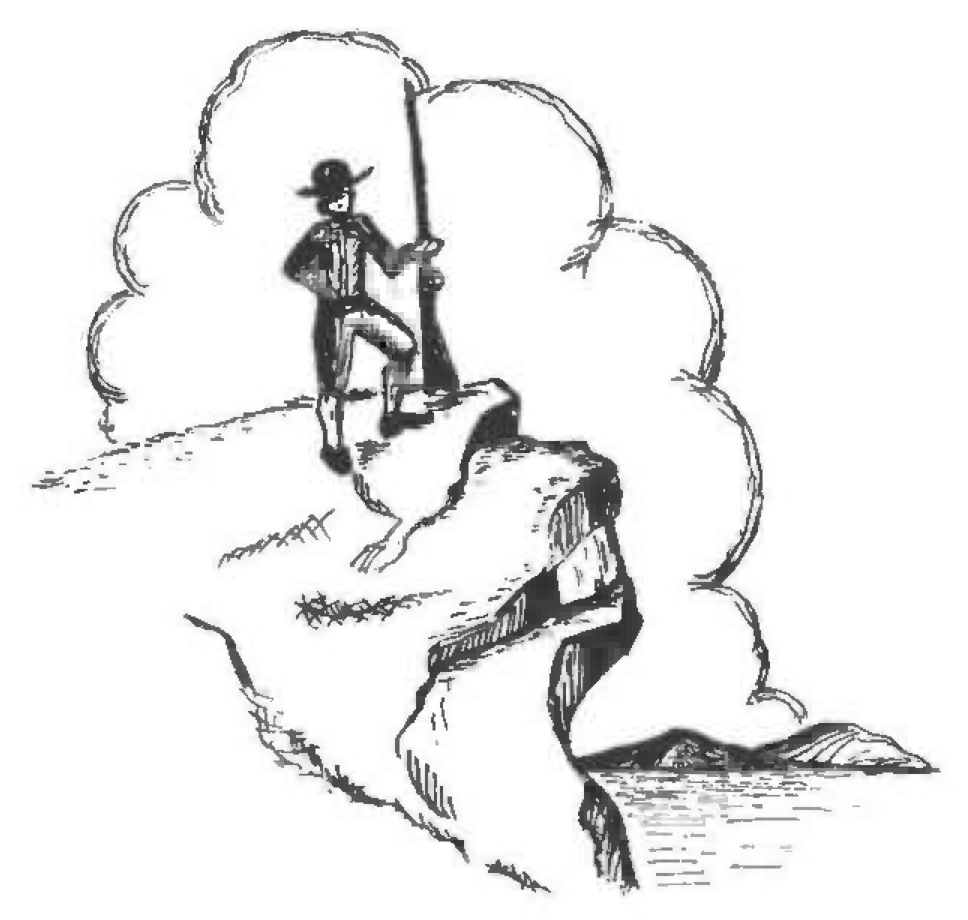
First member of the Bridges family to settle in what is now Trigg County, Kentucky, was Drury Bridges. He migrated from North Carolina to Christian County in 1804.1 bringing with him his wife Charity (Cohoon) Bridges and their four children — three girls and a boy. One other child, a boy, had died prior to their leaving North Carolina. Two more children, both girls, were born after they settled in Kentucky. Drury and his family settled first in the Donaldson Creek valley although there is no record of his ever having acquired land there.2 He later moved some three miles farther northwest to a site on the north bank of a stream mentioned in old records as “the Beechy Fork of Donaldson Creek,” which later was to be called Beechy Fork Creek. There he acquired land and settled for the remainder of his life.
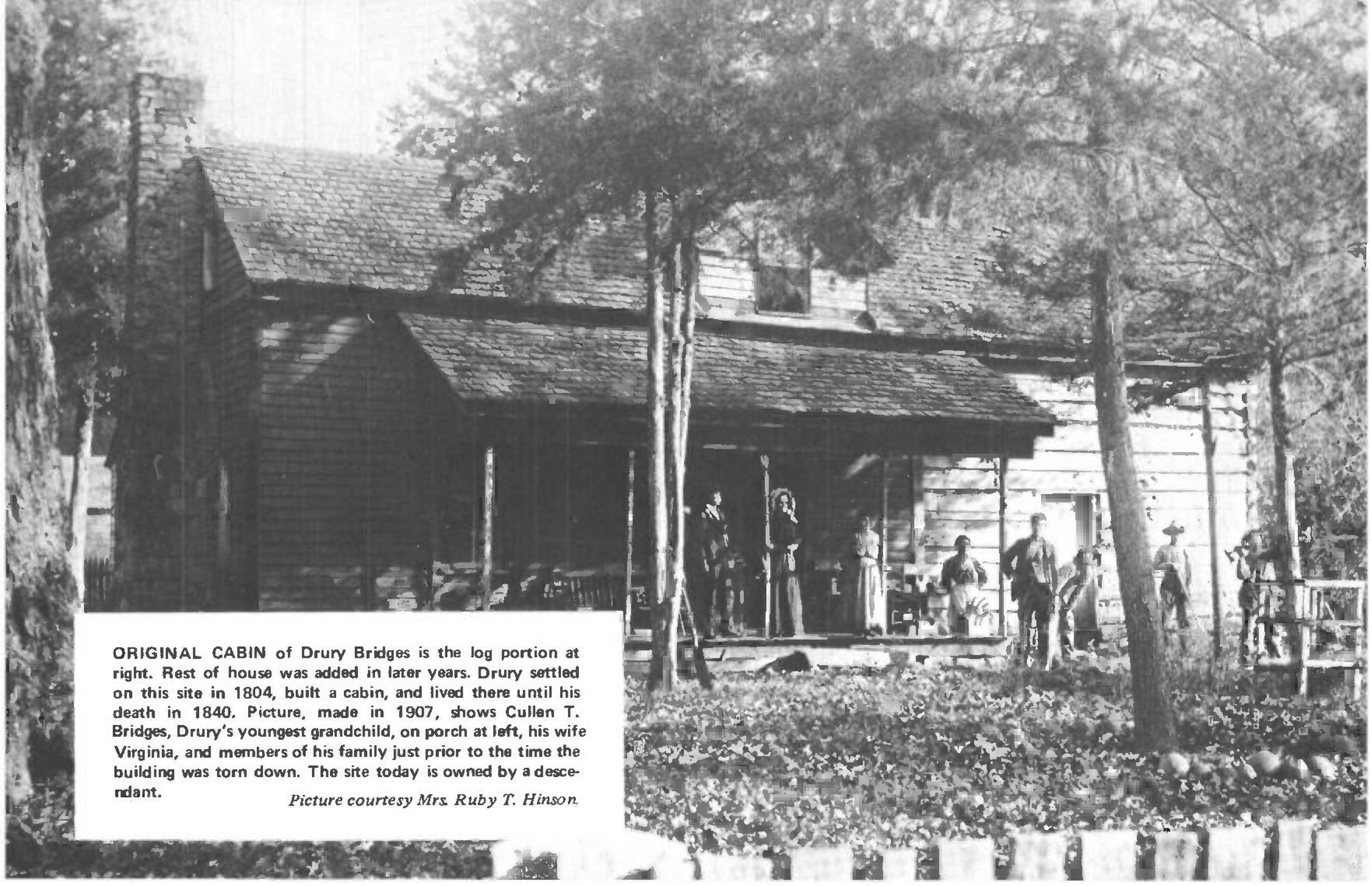
Drury Bridges built a log cabin in a level wooded area near the little creek, and called it Maple Grove, a name that eventually was adopted by the entire community. The log cabin built by Drury Bridges, along with several additions, stood until 1907 when it was dismantled and the logs moved about a half a mile south where they were used to build a cabin for Jack Bridges, a descendant of one of the family slaves.
Drury Bridges was born August 30, 1765 on a plantation near Fishing Creek and the Long Swamp in the northern part of Edgecombe County, North Carolina. Today this creek is the dividing line between Edgecombe and Halifax Counties. His parents were William and Jemima Bridgers3 who later acquired land 10 miles south on Tyancoca Swamp, now called Cokey Swamp, less than three miles southeast of present day Rocky Mount, North Carolina. In this area too, lived the Cohoon and Flowers families4 both of whom the Kentucky Bridges line also lists as ancestors. Drury, the oldest of the children of William and Jemima Bridgers, was 14 years old when the family moved to that area. He and his three sisters and two brothers grew up in this section of Edgecombe County, and it was there that he met Miss Charity Cohoon, the girl who later was to become his wife. They were married in the latter part of 1789 or early 1790. Most of the marriage bonds of Edgecombe County are missing between the years 1774 and 1798 so the exact date cannot be determined.
Although Drury Bridges is said to have migrated to Kentucky in 1804, various records indicate that he, his wife Charity and their four children, Jemima, 8; Selethia and Piety (twins), 6, and William, 3, may have left North Carolina for Tennessee at least by the early part of 1803. They were accompanied by Drury’s sisters, Priscilla and Sylvias, also a third sister and two brothers whose names are not known.5
Their route west from Edgecombe County was similar to the one which would be taken by James Thomas, Sr., in 1806 three years later (See Chap. 2)—across North Carolina to Elizabethton, Tenn., where they joined a larger group of settlers headed for the Cumberland Valley of Tennessee. They also traveled over the Walton Road, which at the time had just been completed. Although it is pretty certain that James Thomas took the Holston River route, likely Drury Bridges and his family continued their journey overland.
At Carthage, Tenn., Drury crossed the Cumberland River and continued along the trail on the north side of it for some 25 miles to the vicinity of Gallatin in Sumner County, Tenn. At that time, several Bridges families from Nash County, North Carolina, lived near Gallatin, among them, Sampson, William and John. It is likely that Drury stopped and visited there for a period of time, just how long is not certain. In any event, it is certain that several things happened while he was there. First, Drury changed his mind about settling in Tennessee. Instead, he decided to take his family farther into the wilderness to Kentucky. There is no record of why he made this decision, but for some reason, his three sisters and two brothers chose to remain in Sumner County.
At this point, the fate of the rest of the family becomes somewhat obscure. There is no record of later activities of Drury’s two brothers, nor of one of his sisters. There is mention of Bridges families in records of adjoining Robertson and Smith counties, but not enough for conclusive deductions.
Two of Drury’s sisters—Priscilla and Sylvias—however, did leave trace. Priscilla married John Brake and they later moved from Sumner to adjoining Robertson County, Tenn., of which Springfield is the county seat. By 1820, they had six children, three boys and three girls. Both John and Priscilla died before 1840.6
Sylvias married James Brown. They moved to Montgomery County, Tenn., of which Clarksville is the county seat, and settled on a farm near the village of Port Royal, which today is a rural community located a few miles south of the Kentucky-Tennessee state line near Guthrie, Kentucky. James Brown, Sylvias’ husband, died in December 1834 without making a will, and an inventory of his estate was ordered.7 This inventory was filed with the court on January 12, 1835. A land division was made December 20, 1834 and recorded March 16, 1835.8 Sylvias Brown, the widow, was allotted 30 1/2 acres as her right of dowery and the rest went to the heirs although none was named. Among the property filed with the county court were six slaves which were sold for $3,371.50. The settlement was made by A. G. Brown, agent, and commissioners settlement was made by Albert Gallatin Brown, administrator, apparently the same person, perhaps a son, on April 16, 1836.9
Sylvias (Bridges) Brown is said to have been buried in Montgomery County, Tenn., near Port Royal, just south of the state line, and according to one source, with her grave marked “. . .with a handsome granite stone.”10
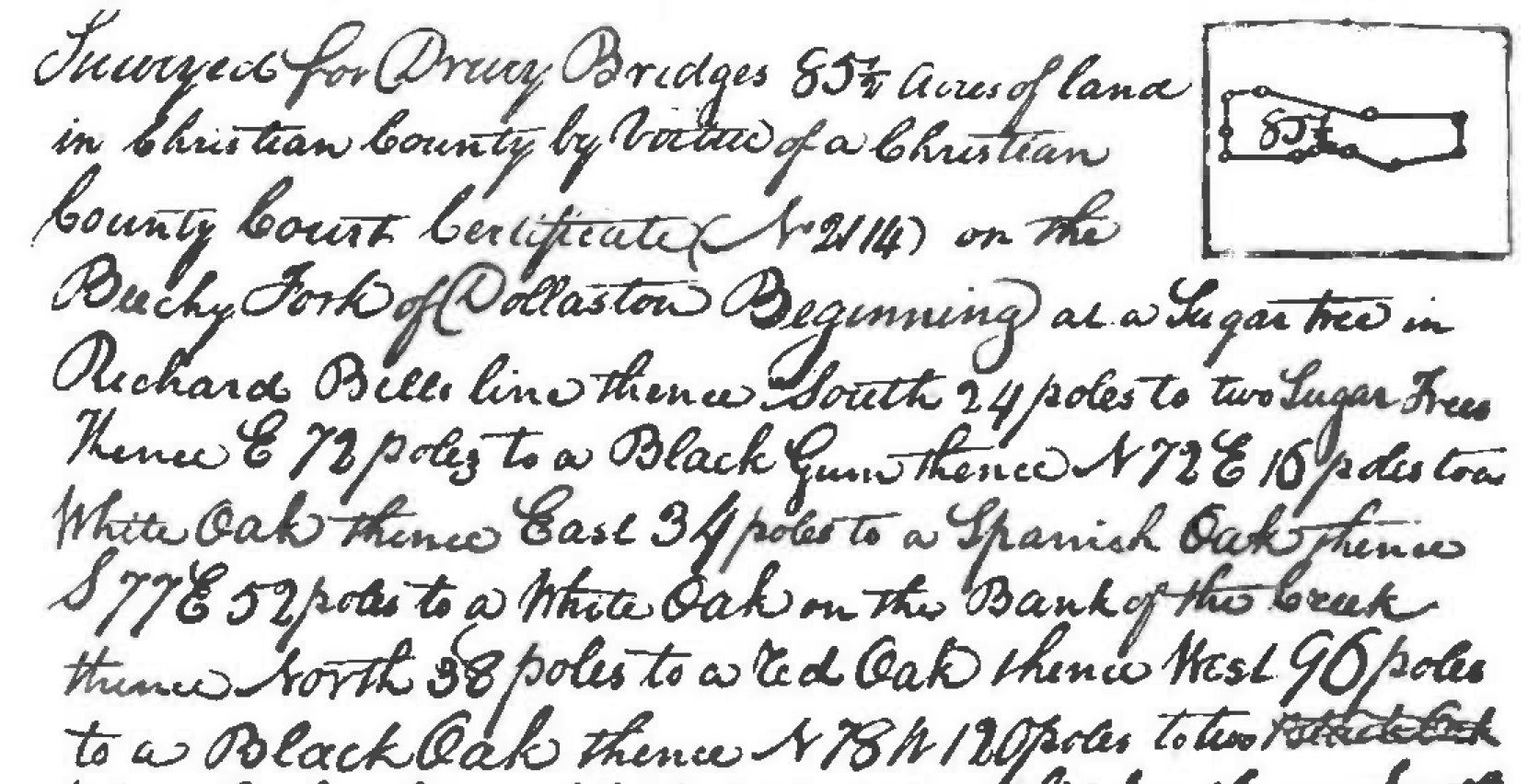
After his arrival in Christian County, Ky., Drury Bridges acquired an 85 1/2 acre tract of land on Beechy Fork Creek. Surveyed “. . .by virtue of a Christian County Court certificate No. 2114. . .” on Nov. 16, 1804, the land was described as “. . .Lying being in the County of Christian on the Beechy Fork of Dollatson (Donaldson) and bounded as followeth, to wit: Beginning at a sugar tree in Richard Bell’s land thence South 24 poles to two sugar trees thence East 72 poles to a black gum, thence North 72 east 16 poles to a white oak thence east 34 poles to a Spanish oak thence south 77 east 52 poles to a white oak on the bank of the creek, thence N38 poles to a red oak thence west 96 poles to a black oak thence north 78 west 120 poles to two white oaks, thence south 80 west 44 poles to a stake thence south 40 poles to the beginning. . .” Drury’s acquisition of the property was recorded in the State Land office at Frankfort, Ky., in “Land Grants South of the Green River,” on January 6, 1815.11
Beechy Fork Creek originates high in the hills bordering the northern part of the Donaldson Valley and runs west some five miles through a picturesque but smaller valley, then almost due south to a confluence with Donaldson Creek only a few miles before it empties into the Cumberland River. The mouth of Beechy Fork Creek today is covered by the waters of Lake Barkley, which also covers the lower third of the length of the Donaldson Valley. The area where Drury Bridges settled was entirely different from the flat to rolling area around the Tyancoca Swamp in Edgecombe County, North Carolina, and probably looked much more attractive to Drury and his family despite the hardships and uncertainties of life in the wilderness.
On March 3, 1822, Drury Bridges acquired two more land grants, one for 225 acres and the other for 50 acres, in the same general vicinity of his original land acquisitions.12 Later he purchased more land, ultimately acquiring approximately 700 acres, all in the area on both sides of Beechy Fork Creek surrounding his original homestead.
Drury and his wife Charity and their four North Carolina born children, settled down in a log cabin on the north side of Beechy Fork Creek to make their home in Kentucky. Two more children—Elizabeth and Mary—were born there.
Drury took a prominent part in the affairs of Trigg County after it was formed in 1820. There is no record of his formal education, but he was quite well educated for his time, apparently in a school somewhere in the Fishing Creek and Tyancoca Swamp communities of Edgecombe County, North Carolina. In Kentucky he was often called upon by his neighbors and others in the community for help with their business transactions. When the Donaldson Creek Church was organized in 1814 (See Chap. 4) Drury, along with his wife, Charity, and their twin daughters Piety (Bridges) Brunk, and Selethia Bridges, were among the 27 charter members. Also included in the group were Charity’s brother, Joel Cohoon, and members of his family.
In his later years, Drury Bridges was disabled by a stroke making it necessary for him to use crutches for the remainder of his life. He died June 13, 1840 at the age of 74.
No will nor inventory of the property of Drury was ever recorded in the Trigg County court, and apparently, after he died, his widow and surviving children simply divided the estate among them. Accounted for however were two tracts of land totaling 212 1/2 acres which the daughters and their husbands collectively sold to William Bridges, Drury’s only living son. This transfer of deeds, recorded in the Trigg County court13 reads:
’This indenture made and entered into this 13th day of August 1840 between Noah Brunk and his wife Piety Brunk, Joel Futrell and his wife Selethia Futrell, Allen Sholar and his wife Jemima Sholar, Perry Thomas and his wife Elizabeth Thomas, and Starkey Thomas and his wife Polly Thomas, heirs and devisees of Drury Bridges decd of the County of Trigg and State of Kentucky of the one part, and William Bridges of the county and state aforesaid of the other part, witnesseth that the said Noah Brunk and his wife, Joel Futrell and wife, Allen Sholar and wife, Perry Thomas and wife and Starkey Thomas and wife for and in consideration of the relationship and the good will they bear to the said William Bridges, have granted, released, conveyed and confirmed to the said Bridges his heirs and assigns forever, all our interests in one certain tract or parcel of land situated and being in the county and state aforesaid on the Beechy Fork of Donaldson Creek containing 112 1/2 acres, be the same more or less bounded as follows (to wit) beginning at a white oak in the upper line of 113 1/2 acre survey made for John Wilson thence N33 E145 poles to a dogwood and black gum, thence NW40 poles to 2 black gums, thence N83 E 28 poles to an ash and elm thence S 30 E 30 poles to a white oak and Spanish oak, thence S 84 E 46 poles to two white oaks, thence S 31 E 13 poles to a hickory and white oak, thence 80 E 58 poles to a large poplar and white oak thence S 10 W 50 poles to a large ash in the edge of a drain, thence W 110 poles to a branch thence S 30 W to a beech and white walnut in said Wilson’s survey and corner thereof, thence with said Wilson’s line N 63 W 60 poles to the beginning.
(Excepted were three acres that Drury had previously sold to William Elder, and the growing crop Drury had already started on his land.) Witnesses were William Pritchard and John Martin. The purchase price for this tract was not listed.
Eight days later, August 22, 1840, William Bridges bought an additional 100 acres of adjoining land from his sisters and their husbands under the same conditions as specified in the first deed. That purchase price was $250. Witnesses were Archibald Cohoon and John Martin. Both deeds were recorded with Trigg County Court Clerk J. E. Thompson on September 5, 1840. The deeds were examined and purchase price delivered to Stanley Thomas on behalf of the heirs on February 3, 1841.
There is nothing on record indicating that any other part of Drury’s property was disposed of, so it is assumed that his widow, Charity (Cohoon) Bridges, continued to live at the homestead.
Charity outlived Drury by 12 years and died October 16, 1852 at the age of 81. Both are buried in the Bridges family cemetery about 100 yards from their original Kentucky homesite and their gravestones are still in an excellent state of preservation. The original 85 1/2 acre tract and surrounding lands, are still in the hands of their descendants.
When Charity died, her son-in-law, Perry Thomas, was appointed by the Trigg County Court as administrator for which he posted an $8,000 bond. T. M. Ingram, Moses Thompson and Cullen Thomas, Perry’s brother, were appointed appraisers. Their appraisal, dated Nov. 16, 1852, was filed with County Clerk A. S. Dabney, on Dec. 13, 1852.14 Among the items listed were: 12 chairs, a dining table, one clock, press, sets of dinnerware, glassware and silverware; several pewter dishes, set of candlesticks, a candle mold, one lot of stoneware, two demijohns, several churns, two flat irons, one coffee mill, a loom and fixtures; two spinning wheels and reels, two baskets of flax, a bag of dried fruit, one lot of cotton, one scythe and cradle; 114 bushels of corn, six stacks of oats, one log chain, one ox cart, two axes, one gun, four large troughs, one barrel of salt, three plows and two sets of gear. Livestock included 11 head of cattle, 10 sheep, 19 hogs, six shoats, three mares, two colts, one yoke of oxen, eight geese and 20 chickens.
Seven slaves and value listed, were: Lewis, $250; Norris, $250; Sam $800; Misemi, $600; Nancy, $450; Mary, $450, and Eliza Ann, $150, a total of $2,950.
Also included in the inventory were notes due from several relatives and neighbors in the amount of $357.51, and $204.00 in cash.
Perry Thomas filed his settlement with the court on November 14, 1853, two days less than a year after the appraisal had been filed, and closed out the estate of Drury and Charity (Cohoon) Bridges, one they had begun in 1804 some 49 years earlier when they arrived from North Carolina with their children to make for themselves a home in the wilderness.
Collectively the seven children of Drury and Charity (Cohoon) Bridges, had 53 children, who in turn had 221 children. These 221 children had 884 children. By the fifth generation, Drury and Charity Bridges had over 3,500 descendants. The majority of these descendants also claimed James and Mary Thomas as their ancestors.
The Children of Drury Bridges and Charity (Cohoon) Bridges
Piety and Selethia Bridges
Piety and Selethia, twin girls, were born Nov. 26, 1790 in North Carolina. The oldest children of Drury and Charity, they came to Kentucky with their parents in 1804. Piety married Noah Brunk in Christian County, Kentucky, June 3, 1813, with Dudley Williams as the officiating minister; it was the second marriage for both. She and her husband had five daughters: Lucinda, Elizabeth, Jennie, Priscilla and Martha,15 Piety died in 1853.
Selethia, whose name also appears in various Christian and Trigg County records as Teletha and Leththa, married Joel Futrell in Trigg County on November 9, 1831. He was born November 29, 1802, the son of Shadrach and Charlotte (Johnson) Futrell, who lived on Donaldson Creek. She was baptized and became one of the original members of the Donaldson Creek church when it was organized in 1814. She had been a member of that church for 64 years when she died Dec. 9, 1879 at the age of 89. Her husband Joel was still living in 1880 and was listed in the census that year. The date of his death is uncertain.
Selethia was buried beside her parents in the Drury Bridges family cemetery near Drury’s original homesite on Maple Grove, and Joel was buried on Donaldson Creek although the exact spot is not known today.16 They had no children.
Orren Dates Bridges
Orren Dates, third child of Drury and Charity, was born Sept 7 1792 in North Carolina. However, he died prior to the time the family left Edgecombe County for Kentucky, and is buried somewhere in the Tyancoca Swamp community.
Jemima Bridges
Jemima, the fourth child of Drury and Charity, was born October 12, 1795 in Edgecombe County, North Carolina, on the plantation owned by Drury in the Tyancoca Swamp community. She was nine years old when the family came to Kentucky. She married Allen Sholar, October 20, 1812, in Christian County, Kentucky. Allen, born May 26, 1793 in Bertie County, North Carolina, was the son of Laodicea (Thomas) and Benjamin Sholar, of Bertie County, N. C. Allen and his cousin, Joshua Sholar, came to Christian County, Kentucky about 1806 and settled in the extreme eastern end of the Donaldson valley. Jemima (Bridges) and Allen Sholar were the parents of 11 children, six boys and five girls. They were:
- David, (b. Sept. 3, 1813; d: Jan. 6, 1860), married Temperance Lawrence, Nov. 28, 1842, three children.
- Pollie, (b. July 1, 1815; d. — ), married Ezekiel Lawrence, March 30, 1837, four children.
- Sarah, (b. July 6, 1817, no further data.)
- William B., (b. June 10, 1819; d. March 21, 1892), married Mary E. Hutts, Jan. 6, 1851, five children.
- Elizabeth, (b. March 17, 1821; d. — ), married James Henry Lawrence, Nov. 8, 1841, four children.
- Allen, (b. Aug. 22, 1823; d. Sept. 14, 1855), probably never married.
- Thomas, (b. Apr. 26, 1825; d. June 23, 1873), married Martha Jane Rogers, Jan. 4, 1848, eight children.
- Emily, (b. Jan. 20, 1827; d. Nov. 10, 1855), probably never married.
- Alpha, (b. Feb. 28, 1829; d. Jan. 16, 1914), married Thomas Allison Vinson, March 30, 1853, (his third wife), four children.
- Drewry Bridges, (b. May 16, 1831; d. Feb. 11, 1889), married: (1) Martha Jane Carr, Jan. 12, 1860, four children. (2) Helen Wiles, Dec. 24, 1871, seven children.
- Peyton, (b. July 25, 1834; d. Dec. 20, 1883), married: (1) Frances Etna Vinson (no date), three children. (2) Martha Calhoun, Oct. 4, 1874, two children.
Jemima (Bridges) Sholar died July 22, 1877; Allen, her husband, died Jan. 29, 1853. Both are buried in the James Thomas cemetery located about 50 yards west of the original Cullen Thomas homesite on the south side of Donaldson Creek.17
William Bridges
William was born on the Bridgers plantation in the Tyancoca Swamp community of Edgecombe County, North Carolina, on May 30, 1800, and was four years old when the family migrated to Kentucky. He grew up on his father’s farm in the area now known as Maple Grove, the only son of Drury and Charity (Cohoon) Bridges to grow to maturity, and he did a remarkable job of perpetuating the family name. On June 20, 1820, the same year that Trigg County was formed, he married Mary Thomas, youngest daughter of James and Mary (Standley) Thomas. They had 12 children, nine boys and three girls. Through the issue of six of these nine sons, the Bridges name today is not only well established in Trigg County, but also throughout the United States. The 12 children were:
- Orren D., (b. June 27, 1821; d. Apr. 27, 1904), married Mary Elizabeth Hixon, May 27, 1848, 12 children.
- Starkie T., (b. Feb. 15, 1823; d. Nov. 15, 1896), married: (1) Minerva Hixon, Dec. 28, 1852, (sister of Orren’s wife), one child. (2) Elizabeth W. Lawrence, June 3, 1862, eight children.
- Simco N., (b. Jan. 17, 1825; d. Nov. 1, 1901), married Emeline Martin, Apr. 11, 1848, nine children.
- Drewry, (b. Jan. 20, 1827; d. July 4, 1916), married; (1) Peaches Ann Tart, Oct. 25, 1849, 11 children. (2) Nannie Gresham, June 13, 1887, two children.
- Burnetta, (b. Mch. 5, 1830; d. Jan. 2, 1844, age 14).
- James C., (b. June 14, 1832; d. Apr. 20, 1863), married Mary Calhoun, Dec. 10, 1855, four children.
- William (b. Oct. 3, 1834). Never married. On July 1, 1861, at age 27, enlisted in Confederate Army; reported for duty Sept. 14, 1861, Camp Burnett, Tenn. Assigned Co. G, Fourth Regt. Ky. Brigade, served as a musician. Transferred to Co. 1, Jan. 1862, saw service Ft. Donelson, only 15 miles from home, later at Shiloh and Vicksburg. Died Apr. 22, 1862 of illness, Castillion Springs, Miss., where he is buried.18
- Stanley, (b. Feb. 14, 1837; d. July 17, 1838).
- Mary Adeline, (b. Apr. 23, 1839; d. July 9, 1912), married Thomas A. Hixon, July 30, 1860, (brother of wives of Orren and Starkie), nine children.
- Charity S., (b. May 2, 1842; d. June 25, 1908), married James J. Battoe, Oct. 15, 1859, two children.
- John, (twin of Charity, died at birth.)
- Cullen T., (b. Aug. 12, 1844; d. Apr. 15, 1913), married Virginia Ann Thomas, Nov. 9, 1863, ten children. At age 17, Cullen enlisted in Confederate Army and served under Col. Thomas Woodward, commander of a division of the 2nd Kentucky Cavalry, under Gen. N. B. Forrest.19 Saw service at Fort Donelson along with his brother William, and was with his division until it disbanded prior to the end of the war.
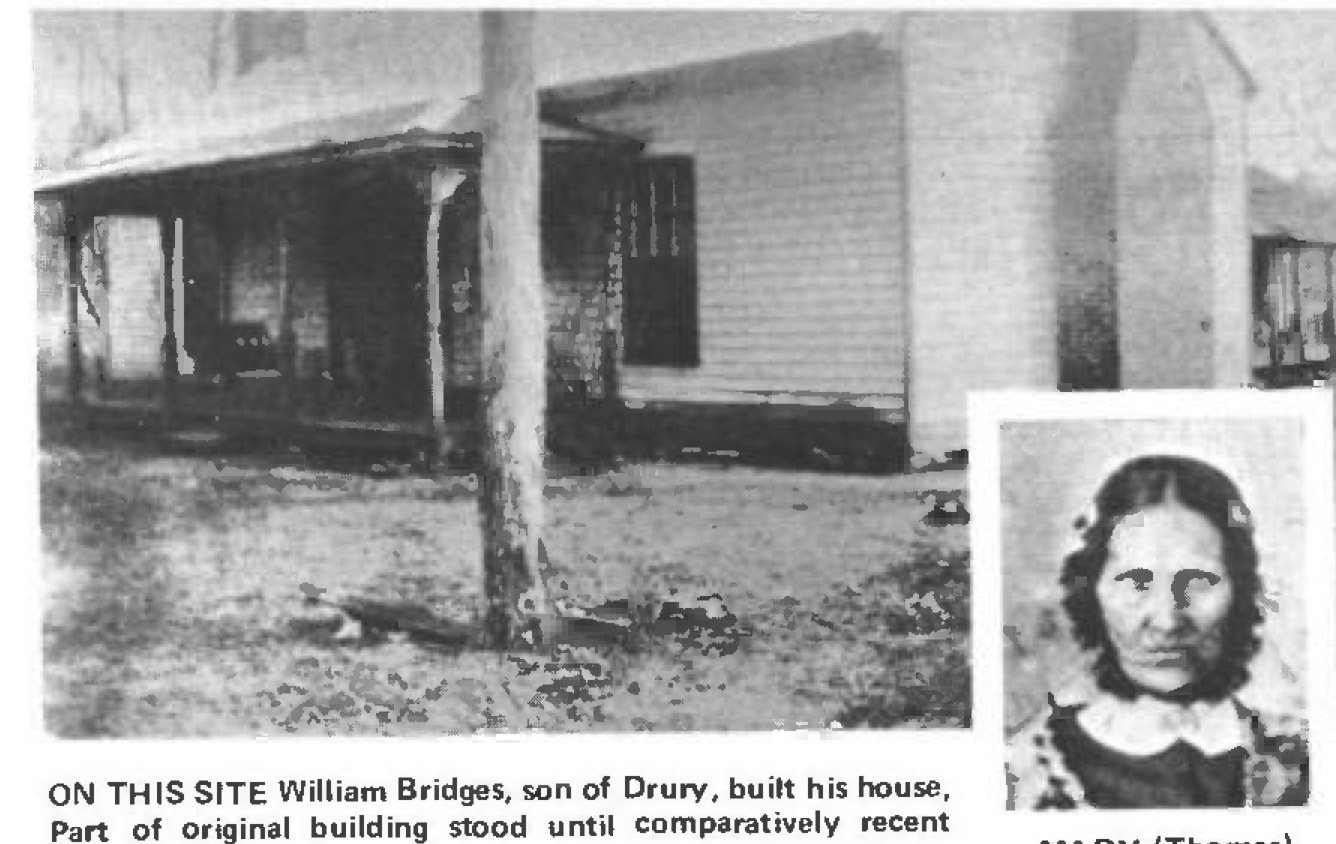
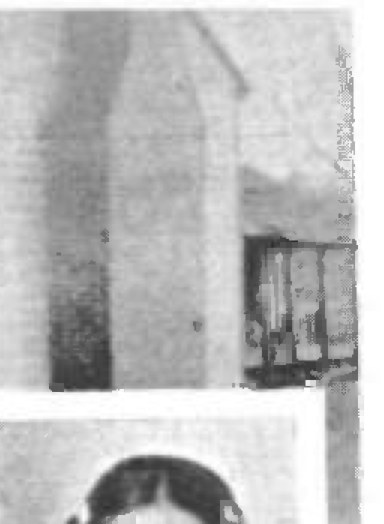
William Bridges settled on a farm about two miles west of his father’s original homestead near what is known as “Little Spring.” at a point where Beechy Fork Creek turns southward toward its confluence with Donaldson Creek. He died there July 11, 1844, at the age of 44.
William left no will, and James Thomas, Jr., his brother-in-law, was appointed administrator to settle his estate. On Sept. 27, 1844, an inventory and appraisal of the personal estate and slaves of William Bridges was filed with the Trigg County Court. Listed were many items of household goods along with saddles, bridles, harness, stands of bees, a copper still and lot of barrels, grindstone and cradle, small mare valued at $25; one blind mare and colt, $20; six head of cattle, 16 head of sheep, plows, guns, 100 barrels of corn in the field, and a note on Futrell, first name not given, and C. Elon on which a balance of $40 was due.
The slave inventory included: Daniel, age 46, valued at $400; Rachael, 32, and four-months-old child, $400; Burrell, age about 15, $450; Jack, age 12, $350; Jacob, age 10, $250; Hasty, age 8, $200; Liney, age 5, $225; Silcy, age 3, $100, for a total of $2,375.
Witnessess to filing of the inventory were Stanley Thomas, Starkie Thomas, Joel Sumner and Archibald Cohoon. It was approved and recorded May 12, 1845.20 The estate was not completely settled however, until Nov. 10, 1855.21
William’s wife, Mary (Thomas) Bridges, who was born in 1802 in Bertie County, North Carolina, died in Trigg County, July 28, 1876, at the age of 74, outliving her husband by 32 years. Both are buried in the family graveyard located on a hillside adjacent to the house where they lived. The author of this work is descended maternally from William through his youngest son, Cullen T. Bridges, and Cullen’s oldest daughter, Ora Agnes, who married Robert H. Thomas, grandson of James Thomas, Jr.
Elizabeth Josephine Bridges
Elizabeth was born October 29, 1804, shortly after the family arrived in Kentucky and was the first of the family to have been born in the state. She married Perry Thomas, third son of James and Mary (Standley) Thomas. They had 14 children. (For additional details, see Chapter 10.)
Mary Bridges
Mary was born in Christian County, Ky., July 25, 1807, in the original log cabin built by Drury Bridges on the north side of Beechy Fork Creek. She was the youngest child. Mary married Starkie Thomas, fourth child of James and Mary (Standley) Thomas. They had 11 children. (For additional details, see Chapter 10.)
NOTE: Data in the handwriting of Drury Bridges, his daughter Elizabeth and her husband Perry Thomas, from collections of Allison Thomas, Linda Koch and Agnes Wilburn, are sources of birth and death dates of Drury and Charity’s children.
G. A. Bridges Family History, 1928.↩︎
Perrin’s History of Trigg County, page 109.↩︎
The R was dropped by the family before Drury left North Carolina.↩︎
Edgecombe County, N. C., records; 1790 census.↩︎
G.A. Bridges Family History, 1928, in which the author calls one sister Sylvester. Records in Montgomery County, Tenn., seem to substantiate the fact that her name was Sylvias.↩︎
Census, 1820-1840, Montgomery, County, Tenn.↩︎
Montgomery County, Tenn., Will Book G, pages 155-156.↩︎
Ibid, pages 159,160.↩︎
Ibid, pages 368, 369.↩︎
G. A. Bridges Family History, 1928.↩︎
Book 16, page 127.↩︎
Book L, pages 22, 23.↩︎
Trigg County Deed Book G, page 441.↩︎
Trigg County Will Book D, page 207.↩︎
Noah Brunk’s first marriage was to Matilda Raburn, Dec. 20, 1810. Piety’s first husband was named Sikes; nothing else is known about him.↩︎
G. A. Bridges Family History, 1928.↩︎
Jemima’s data from records of Miss Mary Hamilton The birth dates are from a small “memo book” found in her grandfather Drewry Bridges Sholar’s papers after his death.↩︎
General Services Administration, National Archives and Records Service, Washington, D. C.↩︎
Kentucky Historical Society, Frankfort, Ky. Data also on Cullen’s gravestone in family cemetery on Maple Grove.↩︎
Trigg County Will Book C, page 111.↩︎
Trigg County Will Book D, pages 549-550; 562-563; 634.↩︎