← The Thomas and Bridges Story, 1540–1840
Chapter XII: Origin of the Thomas family in Wales
Even with an American family line that goes back nearly 370 years, one still wonders where the Thomas family originated. It came to America with John Thomas in 1610, but where did John Thomas come from?
It is recorded that he boarded the sailing ship, Sea Venture, in England, either at Wookwick, near London, the Port of Embarkation, or at Plymouth where the ship docked to take on the last of its 150 passengers and join the fleet of the “Third Supply” before sailing for Jamestown, Virginia, on June 2, 1609. But moving back into history from that date, we have no documented proof of John Thomas’ lineage.
Preliminary research in England a few years ago1 in an attempt to trace the Thomas line, indicated a Thomas connection in Radnorshire, Wales. This research, however, did not delve deeply enough into old records, and failed to reveal anything significant.
The most comprehensive documentation of the Thomas family line that I have been able to find is contained in a massive volume of several hundred pages called, appropriately enough, “The Thomas Book.” by Lawrence Buckley Thomas, D.D.2 Written in 1896, Dr. Thomas has traced the genealogy of Sir Rhys ap Thomas, Knight of the Garter, the various Thomas families that descended from him, and some of the allied families.
Needless to say, Dr. Thomas dug deep into the past to follow the lineage of the family that eventually originated the surname Thomas. He picked up the line about the year 500 A.D., with a British Prince named Urien Rheged. The author pointed out that the links connecting him with Sir Rhys ap Thomas, the Welsh ancestor of the American Thomases “. . .may not all be of equal certainty, but such conclusion is the uniform judgement of all writers upon Welsh history and genealogy.”3
The author goes into considerable detail about the genealogy of Urien Rheged, quoting as his source material, British and Welsh genealogical records, thus one need not question the authenticity of his research. Certainly it would take many months just to run down the footnotes he has used as references, even if one had access to these ancient Welsh and English records. Needless to say, the descendants of Urien Rheged, son of Cynvarch Oer (who was the son of Meirchion Gul), were active in Welsh history down through the centuries.4
One descendant of Urien Rheged, named Nicholas ap Philip, who lived in Caermarthenshire, Wales, was said to have possessed an ample fortune and appeared to have owned considerable property in Caermarthen town.5 He was described as being “. . .of hasty spirit and violent temper, that often involved him in complications with his neighbors, from which it required the exercise of all his ingenuity to extricate himself. . .” Certainly those of us who know our Thomas line well, can see some of our own traits in this brief description.
The surname Thomas as it affects the Thomases of Trigg County, did not emerge until about the year 1400 A.D. However, it had been popular as a given name since the Battle of Hastings in 1066 A.D. The above-mentioned Nicholas ap Philip, had a son named Gruffyd ap Nicholas. He in turn has a son which he named Thomas ap Gruffyd, and who succeeded his father as head of the household and became the first of the family to bear the given name Thomas. He was described as a man with a character very different from his turbulent father, and one of the most accomplished gentleman of the age. It was said that his mild disposition and elegance of manners was rarely found in those cruel times of civil warfare. Certainly many of us today would like to think that we too inherited some of his good traits. He was very proficient however, as a participant in various tournaments so prevalent in those days when men gathered and demonstrated their prowess with various implements of war. Thomas’ strong point was dueling with the sword. While resting after a duel in which he had slain his opponient, he was trecherously run through the body and killed by one of his victim’s seconds. Thomas ap Gruffyd was buried in the Abbey of Bardsey, Caermarthenshire, Wales.
Thomas ap Gruffyd married Elizabeth, daughter of Sir John Griffith. His second wife was another Elizabeth. He had nine children by his first wife, the fifth of whom was a son, Rhys or Rees, who eventually became his father’s favorite and heir.
Rhys ap Thomas was born in 1449, over 40 years before Columbus discovered America. He was educated at the Court of Burgundy where he held a post of honor in the Duke’s household. When his father was banished to Wales, however, he gave up that post and went with his father. An anonymous author of a biography of Rhys ap Thomas, who seemed to have become carried away by his enthusiasm, said of the family: “. . .they were the best born gentlemen in Wales, and furtherest spread in their branches of any family in England. . .His home and hospitality were in every respect suitable to his immense wealth and displayed the magnificence of a prince rather than of a private gentleman.” This trait, except the wealth, remains true among the Thomas descendants today, and the sharing of hearth and home of the Thomases of Trigg County, has been recalled by many from the pioneer days of 1806 to the present.
Rhys ap Thomas figured in a number of historic battles while playing his part against the broad backdrop of the history of Wales. One of these battles took place August 22, 1485 on the field of Bosworth near Leicester, and included as opponients, King Richard III and the Earl of Richmond.6 According to tradition, Rhys ap Thomas slew King Richard just as the latter was closing in to slay the Earl of Richmond. The Earl was so grateful to Rhys ap Thomas for saving his life that he knighted him on the field after the victory. After further engagements over the next 20 years, during which time he displayed his courage and loyalty, Sir Rhys ap Thomas was, on April 22, 1505, elected a Knight Companion of the most noble Order of the Garter and occupied the 12th stall of the sovereign’s side in St. George’s Chapel, Windsor, where his Garter plate still remains.
During those years, Sir Rhys (sometimes spelled Ryce or Rice) held various official positions and appointments and had served as mayor of Caermarthen in 1488, 1494 and 1500.
He made his will February 2, 1524-25, and died that year at the age of 76, the will being probated July 5, 1525. He was buried in the Church of the Grey Friars at Caermarthen, but his body was afterwards removed to the eastern aisle of St. Peter’s Church in the same town. His monument, a sculptured block, surmounted by recumbent figures of Sir Rhys and his last wife, Elizabeth Herbert, is said to be the most remarkable the church contains. This monument, restored in 1865, was moved to a position under the arch between the chancel and the consistory court, and contains the effigy of Sir Rhys and Elizabeth on a slab 10 feet long by three feet wide by two inches thick. He is shown lying in an attitude of prayer, clothed in mail and chain armor.
According to Dr. Thomas, Sir Rhys ap Thomas was married more than once, and it is difficult to state with absolute certainty his marriage relations. His first wife, Eva, already mentioned, bore him a son. She apparently died young and his second wife, Gwenllian, was the sister of an intimate friend, Robert ap Gwylim. She was mother of nine of his children and descendants of some of them migrated to America in the 1600’s, among them, John Thomas, ancestor of the Thomases of Trigg County. Third wife was Jenet, daughter of Thomas Matthews. She too was mother of several of his children. His fourth and perhaps his last wife, was Elizabeth Herbert, sister of William Herbert, first Earl of Pembroke.
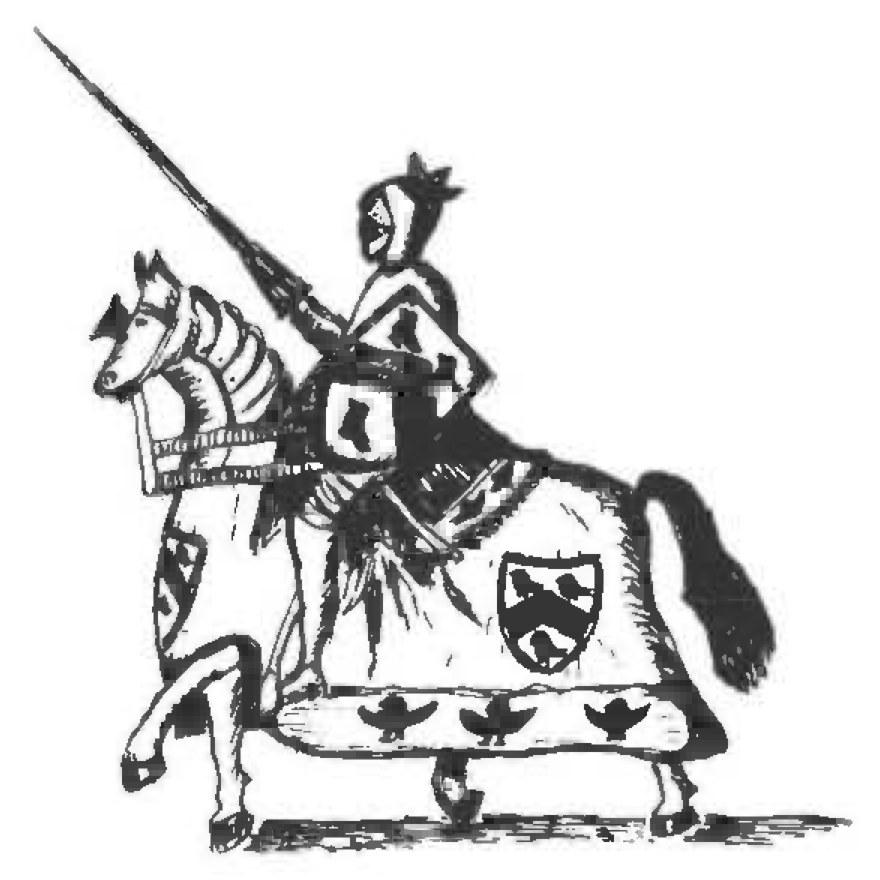
By the time Sir Rhys ap Thomas died in 1525, his descendants had already adopted Thomas as their surname and it had become quite prevalent in Wales. It is this reason among many others, that tracing in detail the line of John Thomas, who emigrated to Virginia in 1610 would be an enormous and time consuming task. It has been estimated that John Thomas was born about 1585 or 1590. Thus, in descending from Sir Rhys ap Thomas, he likely would have been either a grandson or a great grandson. The fact that Sir Rhys’ Coat of Arms was brought to America by the very first Thomases certainly indicates a lineal connection.
Although the exact genealogical line may never be completely documented, the Thomases of Trigg County can look back with pride upon a line of descent that spans nearly 1500 years.
Correspondence between H. M. Thomas, Grundy, Va., and G. P. Willson, 64 Princess Way, London, England.↩︎
Published by Henry T. Thomas Co., New York City, 1896. Copy in Library of Congress, Washington, D. C., and Tennessee State Library, Nashville, Tenn.↩︎
References to Dr. Thomas’ account used throughout this chapter can be found in the first 29 pages of his book.↩︎
To clarify the use of the Welsh word “ap” one should remember that it means “son of.” If the reader will use it in this sense, he will be able to follow the line and see how the surname Thomas came into being. Even after surnames were accepted as permanent, the word “ap” continued to be used in many instances after some of the Thomas family came to Virginia. Eventually it was dropped by all U.S. descendants.↩︎
Caermarthen in Caermarthenshire is on the north side of the Bristol Channel in the southern part of Wales. Across that channel is Devonshire, England, in which is located Plymouth, the port of embarkation of the Sea Venture when it left for Virginia in 1609. Nearness of Caermarthen to Plymouth — only a few days journey by boat around Land’s End — lends strength to the theory that John Thomas left from there instead of London.↩︎
The Earl of Richmond became Henry VII and succeeded Richard III as King of England. His accession to the throne marked the end of the War of Roses and the beginning of what is considered the modern period of English history. —The Columbia Encyclopedia, page 882.↩︎