← The Thomas and Bridges Story, 1540–1840
Chapter VI: Thomas descendants in 17th century Virginia
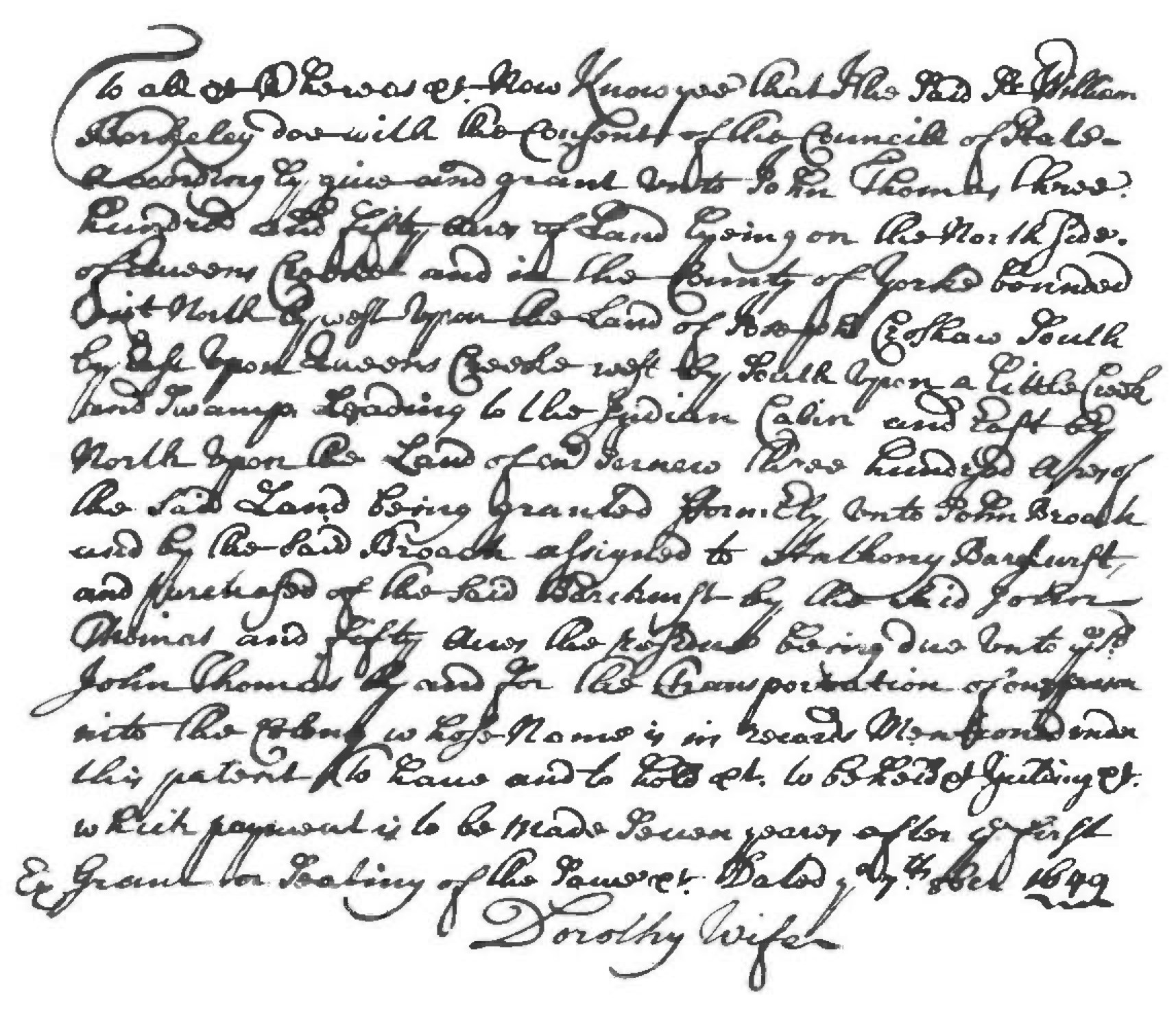
After a safe arrival in Virginia following his experience during the wreck of the Sea Venture, apparently John Thomas set to work in earnest in order to redeem his own headright and, if possible, acquire others so he could patent land for himself. On October 7, 1649 he was granted a land patent by Sir William Berkeley, the governor of Virginia. The patent contained 350 acres of land on Queens Creek in York County, Virginia.1
The patent reads, with original spelling:
“To all ct. whereas ct. now know yee that I, the said Sir William Berkeley doo with the consent of the councill of State—accordingly give and grant unto John Thomas, three hundred and fifty acres of land lyeing on the north side of Queens Creeke and in the County of Yorke bounded vizt: north by west upon the land of Joseph Croshaw south by east upon Queens Creeke, west by south upon a little creek and swamp leading to the Indian cabin and east by north upon the land of M. Jernew, three hundred acres of the said land being granted formerly unto John Broach and by the said Broach assigned to Anthony Barckurst, and purchased of the said Barckurst by the said John Thomas and fifty acres the residue being due unto ye sd John Thomas by and for the transportation of one person into the Colony whose name is in records mentioned under this patent to have and to hold ct. to behold ct. yielding ct which payment to be made seven years after ye first ec grant or sealing of the lawe ct. Dated ye 7th 8ber (October) 1649. Dorothy wife.”2
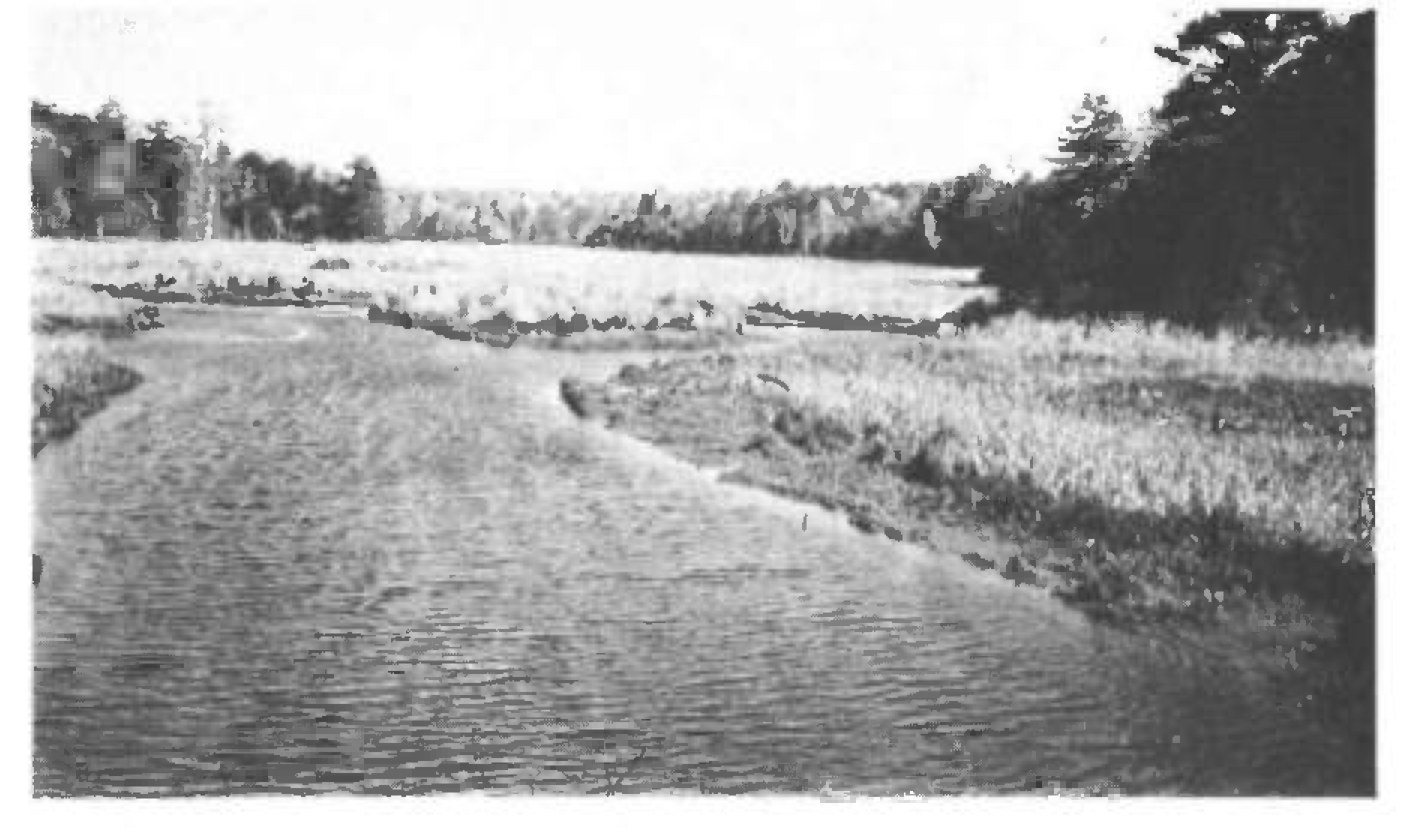
John Thomas and his wife Dorothy settled on his 350 acres of land which was located near what is now the city of Williamsburg, Virginia. Today it is a part of a military reservation and not accessible to the public. However, the general area can be plainly seen from a concrete bridge that carries State Road No. 132 across Queens Creek. The area lies on the east or right side of the creek as one looks upstream.3
Understandably, we know very few vital statistics about John Thomas. He was born about 1585, certainly not later than 1590, probably in Carmarthenshire, Wales. He died before 1653 in York County, Virginia, having lived approximately four years on the land he had patented on Queens Creek. He and his wife Dorothy had five sons all of whom settled in the area around John’s original land patent.4 Available records do not disclose whether John and Dorothy Thomas were married in Wales or England before they came to Virginia, whether they were married in Virginia, or whether perhaps Dorothy came later’ with the children. The time element involved leaves it open for question in either instance.
Sons of John and Dorothy Thomas were:
A. John Jr: (it is through John Jr., the Trigg County Thomas line descends); B. Phillip, m. Sarah McKennie; C. Richard; D. William, (one source indicates another son, Marke.) These sons each grew up and settled in the area on Queens Creek but later migrated to Isle of Wight and Nansemond counties.5 All of the sons married and raised families.
A. John Jr., married, wife’s name not recorded. They had six children:
- Richard, born about 1629, married Elizabeth Marshall about 1647. The Trigg County line descends through Richard.
- William, married twice. His first wife’s name was Christian, and his second wife was Priscilla Jordan. He died Feb. 17, 1719.
- John, Esq., married, had a son John Jr., who married Hannah Dawson.
- Elizabeth, married John Sanders.
- Sarah, married Jonathan Robinson in 1681.
- Katherine, married Thomas Oglethorpe who died 1687. They had three children — Katherine, Sarah and Margaret.
B. Phillip, who probably married Sarah McKinnie, had eight children: Evan, Joseph, Michael, Robert, John, Phillip, Jr., Mourning and Priscilla.
C. Richard, had three children: Richard Jr., John and William.
D. William, had eight children: William Jr., married Elizabeth Hill, daughter of Major Nicholas and Sylvester (Bennett) Hill; Humphrey; Simon; Gabriel; John; Priscilla, who married Humphrey Marshall; Rebecca, who married William Harrison, and Elizabeth, who married Thomas Hill.
While John and Dorothy Thomas’ sons were growing up, life moved leisurely along at the Jamestown settlement. The people dealt with the Indians, made friends with Chief Powhatan, and found the tribes around them to be rather friendly but unpredictable. It was while on a trading expedition along the Potomac River that Captain Samuel Argall captured Powhatan’s daughter, Pocahontas, and brought her back to Jamestown as a prisoner. Pocahontas was no stranger to the people at Jamestown as she had visited there many times. Her father refused to pay the ransom price for her release, so she was detained at Jamestown. Later she decided that she liked the English and expressed a desire to live with them instead of returning to her native village.6
She was instructed in the religious faith and eventually baptized. On April 5, 1614 some 200 years before John Thomas’s descendants would organize a church on Donaldson Creek in Christian County, Ky., Pocahontas and John Rolfe were married in the Jamestown church by Rev. Alexander Whittaker. The event was of such widespread interest that just about everyone in the little colony turned out for it, including, in all probablity, John and Dorothy Thomas.
Tobacco soon became the principal crop in the Jamestown settlement and the immigrants began to expand their plantations to take care of this new and strange plant they could sell for cash. Clearing land on the banks of Queens Creek, John Thomas began raising tobacco, and perfected a system that has been handed down through his descendants to those now living in Trigg County, Kentucky.
By 1630 when Sir John Harvey returned to Jamestown as Royal governor, the third generation of Thomases was being born in Virginia.
By 1647, just two years before his great grandfather John Thomas patented his own land on the York River, Richard Thomas, son of John Jr., married Elizabeth Marshall, daughter of Humphrey Marshall. This is evident from his own will dated April 8, 1687, and the will of his father-in-law, Humphrey Marshall in 1711, in which Marshall leaves a bequest to his daughter Elizabeth and to her son John Thomas.7 Humphrey Marshall owned property in York County adjoining John Thomas, Jr., and in the same general area where lived John Thomas, Sr., the original emigrant.
The children of Richard Thomas (son of John Thomas, Jr., grandson of John Thomas of Wales) and Elizabeth (Marshall) Thomas, were:
- John, born about 1648; married twice. The Trigg County line descends through John.
- Phoebe, married John Winborn.
- Sarah, likely died young.
- Elizabeth, never married.
John Thomas, the only son of Richard and Elizabeth (Marshall) Thomas, was about 28 years of age during the time of Bacon’s Rebellion (1676). I found nothing to indicate whether or not he participated in that Rebellion, although Joseph Bridger, Jr., ancestor of Drury Bridges did. (See Chap. 14). However, as the result of it, the original settlement at Jamestown was burned in the summer of 1676. John lived to see the city rebuilt however, but one can imagine the shock that the entire community felt when the state house was burned October 31, 1698, taking with it in the flames, the few remaining records of the early settlement.
After that, the seat of government was moved to Middle Plantation (later named Williamburg) and before many years the first permanent English settlement in America was only a memory. It had lasted approximately 90 years.
John Thomas was married twice. First time, prior to Bacon’s Rebellion, in 1673, was to Susannah (Portis) Frizzell, daughter of John Portis, who died April 7, 1703. John Thomas’ second wife was Mary Lawrence, daughter of John Lawrence, ancestor of the Lawrence family line that later settled in Trigg County, Ky.8
John Thomas had the following children, probably by his first wife:
- John Jr., married Elizabeth Kearney.
- Richard, married daughter of Michael Rogers; their children were: John, Mary, Elizabeth and Richard.
- William, married Martha Robinson.
- Joseph, born about 1680; married (1) Elizabeth ; (2) Alice Spivey. The Trigg County line descends through Joseph and his second wife.
- Phillip, married Ann
- Barnaby, married Sarah Dawson; they had a son Elisha. He died Oct. 5, 1735, she died that same year.
- Elizabeth, married (1) John Boddie; (2) John Dawson, son of Henry and Martha (Martin) Dawson.
John Thomas and his family moved to Nansemond County, Virginia, probably from Isle of Wight, as both he and John Jr., were on the Quit Rent rolls for Nansemond County in 1704.9
Reviewing at this point, the Thomas line, from the arrival of John Thomas at Jamestown, Virginia in 1610, to Joseph Thomas, who settled in Bertie County, North Carolina in 1729, we find:
John Thomas of Wales, and wife Dorothy, had at least four sons, one of whom was John Jr.
John Thomas, Jr., married, wife’s name not known. They had six children, three sons, including Richard, and three daughters.
Richard Thomas married Elizabeth Marshall. They had four children, one son, John, and three daughters.
John Thomas was married twice. His first wife was Susannah (Portis) Frizzell; his second was Mary Lawrence. He was the father of seven children, probably by his first wife. His family included six sons, one of whom was Joseph, and one daughter.
Joseph Thomas moved from Nansemond County, Virginia and settled in Bertie County, North Carolina in 1729.10
Nugent, page 185.↩︎
Virginia Land Patents, Book 2, page 188.↩︎
Excerpt, letter from Joseph F. Inman, genealogist, Richmond, Va: “. . .on map of York County, Va., I have Indicated location of the land patented by John Thomas in 1649. The location is a matter of judgement to some extent since ‘a creek that leads to the Indian cabin’ is indefinite. By checking the compass and considering that no other creek without a name shows on the map, I believe the site marked is the right one. . .”↩︎
Nugent, pages: 45, 73, 128, 144, 171, 185, 186, 220, 267.↩︎
Fleet’s Abstracts, Vols. 24-25.↩︎
“Jamestown and Its Story,” page 17.↩︎
Isle of Wight County, Va., deed book 2, page 533. According to the book, “Bible Records of Early Edgecombe, N. C.,” by Ruth Smith Williams and Margarette Glenn Griffen, Dixie Letter Service, Rocky Mount, N. C., 1958, John Thomas instead of Richard was the husband of Elizabeth Marshall.↩︎
“Thomas & Bridges History, 1968,” by Gilbert N. Bridges, Uniontown, Ky., page 428, et seq.↩︎
Virginia Historical Magazine, 1921, Vol. 29, page 402. The Quit Rent roll, as explained in “The Thomas Book,” page 587 et seq, method of acquiring land in Colonial Virginia was: “by one of the ordnances adopted by the Virginia Company which was continued in force by the Crown, after the revocation of the charter every person removing to Virginia at his own expense with the intention to settle and remain there was entitled to 50 acres of land. The same rule extended also to every member of his family and a husband was entitled to the same number of acres for his wife and children.” All of these rights were called “headrights” and were assignable. A patent, or land so obtained, gave the grantee a fee simple estate in the land conveyed upon condition of paying an annual “quit rent” of one shilling for every 50 acres and of planting and seeding thereon within three years from the date of the grant.↩︎
The family charts included in this chapter, with corrections added, are based on Information found in the book, “Old Albemarle and Its Absentee Landlords,” by Worth S. Ray, and Isle of Wight County, Va., records.↩︎