← The Thomas and Bridges Story, 1540–1840
Chapter I: First Thomas to settle in what is now Trigg County
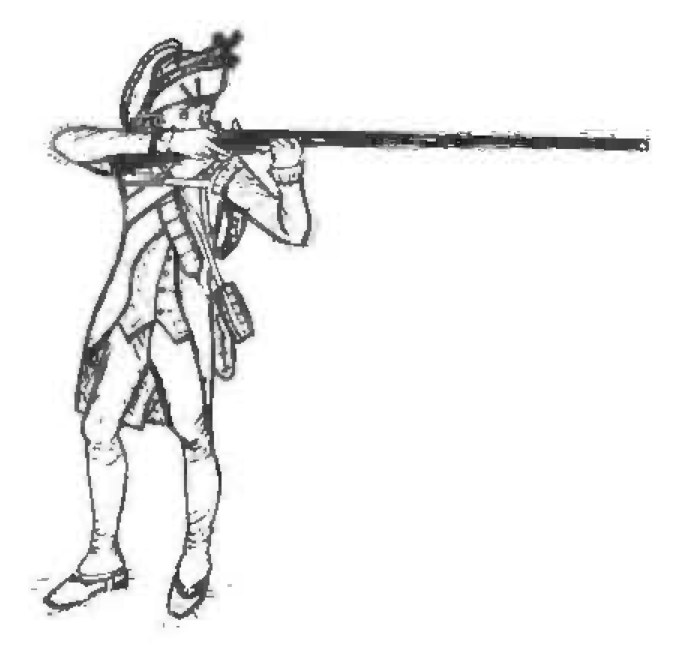
James Thomas II of Bertie County, North Carolina, was the first Thomas to settle permanently in what is now Trigg County, Kentucky.
When he migrated to the state in the summer of 1806, with his wife Mary (Standley) Thomas and their six children, the area on Donaldson Creek, which he chose for his home, was then a part of Christian County.1 Kentucky became a state in 1792 and Christian County was formed from Logan County in 1796. In 1820 Trigg County was formed from Christian County and a small part of Caldwell County.2
James Thomas II was born in 1762 in Bertie County, North Carolina, son of James Thomas, I, and Sarah (Barnes) Thomas.3 He grew up on part of the plantation that his grandfather Joseph Thomas had bought after migrating to North Carolina from Nansemond County, Virginia in 1728.4 The original plantation was located about five miles southeast of Windsor, the county seat, on the south side of the Cashie River.
When James Thomas I died in 1780, he bequeathed his estate to his seven children. James II, youngest of the three sons, and his mother, Sarah (Barnes) Thomas, inherited the plantation which consisted of over 400 acres.5
Some six months after his father died, James II became 19 years of age. At that time, the State of North Carolina, along with the rest of the Colonies, was at war with Great Britain—the Revolution. North Carolina furnished over 17,000 of its young men to serve in the Continental Army;6 James Thomas II was one of them.
He enlisted May 2, 17817 and served under the overall command of General Nathaniel Greene. He was assigned to the 10th Regiment, Captain Thomas Donoho’s Company, Col. Abraham Shepherd commanding.
Events of the war prior to James’ enlistment probably influenced him in his decision. The famed battle at King’s Mountain was fought in October 1780, just about a month before James Thomas I died. The battle of Cowpens took place January 16, 1781, and was followed March 15, by the battle at Guilford Court House, thus all North Carolina was in an uproar over a war that was taking place on its very doorsteps. Two months after the battle at Guilford Court House, James Thomas II enlisted.
He spent his time in service with General Greene’s army in skirmishes against the British, mostly in South Carolina. It has been said that Gen. Greene’s supreme contribution to the ending of the war was his army’s conquest of most of South Carolina and Georgia in 1781.
The war officially ended at Yorktown Virginia, in October 1781 but James Thomas II served until May 2, 1782 after which he returned home to the plantation on the Cashie River.
Affairs at the plantation had come to a virtual standstill during the year James had been away in the army. Ezekiel, his oldest brother, had married before the war and had a wife, a child on the way, and his own plantation to think about; certainly he could not have been expected to give adequate care to another plantation. Luke, James’ other brother, had moved away in 1777, three years before his father died. With only James’ mother, Sarah (Barnes) Thomas, and his three sisters at home, the plantation had become sadly neglected. Thus after his return, his big job was to get the run-down plantation back into production.
Another concern of James was Mary Standley, the girl he eventually was to marry. The Standley family was one of the early settlers in the Cashie River country, having lived there since before 1718, several years prior to the time Bertie became a county, and some 10 years before James’ grandfather, Joseph Thomas, had settled on property across the Cashie near the banks of the Roanoke. Likely James and Mary had grown up together; probably they had attended the same little country church on Sundays and the same school during the week days. James probably had begun his courtship before he went away to fight the British, if not, he certainly began it shortly after his return. That courtship through necessity, set somewhat of a record for longevity—nearly eight years. With a mother and three sisters to support, James was not in position, certainly for a few years at least, to take on the support of a wife, so he waited. Meanwhile, in 1787, five years after James returned home, his sister, Sarah, married the first of her three husbands. It likely was sometime during the summer of 1790, that James’ mother, Sarah (Barnes) Thomas died. Thus James felt free to marry Mary Standley. The wedding took place on September 6, 1790, with Whitmell Whiteacre, a friend and neighbor, as their security,8 and James moved his bride into the big plantation house to live. It was the original structure that had been built by his father, James I, after he and Sarah Barnes had married back in 1751. Built of sturdy logs, many of them walnut, rooms had been added to the basic structure in the ensuing years in order to accommodate James I’s family of seven — three boys and four girls.
James’ other two sisters married within the next two years — Laodicea in 1791 and Lydia in 1792. The 1790 “Heads of Families of North Carolina,” lists James Thomas as head of the family with two adult females and one male under one year of age.9 The 1790 census was not completed until late in 1791, so this listing included James, his wife Mary, his sister Lydia, and his first child, Cullen. Five more children would be born to the family of James and Mary Thomas within the next 14 years, all of them breathing their first breath in the big plantation house near the Cashie River. Their seventh and last child would be born over 650 miles away in Kentucky.
In this peaceful setting, a quiet plantation in North Carolina where he returned after having gone through the ravages of war to help preserve freedom and establish a new nation, one wonders why James Thomas was not content to spend the rest of his days there. No family tradition has been handed down as to why James migrated to Kentucky, but it isn’t difficult to understand what went on in the minds of the people of the coastal states in the period that followed the Revolution. Had the Colonies lost the war the story might have been different, but they won. And to make things even more promising after the war was over, Alexander Martin, governor of North Carolina in 1783, told his people: “Nothing now remains but to enjoy the fruits of uninterrupted Constitutional freedom!”10
This expression of newly-won independence of the Colonies was fine except that, when the war ended, people were in poverty, society was in disorder, and morals and manners were at a low ebb. Some 350,000 people in North Carolina’s 47 counties were face to face with such grim truths as a weak and inefficient state government, unsatisfactory local government, political strife, bitterness and economic depression. It was in this unhappy state of affairs that James Thomas II returned to civilian life and attempted to get his plantation on a sound footing again.
James Thomas and many other veterans of the state and Continental militia, had made tremenduous physical and financial sacrifices to fight for North Carolina, and now the state leaders, rightfully so, felt a moral and legal obligation to them. The urgency of relief measures, the empty state treasury, and the abundance of vast acres of land in the west seemed to point to only one solution—land grants to soldiers.
For several years prior to the Revolution, some of this vast uncharted land had been penetrated by venturesome explorers who braved the wilds of the wilderness and the wrath of the Indians to discover what was beyond the mountains.
These men brought back glowing tales of vast areas of fertile land, rich loam many feet deep, bearing dense forests of oak and poplar, trees often 10 feet in diameter and towering aloft a hundred feet or more before they branched. Indeed, thousands of acres of land in Kentucky and Tennessee—at that time, still parts of their mother states, Virginia and North Carolina—were dangled temptingly in front of veterans living in the coastal plains, as a veritable paradise which was theirs for the taking.
Virginia offered her soldiers the public lands in what was Kentucky county. In North Carolina, the bonus act of 1780 was passed, setting aside a military reservation and this was followed two years later by a supplementary act, which granted lands to soldiers and officers ranging from 640 acres for each private soldier to 12,000 acres for each brigadier general. A commission was appointed in 1782 to survey and lay off lands according to the soldier claims. Thus James Thomas could have qualified for a generous portion of free land in the central part of what later became Tennessee, apparently for the asking. Even if he did not want the land, he could have taken the title and sold it as thousands did. For some reason, he did neither. Apparently he was quite content to stay on the Cashie River, cultivate his tobacco and corn, and raise his family.
Although James refused to request that free land be staked out for him in Tennessee, it apparently did not discourage others. Hundreds of veterans eagerly sought their land bonus and emigrants began to stream in increasing numbers toward the west. This exodus began shortly after the surrender of General Cornwallis to General Washington at Yorktown, Va., in October 1781, and continued well into the early 1800’s. Settlers left almost daily from widely scattered sections of both Virginia and North Carolina and many who lived in James Thomas’ home county of Bertie, began to pack their belongings and dispose of their land in preparation for the big migration west. Dozens of wagons in trains also rumbled westward from Edgecombe, Nash, Northampton, and many other counties throughout North Carolina, bearing settlers and families heading west for a new home. Many would prosper; others would find the going extremely difficult.
Still James Thomas waited. Meanwhile, in 1792 Kentucky became the 15th state, and four years later — 1796—Tennessee became the 16th state.
By 1790 much of the good land in the eastern and central portions of both Kentucky and Tennessee had been gobbled up by the early settlers and by that time, James Thomas had definitely decided that he would have nothing to do with the free land offered in Tennessee by his home state of North Carolina.11 * *
Today, family speculation is that James Thomas made no attempt to accept free land in the west because he had promised to take care of his sisters until they were married, and his mother as long as she lived. His mother owned a third of the plantation which James would inherit when she died.12
Whatever the reason, it was 18 years after he had returned home from serving in the Revolution before James Thomas expressed serious interest in going to Kentucky. This likely came about from an Act of the General Assembly of the new state of Kentucky, December 21, 1795. Prior to the establishment of Kentucky as a state, Virginia had reserved for her soldiers all lands in Kentucky south of the Green River, and until 1797 no person could enter a survey in this area unless he had been a Virginia soldier.13
When Kentucky as a sovereign state took over her vacant lands, the new legislation opened up this once reserved territory. Included was a vast amount of land bounded by a line from the head of the Green River in present day Lincoln County, south of Stanford, to the Cumberland Mountains, and west of these mountains to the North Carolina (now Tennessee) line, thence west to the Tennessee River to the present western boundary of Trigg County; down the Tennessee River to the Ohio, then along that stream to the mouth of the Green a few miles east of Henderson, Ky., and up the Green to the beginning.14
Green River is a meandering stream that runs to the Ohio River through or near present-day Kentucky towns of Livermore, Central City, Greenville, Morgantown, Munfordville, Greensburg, Campbellsville and Liberty. More than 40 counties were later carved from the area known as “Lands South of the Green River.”
The new state Act opened up this land to any person from any state who had a family and who was over 21 years of age. Such persons were entitled to not less than 100 acres or more than 200, but they must have been bona fide settlers on the land for one year before coming into actual possession.15 Likely, with this one final opportunity, James Thomas caught the enthusiasm of the other migrants. At last he would go to Kentucky, and he chose his new land in the vast area south of the Green River in Christian County. From Bertie County, North Carolina, it could not have been much more remote.
James Thomas acquired two tracts of land, one for 200 acres on Donaldson Creek and another, a 400 acre survey, near the headwaters of Bird’s Creek, approximately three miles northeast of the Donaldson site. The 200 acres on Donaldson Creek was a grant, certificate No. 3480 originally issued to James Hamilton October 18, 1798 in Christian County. The certificate was signed by Richard Young, Robert Mabry and James Brown. James Hamilton had served as a lieutenant in the Virginia line, and was issued certificate No. 687 by the Commonwealth of Virginia, for 2,666 2/3 acres of land in Kentucky County on May 30, 1783.16 Kentucky Land Office records indicate that James Hamilton acquired a number of other land grants throughout Kentucky on the strength of this original certificate, and became a land speculator, selling or otherwise disposing of these grants to settlers.
The grant acquired by James Thomas was surveyed for James Hamilton on June 19, 1799 by J. B. Mabry, deputy for Christian County’s surveyor, Young Ewing. However, four months later, Oct. 15, 1799, Hamilton transferred certificate No. 3480 and its survey to Samuel Watson. On January 1, 1801, Watson assigned the land to Benjamin Wilson.
James Thomas II and his family arrived in the Donaldson Creek valley in July 1806 and the following spring he acquired land grant certificate No. 3480 and survey from Benjamin Wilson. There is no record of the price he paid. Endorsement on the back of the original certificate reads: “I for value received, do sign the within platt and certificate to James Thomas as witness my hand this 4 day of March 1807, (signed) Benj. Wilson.” The property was described as: “. . .lying and being in the County of Christian on Donelson Creek17 and bounded as followeth, to wit: Beginning on the north side of the said creek at a post oak on the hillside marked J. H. running south one hundred and eighty poles by Lindsay’s line to a white oak and Spanish oak about 20 poles south of Lindsay’s corner thence west 180 poles to a hickory and whiteoak thence north 180 poles to a stake then east to the beginning.”18 To this day the land is referred to as the Watson tract.
A receipt from the auditor’s office dated December 9, 1808, for surveyor’s fee and taxes, reads: “Received of James Thomas, assignee, the Treasurer’s receipt for Seventy dollars and 90 cents, being in full a certificate, No. 3480 for 200 acres of land in Christian County granted to him by virtue of an act of assembly, entitled an act for encouraging and granting relief to settlers on the south of Green River.” It was signed by George Madison, auditor. The survey number was 6211.
The Bird’s Creek property was surveyed for George Wilcore on September 11, 1806, and James Thomas bought it from him. It was described as: “. . .lying on headwaters of Bird’s Creek, beginning at a post oak in or near the line of 2,500 acre survey made for the Shelby Academy, thence south 15 degrees east, 200 poles, to two black oaks and a post oak, thence south 75 degrees east, 320 poles to a black oak and post oak, thence north 15 degrees west, 200 poles to a stake thence north 75 degrees west 320 poles to the beginning.” John Breathitt, deputy surveyor made the survey for Edward Bradshaw, county surveyor, and witnesses were Caleb Lindsay and Josiah Skinner.
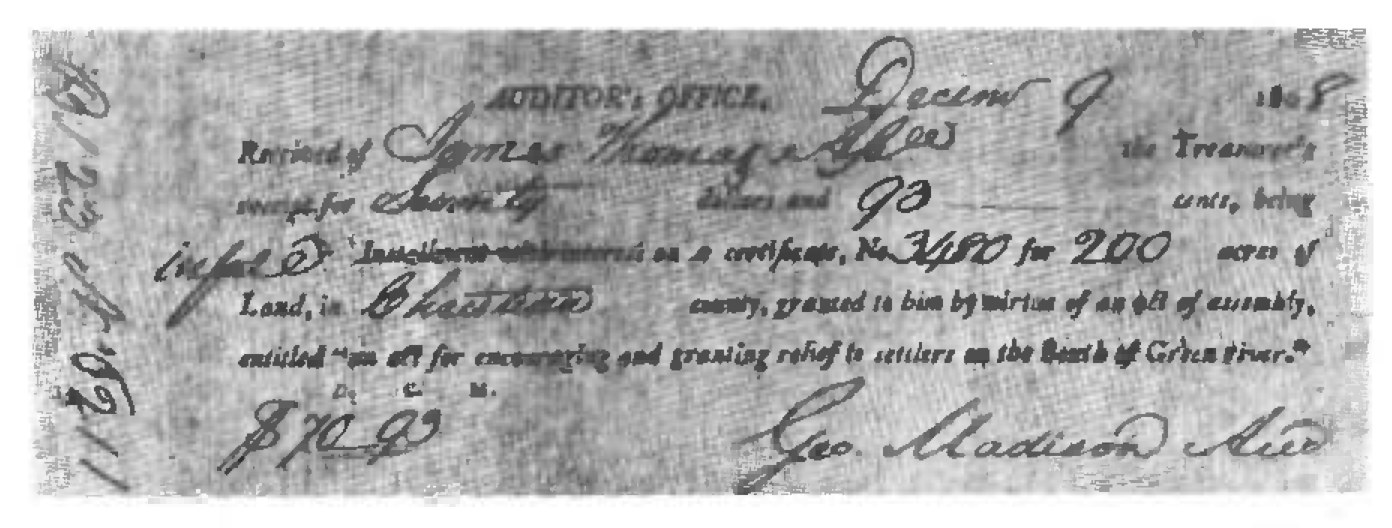
The Donaldson Creek grant was recorded in Book 6, page 105, in the Kentucky Land Office at Frankfort on January 18, 1809, and was one of the first five grants surveyed on Donaldson Creek in what is now Trigg County. The Bird’s Creek survey, No. 6216, was recorded in Book 25, page 347 at Frankfort, March 26, 1822.
James Thomas was one of the first five permanent settlers on Donaldson Creek. The others were: Shadrach Futrell, John Craig, Basil Holland and Joel Cohoon. These men came from different parts of Virginia, North Carolina and South Carolina and apparently had no connection with each other until they arrived in Kentucky and became neighbors on Donaldson Creek.
It is on record in the Kentucky Land Office at Frankfort that each of the four men, in addition to James Thomas, purchased or otherwise acquired land either from owners or speculators who had gotten the property by original land grants from Virginia or from Kentucky after it had become a state. Shadrach Futrell, ancestor of one of the Futrell lines in Trigg County, acquired his 200 acres from Caleb Lindsay of Orange County, Virginia, who received the grant October 17, 1798. It was surveyed January 14, 1799 and according to the endorsement on the certificate, Caleb Lindsay transferred the land to Shadrach Futrell on November 2, 1807. A native of Northampton County, North Carolina, Shadrach Futrell settled on land located east of that of James Thomas, on what is now known as the Skinner place. He eventually acquired additional acreage adjoining that tract. In 1822 his brother, Nathan Futrell, acquired land on Ford’s Creek on the west side of the Cumberland River just opposite and slightly upstream from the mouth of Donaldson Creek where, later, Shadrach joined him.
John Craig of Albemarle County, Virginia, settled in a short valley that branched southward from the Donaldson valley. The little stream that ran through his property is still called Craig’s Branch. The 200 acres assigned to him by William Ward, lay along the narrow confines of the valley on both sides of the stream.
Basil Holland, of Laurens County, South Carolina, acquired his 200 acres of land in 1803 from James Edmonston, an assignee of John Dempsey, for whom it was surveyed June 10, 1799. Dempsey, who had served three years as a soldier in the Virginia line, by ownership of certificate No. 960 from the Commonwealth of Virginia, dated June 20, 1783, had become a land speculator also. Basil Holland paid surveyor’s fee and tax of $91.83 and five mills. The property was located about a mile west of the James Thomas property.
Basil Holland died in the 1830’s and the property he owned was later acquired by James Thomas III. This land is located in the immediate vicinity of the present day Donaldson Creek Baptist Church.
Joel Cohoon’s 200 acres lay farther west near the Cumberland River, and his land, like that of James Thomas, Shadrach Futrell and Basil Holland, was also located on both sides of the waters of Donaldson Creek. Joel’s land was originally granted to Samuel Watson and had been assigned to Adam Young, John Edmonston and William Boren. He acquired it from the latter in 1807. This land is now submerged by the waters of Barkley Lake.
Joel Cohoon, a native of Edgecombe County, North Carolina, and a veteran of the Revolution, was brother of Charity (Cohoon) Bridges, wife of Drury Bridges, and ancestor of the Calhoun family in Trigg County.19
Just when the first settlers came to the Donaldson Creek area is not officially recorded, although William Henry Perrin, in his 1884 history of Trigg County, sets 1799 as the year that “. . .a small settlement was made on Donaldson Creek.”20 He listed the first settlers as John and Shadrach Futrell, Josiah (apparently Joshua) Lindsay and his brothers James L., Caleb and Carleton. However, Kentucky land office records do not wholly support this.
Settlers who later acquired land in the area were: Jonathan Ricks, ancestor of the Ricks family of Trigg County,21 and Charles Boren, both on Donaldson Creek, Richard Bell and John Wilson on Beechy Fork Creek.
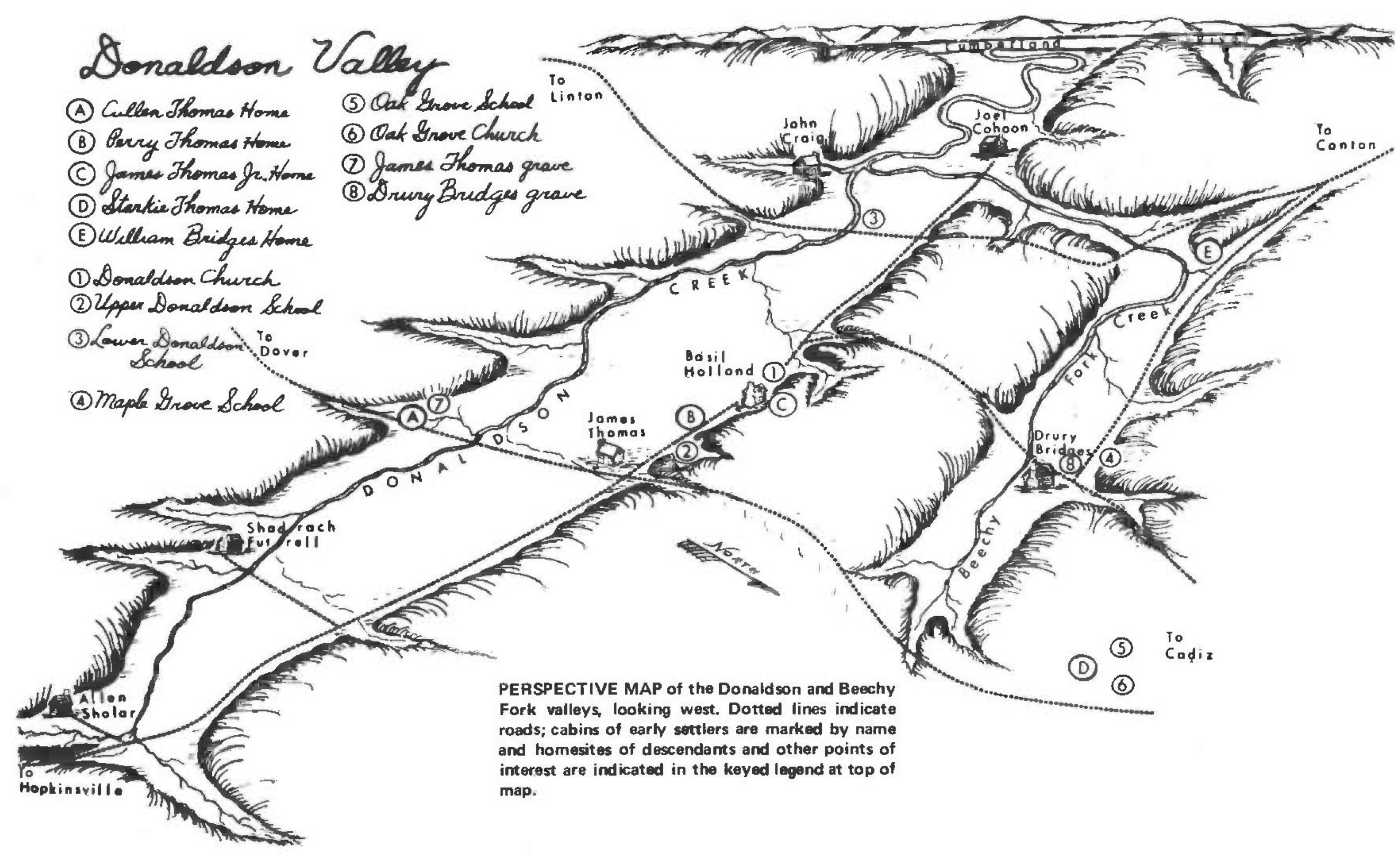
Allen Sholar of Bertie County, North Carolina, son of Laodicea (Thomas) Sholar and Benjamin Sholar, and nephew of James Thomas, II, acquired from James Lindsay, 200 acres in the valley at the head of Donaldson Creek. Benjamin was ancestor of the Sholar family of Trigg County. Isaac Sumner, ancestor of the Sumner family of Trigg County, acquired 213 acres on Beechy Fork Creek, and Drury Bridges of Edgecombe County, North Carolina, ancestor of the Bridges family of Trigg County (See Chapter 13, et seq.) acquired 85 1/2 acres on the same stream.
Land grant acreage in the valley was acquired in succeeding years by George Hargrove, Benjamin Wilson, James Dixon, John Allen and Daniel Cohoon, son of Joel. Probably the last free land grant on Donaldson Creek was 55 acres, surveyed November 11, 1814 for Ezekiel Thomas, Jr., nephew of James Thomas II, who had migrated two years before from Bertie County, N. C., with his brother Luke. This property was located adjacent to that of Shadrach Futrell.
Kentucky began to sell its public land in 1815 and warrants were issued to William Mashburn in 1818, John Craig in 1819, Levi Lancaster and Joshua Sholar, cousin of Allen Sholar, in 1821, and Christopher Pritchard in 1823.
Although there is no record of land grants or warrants, other families mentioned as early settlers in the Donaldson Creek valley were Whitmell Holland, Lawrence Killabrew and James and Allen Barnes. Some settled on land on both Donaldson and Beechy Fork creeks and did not seem to have been in a hurry to acquire it officially. Drury Bridges, for example, settled on 85 1/2 acres on Beechy Fork Creek22 in 1804, but ownership papers were not filed in Frankfort until January 6, 1815. Also, Joshua Lindsay had certificate No. 279 for 92 acres granted in 1802, but it was not recored at Frankfort until 1815 after the state had begun to sell its public lands.
Eventually a large part of the land in the Donaldson Creek valley and surrounding hills was acquired by descendants of James Thomas II. By the time his five sons had grown to maturity and acquired land, they collectively owned almost 4,000 acres, the nucleus of which was the original 200 acre survey made in 1799 at what is now the intersection of the Donaldson and Cadiz roads.
Today many descendants of the sons of James Thomas and those of other early settlers on Donaldson and Beechy Fork Creeks still own and reside on a large portion of the land in the valleys, much of it the original land grants.
Collins “History of Kentucky,” 1874 edition, pages 730-732.↩︎
Ibid↩︎
“Thomas and Bridges Family History,” by G. A. Bridges, 1928, page 10.
NOTE: To avoid confusion I have identified the three James Thomases in this work as James I, James II and James III. Actually, James II signed his name as “James Sr.,” and James III as “James Jr.” As far as official records were concerned, James I and James II never used the “Sr-Jr” designation.↩︎
Chowan County, N. C., Deed Book H, page 15; Bertie County, N. C., Deed Book G, page 212.↩︎
Bertie County Wills, Vol. VIII, page 5, State Archives, Raleigh, N. C.↩︎
“History of a Southern State, North Carolina,” by Hugh Talmadge Lefler and Albert Ray Newsome, page 230.↩︎
Revolutionary War Records, National Archives, Washington, D. C ; Lineage book, the National Society of Sons of the American Revolution, Washington, D. C., James Thomas, national number 98251, and Kentucky state number 1392 assigned to Edison H. Thomas.
James Thomas, private, No. 90144, is listed in Pierce’s Register, page 1174. He also is listed as soldier in North Carolina Revolutionary Army accounts dated July 25, 1783, journal of the proceedings of the Commissioners appointed by Act of Assembly passed in May 1783 to liquidate and finally settle the accounts of the officers and soldiers of the Continental line of the State of North Carolina.
The book, “Roster of Soldiers from North Carolina in the American Revolution,” by Cooper and Hay, Seeman Press, Durham, N. C., in addition to James Thomas, lists the following from Bertie County who served in the North Carolina troops: John Barnes, sgt., 1 Oct. 1776 — 1 Apr. 1779; David Standley, one of 11 men, delegates from Bertie County to Provincial Congress of North Carolina held at Hillsboro Aug. 20, 1775; Jonathan Standley, private, Ralford’s Company, enlisted 1782 for 18 months, No. 90956 in Pierce’s Register. Both James and Jonathan Standley received land grants of 274 acres each for their services. James, who served 36 months, deeded his land to a Captain Herren. Jonathan, who served 84 months, deeded his to John Price.↩︎
Bertie County, N. C. marriage bonds.↩︎
North Carolina Census, 1790, Edenton Dist., Bertie County, page 15.↩︎
See reference No. 6.↩︎
In a letter to the author dated March 27, 1970, the Secretary of State of North Carolina, said: “We made a thorough search of our records and do not find a grant for James Thomas in Bertie County. We also searched the records in Tennessee (which at the time was our western territory) and found no record of a military grant or purchase grant for James Thomas. We also checked with the Department of Archives and History and they have no record of a military land warrant to James Thomas. . .”↩︎
See Reference No. 5.↩︎
“Kentucky Land Grants,” by Willard Rouse Jillson, 1925, Standard Printing Co., Louisville, Ky., page 5.↩︎
Ibid, pages 7 and 9.↩︎
Ibid↩︎
“Old Kentucky Entries and Deeds,” Willard Rouse Jillson, 1925, Standard Printing Co., Louisville, page 336.↩︎
Kentucky Land office records, Secretary of State, Frankfort, Ky.↩︎
Ibid. Reference to “Lindsay’s line” and “Lindsay’s corner,” in the grant, indicates the property of Caleb Lindsay. The initials “JH” marked corner of property of James Hamilton, the original grantee.↩︎
Spelling of the family name Cohoon, or Cahoon, was changed to Calhoun as it is spelled today. Joel also is on record as having drawn a pension for his Revolutionary War service, (see chap. 13.)↩︎
Page 180 et seq.↩︎
The Ricks family probably originated in Norfolk County, England. First of the family to arrive in Virginia was Isaac Ricks, who died Jan. 2, 1723 at the age of 85. A son, Isaac Ricks, moved to Edgecombe County, North Carolina. Jonathan is probably descended from that line. —“17th Century Isle of Wight County,” by John Bennett Boddie, pages 242-244.↩︎
This land and several hundred additional acres acquired by Drury Bridges in ensuing years has been in the Bridges family since Drury’s death June 15, 1840.↩︎