The First Thomases in Virginia
The First Thomases in Virginia
Every account of my Thomas line agrees from the Reverend John Thomas of Edgecombe County, North Carolina, down to me. Before him, they don’t agree. There are three accounts of the early Virginia Thomases: one in Robert E. Thomas’s The Thomas Family in 300 Years of American History (1978), one in Edison H. Thomas’s The Thomas and Bridges Story, 1540–1840 (1972), and a third in the online family trees, which turns out to be a mixture of the first two. They don’t even all set out to trace my line, as you’ll see. This post sets them side by side, with the evidence each one rests on, because I don’t think any of them can be called proven before about 1650.
Where everyone agrees: John Thomas (1705–1788)
The Dictionary of North Carolina Biography gives the starting point. John Thomas was born on October 11, 1705, in Nansemond County, Virginia, “the son of John and Mary Lawrence Thomas.” He moved to North Carolina about 1740, became a Baptist in 1748, and in 1756 founded the Tosneot Baptist Church, the first church of any denomination in lower Edgecombe County. He died on December 3, 1788. His son was Major Theophilus Thomas, and from Theophilus the line runs through Benjamin, Shadrach and Samuel Brown Thomas to me.
One small tangle first. Family trees call this John “Reverend John Thomas Jr.” Robert E. Thomas gives that title to his eldest son, also John (born 1733), who was a Baptist preacher too and moved to Hancock County, Georgia. Both were preachers, and both were sons of a John, so both names have some basis. I’ll call the 1705 John “Elder John Thomas”, as the Dictionary does.
So the question is: who were his father, John Thomas, and his mother, Mary Lawrence, and where did their family come from?
The three accounts
| Generation | Robert E. Thomas (1978) | Thomas and Bridges (1972) | Family trees |
|---|---|---|---|
| The immigrant | John Thomas, aged 18 in the 1624/25 muster, came on the Southampton in 1622 | John Thomas “of Wales”, born about 1585, probably in Carmarthenshire; came on the Sea Venture in 1609–10; wife Dorothy | John David Thomas, born 1585 in Carmarthenshire; wife “Dorothy de Cymru” |
| John Thomas (about 1628–1655), Nansemond; wife Elinor, probably Montague | John Thomas Jr.; wife’s name unknown | John Thomas (1628–1655); wife Elinor Montague | |
| Richard Thomas (about 1648–1687); wife Elizabeth, probably Sanders | Richard Thomas (born about 1629); wife Elizabeth Marshall | Richard Thomas (1648–1687); wife “Elizabeth Marshall Sanders” | |
| Mary Lawrence’s husband | John Thomas (1668–about 1706); first wife a daughter of Michael Rogers | John Thomas (born about 1648); first wife Susannah (Portis) Frizzell | John Thomas (1668–1704); no first wife |
| Elder John Thomas (1705–1788) | Not in the book. It lists seven children, “probably by his first wife”, and follows one of them, Joseph, to Bertie County and Kentucky | Elder John Thomas (1705–1788) |
Two of the three agree that a John Thomas of Nansemond County married Mary Lawrence as his second wife. Above that, they disagree about almost everything.
Robert E. Thomas: Hugh Johnston’s research
Robert’s account of the Virginia generations isn’t really his own. In his foreword he says that all the genealogy in his first two chapters “is based on the work of Mr. Johnston”: Hugh Buckner Johnston, the Wilson, North Carolina genealogist who also wrote the 1956 article I transcribed for Theophilus. Robert gives few citations for this part of the book, but the account is built from land records, and from 1654 onward it holds together well.
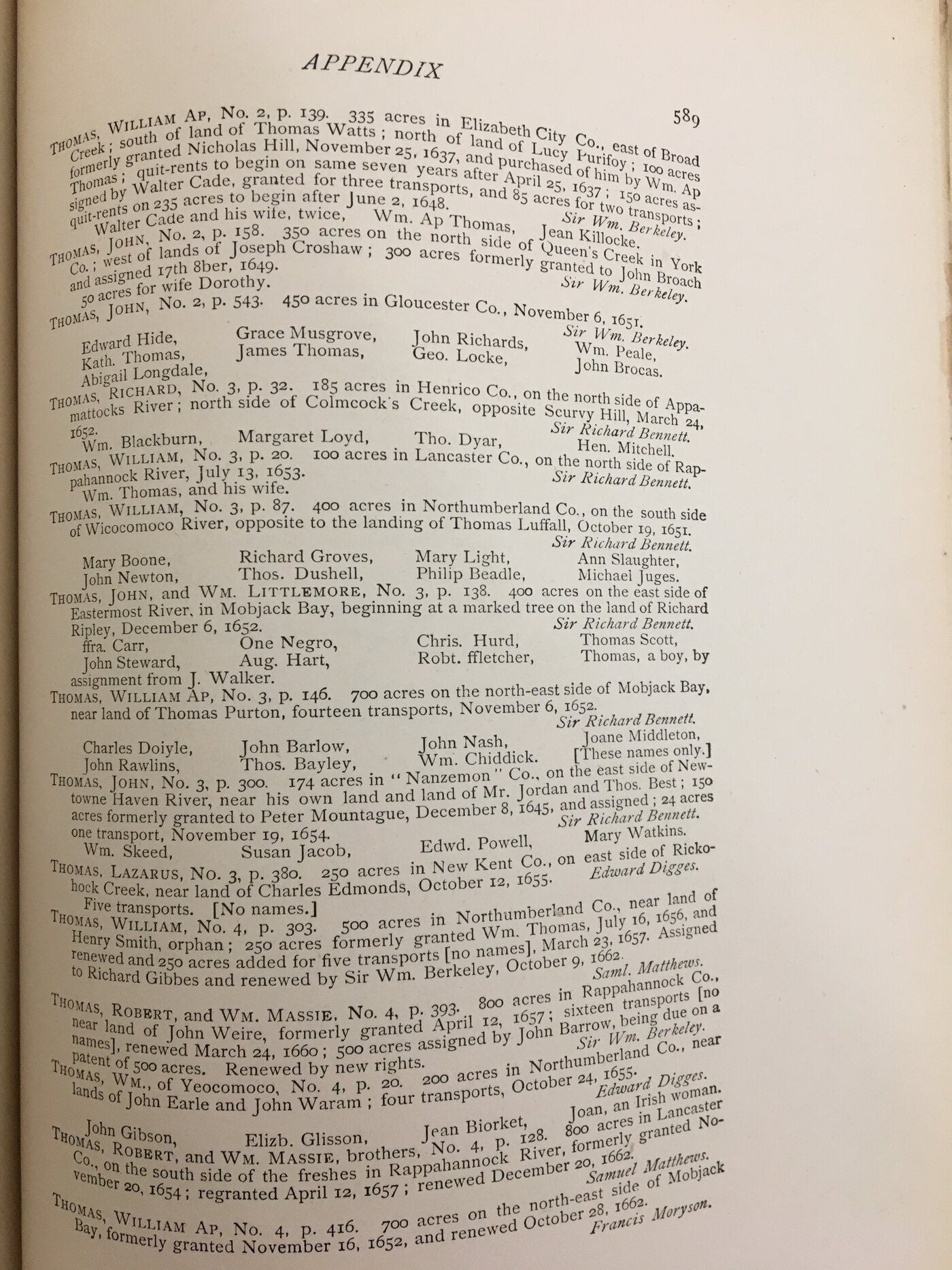
- In 1654 a John Thomas patented 174 acres in Nansemond County, 150 of them “formerly granted to Peter Mountague.” That patent is real: it’s abstracted in The Thomas Book (p. 589, pictured). Robert reasons that Montague gave the land when John married his daughter Elinor. It’s an inference, though it fits: Montague’s 1659 will, as Robert reports it, left tobacco to a daughter Ellen, “the wife of William Thompson”, and Robert takes Ellen to be John’s widow, remarried.
- In 1676 the same 174 acres were regranted to Richard Thomas as “son and heir” of John Thomas, late of Nansemond County. That’s a documented father-to-son link.
- Robert says records “indicate” that Richard married an Elizabeth Sanders about 1668, though he doesn’t cite them, and his own chart says “probably”. In 1681 Richard patented 1,650 acres with John Sanders and Jonathan Robinson, and he left his share to his four children, John, Phoebe, Sarah and Elizabeth.
- Richard’s son John (born 1668) married first a daughter of Michael Rogers, whose will of 1710 names his Thomas grandchildren, and second Mary Lawrence. In 1704 John sold a tract in North Carolina that had been her father’s, “by right of Mary my now wife”, and Mary went on living on land she had inherited from her father on the Blackwater River in Virginia, which passed to her son, Elder John. Robert says that without John Lawrence’s will the link between the Virginia and North Carolina generations “probably would have been impossible” to make.
The weak point is the top. Robert’s immigrant is a John Thomas, aged 18, who came over on the Southampton in 1622 and was listed among Captain Samuel Matthews’s people in the muster of 1624/25. Robert calls him “the earliest member of our branch of the Thomas family to come to America”, but he doesn’t show that this man was the father of the John born about 1628. He’s candid about a second candidate, too: a “John Thomas, Jr.” whom Matthews brought over in 1643, of whom he writes, “We cannot establish that this John Thomas, Jr. was the son of the first Thomas, but it is at least reasonable.” (A Sons of the Republic of Texas biography of Benjamin Thomas also has the family’s ancestor arriving in 1622, aged 16.)
Thomas and Bridges: the Sea Venture and Dorothy
Edison H. Thomas was tracing his own line, the Thomases of Trigg County, Kentucky, and his account has the best story. His John Thomas sailed from Plymouth in June 1609 on the Sea Venture, one of nine men whose passage had been paid by William Sharpe. The ship was wrecked on Bermuda in a hurricane (the wreck that’s thought to have inspired Shakespeare’s The Tempest), and the survivors built two small boats and reached Jamestown on May 24, 1610. There’s no passenger list; Sharpe’s headrights are the evidence.
Edison finds a John Thomas with land in York County by 1637, near Henry Marshall on the York River by 1638, and then patenting land in October 1649: 350 acres on the north side of Queen’s Creek, near what’s now Williamsburg, including “50 acres for wife Dorothy.” The Thomas Book abstracts that patent on the same page as the Nansemond one. That’s where the name Dorothy comes from: she was a headright, which suggests she came over separately.
Below that, Edison’s line compresses the generations and rearranges some of the same names:
- John of Wales and Dorothy had sons John Jr., Phillip, Richard and William.
- John Jr.’s son Richard (born about 1629) married Elizabeth Marshall about 1647. Edison cites Richard’s will of 1687, and Humphrey Marshall’s will of 1711, which leaves a bequest to his daughter Elizabeth and her son John Thomas. John Jr.’s daughters included Elizabeth, who married John Sanders; Sarah, who married Jonathan Robinson; and Katherine, who married Thomas Oglethorpe.
- Richard’s son John (born about 1648) married first Susannah (Portis) Frizzell, in 1673, and second Mary Lawrence. In this version, it’s his son Richard who married Michael Rogers’s daughter.
Edison never mentions Elder John. But his John Thomas who married Mary Lawrence looks like the same man as Robert’s, and if he is, Elder John would be the son of that marriage. That’s my inference, not his.
Edison was candid about the gaps. He notes that another source, Bible Records of Early Edgecombe, has John rather than Richard marrying Elizabeth Marshall. That fits Humphrey Marshall’s will better: a father still leaving bequests to his daughter in 1711 sits oddly with her having married in 1647. Edison also reports a disagreement from Hugh Johnston himself: Johnston saw the Kentucky line “circumstantially proven” back to a Michael Thomas who patented land in Nansemond in 1686, and thought that Michael was “apparently” Joseph’s father. If Johnston was right, the Kentucky Thomases may not descend from the John Thomas who married Mary Lawrence at all.
The other problem is geography. The John Thomas with the wife Dorothy had land in York County, north of the James River, in 1649. The John Thomas with the Montague land was in Nansemond, south of it, by 1654. Both books assume the family moved from York to Nansemond, and Robert even has Richard born in York County, but neither shows which York County John Thomas, if either, was the father of the Nansemond one.
The family trees: a mixture
The version in most online trees, including the one I started from, takes Edison’s immigrant (born 1585, wife Dorothy) and attaches him to Robert’s middle generations (John and Elinor Montague, Richard, John), and then gives Richard a wife called “Elizabeth Marshall Sanders”, which looks like the two books’ candidates run together. It also adds details that aren’t in either book: the middle name David, a birthplace at “Llancennech” (Llangennech) in Carmarthenshire, a surname “de Cymru” for Dorothy (roughly “of Wales”, though not real Welsh), and a marriage in Virginia in 1608, the year before the Sea Venture sailed. The tree’s only sources for these are a Find a Grave index and other people’s Ancestry trees, so I’d treat them as unproven until someone shows a record.
Wales
All of the Welsh ancestry comes from The Thomas Book (1896), by Lawrence Buckley Thomas, which traces the descendants of Sir Rhys ap Thomas, the Welsh knight said to have killed Richard III at Bosworth. Edison relies on it, and on the family’s use of the same coat of arms, which he says “certainly indicates a lineal connection”. But he also writes that before 1609 “we have no documented proof of John Thomas’ lineage”, and as far as I can find, The Thomas Book doesn’t connect our John Thomas to Sir Rhys either. It’s a family tradition, and a good story, but nothing more yet.
What I think
From Elder John Thomas back to John and Elinor Thomas of Nansemond in the 1650s, the Johnston–Robert chain of land records is the best-supported account, and the Dictionary of North Carolina Biography agrees with its last link (though it may draw on Johnston’s work too). Before about 1650, nothing is proven. Robert’s 1622 immigrant fits by age, Edison’s 1610 immigrant has the better story and a wife called Dorothy, and neither is shown to be the father of the John Thomas who married Elinor. The Welsh descent is tradition.
What would settle it
- Y-DNA. I’ve tested. Edison puts the Kentucky Thomases under the John Thomas who married Mary Lawrence, and the Johnston–Robert chain puts my line there too, but Johnston thought the Kentucky line came from a Michael Thomas instead. A Y-DNA comparison with a Trigg County Thomas would show whether the two lines share a paternal ancestor at all.
- The Virginia land patents. The original patent books, and Nugent’s Cavaliers and Pioneers abstracts, might connect the York County and Nansemond John Thomases, or the 1622 John to either.
- The wills. Humphrey Marshall’s will of 1711 and John Lawrence’s will are the two documents each version leans on. Reading them, rather than the books’ summaries of them, would be the next step.
- Nansemond records. Most of them burned, in 1734 and again in 1866, but the surviving deeds, quit rents and church books are worth another look.
If you’ve worked on the early Thomases of Virginia, or you’re a Thomas from Trigg County, I’d love to hear from you.
References
- Dictionary of North Carolina Biography, “Thomas, John (11 Oct. 1705–3 Dec. 1788)“.
- Robert E. Thomas, The Thomas Family in 300 Years of American History (Dallas, privately printed, 1978), Foreword, “A Chart of the Family” and Chapters I–II.
- Edison H. Thomas, The Thomas and Bridges Story, 1540–1840 (Louisville: T&E Publishers, 1972; reprinted with corrections, 1984), Chapters V–VII and XII.
- Lawrence Buckley Thomas, The Thomas Book (New York: Henry T. Thomas Co., 1896), Appendix, p. 589.
- “Benjamin Thomas, Sr. 1778–1832”, in a Sons of the Republic of Texas collection of members’ ancestors.