← The Thomas Family in 300 Years of American History
FOREWORD AND ACKNOWLEDGMENTS
Author Biographical Note
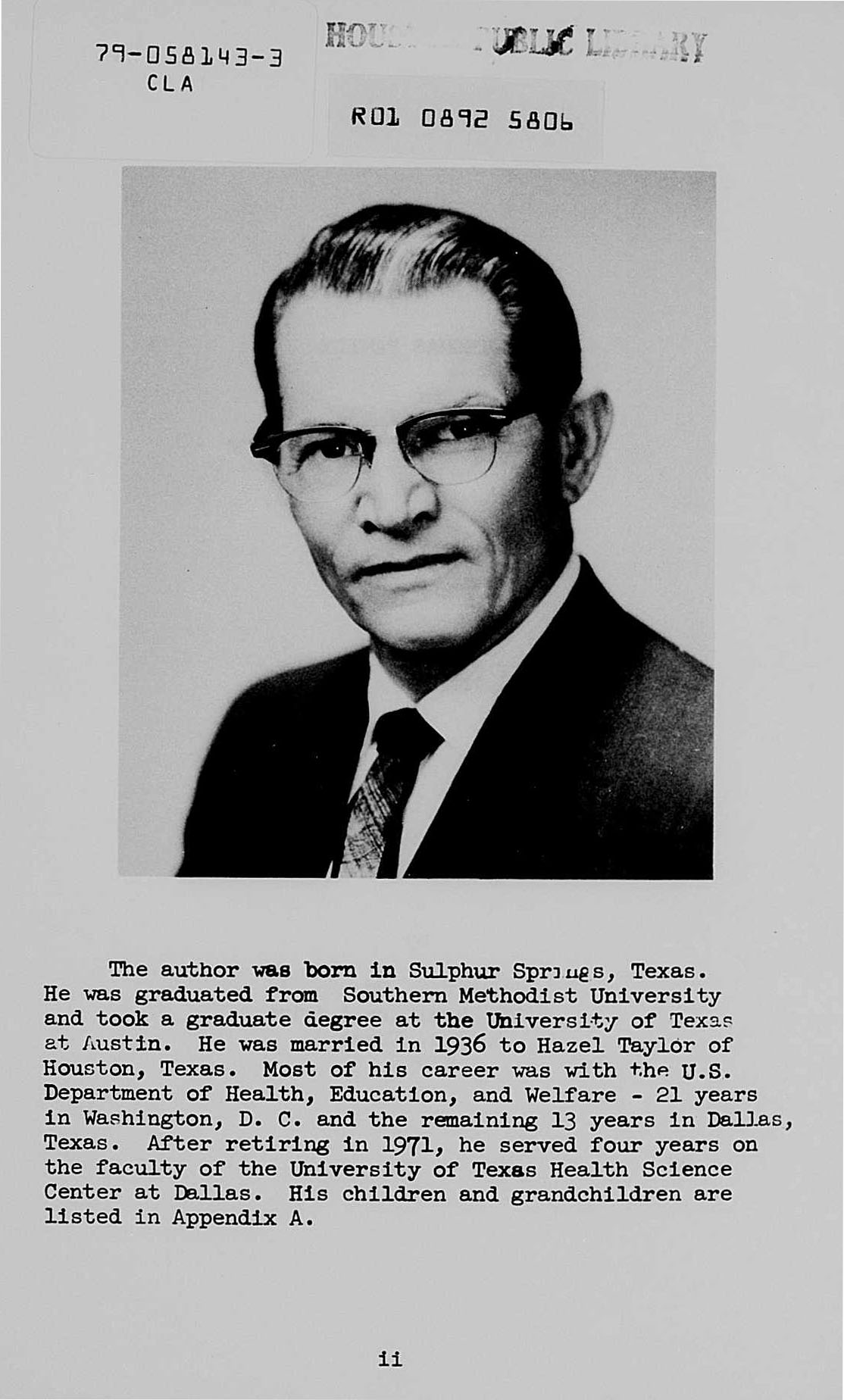
The author was born in Sulphur Spriugs, Texas. He was graduated from Southern Methodist University and took a graduate degree at the University of Texas at Austin. He was married in 1936 to Hazel Taylor of Houston, Texas. Most of his career was with the U.S. Department of Health, Education, and Welfare - 21 years in Washington, D. C. and the remaining 13 years in Dallas, Texas. After retiring in 1971, he served four years on the faculty of the University of Texas Health Science Center at Dallas. His children and grandchildren are listed in Appendix A.
Foreward
I started work on this History in May, 1975, shortly afte my retirement. As a retirement project, genealogy and family history have been for me an engrossing study, particularly so during the Bicentennial Year when there was so much emphasis on the history and heritage of our Nation.
The audience for this History are my grandchildren and those of my brothers, my sister, and all my first cousins on the Thomas side. Buck and Susan Thomas had 31 grandchildren and they in turn had 50 children aria 98 grandchildren. It is my hope that this story of the Thomas ancestors in American history will reach the hands of most of the living descendants of Buck and Susan Thomas. In short, this History covers the life and times of the first ten generations of the Hopkins County Thomas line; it is written by a member of the llth generation and for the following generations.
Readers should bear in mind that this is a history of one Thomas family, not of the whole Thomas family. I have made no great effort to trace the descendants of Reverend John Thomas, Jr., or of Reverend Jonathan who were the brothers of Major Theophilus Thomas; nor the descendants of Ichabod, Theophilus, Jr., Micajah, and John Rogers, who were the brothers of Benjamin; nor of Shadrach, Benjamin R., Wiley, Theophilus, and Jackson, who were the brothers of Iredell. Learning more about them and their sisters, and their descendants, remains a future project for the author.
Many family histories concentrate narrowly on family descent, on births, marriages, deaths, and names of children, with a limited number of family anecdotes and some mention of occupation. My interest centers more on the life of our Nation as seen through the activities of our Thomas ancestors. The most interesting part of my work has been the effort to understand how each ancestor fitted into the economic, political, religious, and social milieu of his time.
I hope the reader can get some understanding of how the Reverend John Thomas was affected by the revolutionary movements in the quarter century preceding the American Revolution, why Benjamin Thomas made the long migration to Texas and how he lived in those difficult days before the Texas War of Independence, and how Buck Thomas sorted out the claims on his life and developed a life style that suited him. The conclusions I have drawn or suggested may not be completely accurate. The reader may have a different opinion, based on the evidence I have given. Or, better still, he may undertake further research, leading +o more acceptable conclusions.
My aim has been to understand and protray the family, not to glorify it. Therefore, I have not omitted from the story those persons or events that might detract from the prestige or social standing of the family. The real strength of a family, as of an individual, comes from the crises of life. When an individual takes an unpopular stand, bucks a strongly entrenched power group, or runs foul of the law, he engenders a crisis that tests the fiber of a family. I have tried to show the family crises in this light.
Perhaps the story of Monroe Edwards may be an exception to this approach. I could have omitted his story, or certainly could have shortened it, especially since we are not directly descended from him. His story is included, however, because it is interesting and because a full account has been set forth by earlier historians. Although he was a scoundrel, he was also a patriot; although from a rough frontier society, he was polished and urbane and at home in the drawing rooms of aristocracy. And finally, because in frontier Texas, as in all societies, there occasionally were tragic figures whose downfall came from a lack of moral strength.
None of our immediate ancestors accumulated great wealth or attained high public office. However, the entire threehundred-year Thomas history shines bright with close-knit family relationships, patriotism, high educational attainment, productivity and reasonable affluence in the economic sphere, community respect and leadership, and perhaps most of all, devotion to the Christian religion and the spread of the Protestant Church through the South from Virginia to Texas.
Without much help, I would never have written this History. During my early years, I did not know much about my family background. I knew that my grandfather had been born and reared in San Augustine, but I wasn't sure where on the east coast his father had come from. My own father died in 1918 when I was only eleven years old, so I did not remember any family stories that he may have told. I left home to attend college when only seventeen, and therefore spent little time with my grandparents or uncles.
My first detailed information on our family came from a cousin, Madeline (Thomas) Nolen of Wichita Falls, Texas. She had been in touch with a distant cousin in North Carolina who had written earlier to her father because of his interest in genealogy and family history. My interest was heightened in April, 1970 when my wife and I made a week-end pilgrimage to San Augustine and Nacogdoches, Texas. There we met five second cousins, all descended from I.D. Thomas. They showed us around the town, pointing out some homes of the early settlers. We visited the Thomas Cemetery where so many of the early members of the family are buried, and then went to Nacogdoches to visit the Old Stone Fort from where my great-grandfather stole away his bride-to-be back in 1830, and to the Oak Grove Cemetery in Nacogdoches where one of the writer's great-grandfathers and other heroes of the Republic of Texas are buried.
In April, 1975, it was my good fortune to become acquainted with Hugh B. Johnston, Jr., of Wilson, North Carolina. Mr. Johnston is a direct descendant of Reverend Jonathan Thomas, a brother of Major Theophilus Thomas. His mother, who was Ruth (Thomas) Johnston, was a fifth cousin of the author. Mr. Johnston is a veritable gold mine of information on the Thomas family. He still owns—lives on and farms—a 90-acre tract that was originally bought by Reverend John Thomas in 1747. This land has been owned by the direct descendants of the original owner for 230 years.
Mr. Johnston lives a few miles from the center of the town of Wilson, North Carolina. His home is on State Highway 42, exactly is miles east of its intersection with Federal highway 301. Immediately in front of his house stands an historical marker, titled "Thomas Farms", which gives the beginning of the farm as March 6, 1742. Nearby is a state marker which indicates the original site of the Toisnot Baptist Church which was established in 1756. Mr. Johnston's nineteenth-century home is framed by tremendous oak trees which were planted by his grandfather about 85 years ago.
Two hundred yards behind his house, in the shade of the pine trees, is the family cemetery. Attractive headstones mark the graves of Rev. John Thomas, Sr., and his son, Major Theophilus Thomas.
Hugh Johnston is an interesting and informed individual. In addition to being a tobacco farmer and a professor of Spanish at the local college, he is a well-known genealogist and the official historian for his County. He has many historical items such as the family Bible that belonged first to Rev. John Thomas and later to Major Theophilus Thomas. He has checked the official records of the family in the State archives of Virginia and North Carolina and in the Court Houses of the appropriate counties in both States.
All the basic genealogical material in my first two chapters, covering the first six generations of the family in Virginia and North Carolina, is based on the work of Mr. Johnston. His basic data on family composition and descent are verifiable from U.S. Census Reports and published volumes of genealogical data which are available in the genealogical section of libraries in Dallas and elsewhere. These works have been consulted and are listed in the bibliography. Beyond the genealogical data, my principal effort has been to record the involvement of our ancestors in the economic, social, and political movements of their day.
In tracing the family's history in the early Texas period, two valuable works were available, both having been published about forty years ago. They are Two Centuries in East Texas by Crocket and Four Families by Emily G. Roberts. Crocket's work provides a scholarly and accurate history of San Augustine County. The twovolume work by Mrs. Roberts provides a wealth of data, but much of the material is based on family tradition rather than on official documents. As indicated by my references for each chapter, I have checked as much of the material as possible by using both published and unpublished offie cial records from those early days.
I have not burdened the text with a multitude of footnotes. Although the sources of my material are completely set forth in the footnotes and the bibliography,
I have not quoted chapter and verse for every statement. Even though I want my work to be scholarly, I am not writing for historians or genealogists. I am writing primarily for the descendants and my chief aim has been to make my account interesting to them. In a few instances, I have used dialogue. Although these passages are fictional in form, they are strictly historical, based on reliable family tradition, newspaper reports, etc.
Each reference work has been footnoted only once. I have used four works which might have been footnoted many times. These four works are the following: newspaper articles, published by Mr. Hugh Johnston, summarizing the life of our Thomas ancestors during the early years in Virginia and during the 1740-1800 period in North Carolina; the two works cited above by George Crocket and Emily Roberts, covering the San Augustine period; and the historical articles on Hopkins County published in the Sulphur Springs News Telegram by Kenneth and Sidney Brice. oer
The final chapter, tracing the lives of the seven sons of Buck and Susan Thomas, is based both on personal recollections and published information. I am especially grateful to John W. Thomas, Jr., W.B. Thomas,Jr., H. Bascom Thonms, Jr., Madeline (Thomas) Nolen, and Rose (Thomas) Phillips; they shared with me letters and other written information, as well as recollections of early family life. To my cousins, other than those named above, as well as to our kinsman, Hugh Johnston, I am especially grateful. And most of all, I am indebted to my wife, Hazel; her interest in the Thomas family history, which preceded my own, helped to get me started, and ist more importantly, to keep me going.
My final word is one of regret. Wisdom and common ane sense dictate that I should publish my findings at this time, even though I should like to continue my research to clear up moot points. For example, I should like to know exactly where and by whom I.D. Thomas and Penelope Edwards were married. I'd like to pin down the route that Benjamin Thomas took in traveling from Alabama to Texas and the exact year he arrived in the State. I would like to know when and by whom Buck Thomas was ordained and how long he continued actively to preach. However, I know that such increase in exactitude would not add greatly to the overall story. There comes a time when one must stop gathering material, must get it written, published, and in the hands of those for whom it was from the start intended.
Robert E. Thomas 6230 Royal Crest Dr. Dallas, Texas 75230 March, 1978