← The Thomas and Bridges Story, 1540–1840
Chapter XVII: William Bridger moves to North Carolina
William Bridger was the third son mentioned in the will of Joseph Bridger, Jr., who died in 1713, and it is through him that the Kentucky Bridges line descends.
Although William shared in the division of his father’s estate after his death as evidenced by items mentioned in the will, he was not mentioned in his mother’s will. Whether or not William, was disappointed because he was not included, despite the fact that the rest of his brothers and sisters were, is not known. For some reason however, he decided to leave Virginia. On September 15, 1716, William purchased 640 acres of land on the north side of the Meherrin River in Bertie County, North Carolina, from James Gee of Surry County, Virginia. He was mentioned in the deed as being a resident of Isle of Wight County, Va., at that time.
Family tradition has it that Joseph Bridger, Jr., father of William, after having been disinherited by his father, changed the spelling of his last name to Bridgers. Actually it was not Joseph Jr., but his son William. On July 4, 1718, William Bridger witnessed a deed in which John Hardin purchased from Will Worrell, land on the north side of the Meherrin River in Bertie County, North Carolina. He signed his name BRIDGER, without the S. Just 12 days later, July 16, 1718, William Bridger bought 150 acres of land from Matthew Russian adjacent to the 640 acres he had purchased two years before, and the deed was signed WILLIAM BRIDGERS, the way he continued to spell it thereafter. Thus was begun the change from Bridger to Bridgers to Bridges as the Trigg County, Kentucky line spells it today. However, the R was not dropped until nearly 70 years later.
William Bridges married Elizabeth Godwin. They had the following children:
- Joseph — no further record.
- William Jr., — married Sarah Dew. It is through William Jr., that the Kentucky Bridges line descends.
- Samuel—died in Northampton County, 1756.
- Benjamin — settled in Edgecombe County.
- Mary — no further record.
- Elizabeth, no further record.
William Bridgers, son of Joseph Bridger Jr., made his will on the second of November 1729. It was comparatively short, and reads, with original spelling intact:
“In the name of God, amen — I William Bridgers of North Carolina being very sick and weak but thanks be tow God for full sane and memory blesed be tow God if I do here make my last will and testament — Firstly I bequeath my soul to God my maker and to Jesus Christ my saviour and secondly my (body) to the earth to be buryed in Christian like manner — And as for my worldly goods I dispose of as follow: ITEM—I give unto my loving son Joseph Bridgers two pewter basens ITEM—I give unto my loving son Benjamin Bridgers my plantation and the land Belonging unto it which is in Virginia that Joshua Turner lives upon — ITEM—I give unto my loving daughter Mary one sow pewter basens ITEM—I give untow my loving daughter Elizabeth another sow pewter basens — And for all the rest of my estate I give untow my loving son Samuell Bridgers my executor abolishing all other wills and testamentes and so before these guidances I doo ordaine and acknowledge this tobe my last will and testament as witness my hand and fixed my seal this second day of November in the year of our Lord 1729.
TESTS:
his John W Woorrill
marke Probated Bertie County
John Bardin Edwin Chitty, jurat May Court 1730.”1
William Jr., the second son of William Bridgers, married Sarah Dew. She was the daughter of John and Susannah (Shearer) granddaughter of Col. Thomas Dew, speaker of the House of Burgesses in 1652, member of the Council 1642-1660, and who first patented land in Upper Norfolk County October 10, 1638. William lived on a plantation on the north side of the Meherrin River, just south of the Virginia line in North Carolina. He made his will March 11, 1728 and it was probated November 1729, about a year before the death of his father.
His will reads:
“In ye name of God amen, I William Bridgers being of ye government of North Carolina and the presinct of Bartey being sick and weake of body butt of sound mind and memory thanks be to God for it due make and ordaine this to be my last will and testament in manner and forme following vz: First I give and bequeath to my son William Bridgers my plantation where I now live with all itts immovables and 220 acres of land belonging to it when he arriveth to ye age of 16 and one dish and one bason and one buckamean gun and ye first coult my mare raiseth, and one yew and one lamb if there be any alive at ye time; Item—I give to my daughter Sarah Bridgers one featherbed and rug and blanket and one dish and one basin; ITEM—I give to my son Josef Bridgers my land and plantation which lyeth one (on) Fishing Creek with all its unmoveabls, and one dish and one basin to him and his heirs forever; ITEM—I give to my sone John Bridgers one hundred acres of land belongeth to my plantation where one beginning ye corner of ye Court House Rode and by bounds between William Bryant’s land and mine running up ye said rode to ye upper side of a small pond so (south) 270 yards ye hed line for his compliment to him and his heirs forever, and one dish and bason and one yew and lam if theve beeny (they have been any) at ye time and every one of my children a coult if my maire bringeth them, and all my stock of cattil which belongeth to my plantation on Fishing Creek. When my brothers Benjamin Bridgers time is out to be equally divided between all children and likeweyes if ever my negro girl bringeth any children I give them to be equally devided amongst my children—and like wise it is my will ye my negro Jack should be sould for money for to put my children to school after my brothers time is up one my plantation on Fishing Creek, I give to my son John Bridgers my negro girl when he arriveth at ye age of 16 years. ITEM—I give to my brother William Bryant my great cote ye was last maid I give to my father John Dew one drugid jacit and britches. ITEM—I give unto my loving wife Sarah Bridgers all ye rest of my estate goods and chattols. And I William Bridgers do appoint William Bryant and John Dew Senior, to be my executors of this, my last will and testament revoking and disallowing and making utterly void all other wills in witness where of I have here unto put my hand and fixed my seal this 11 day of March 1728.” Witt: John Dawson, Jurat and William Bryant, jurat (Seal) her and Mary X Huise marke his Richard X Huise marke Bertie se November Court 1729.
“The above will was in open Court in due form of law proved by the oaths of John Dawson and William Bryant, evidences hereto.”2
Some speculation about this will concerns the statements “my brother William Bryant,” and “my father John Dew.” Actually omission of the words “in law” is fairly common in old wills, and it is quite apparent in this case that William Bridgers meant his father-in-law. However, one might be confused by the fact that William Bryant actually was his brother-in-law unless he knew that Bryant married Patience Dew, daughter of John Dew, and sister of William’s wife, Sarah (Dew) Bridgers.
William and Sarah (Dew) Bridgers had four children. They were:
- William—was under 16 years of age at the time his father made his will. He married Rachael, last name not known. He died in 1763. They had six children: William, John, Patience, Willis, Elizabeth and Temperance.
- Sarah—married James Cotten, younger brother of William Cotten. Her husband died in Bertie County in 1758, naming in his will, his wife Sarah and children: James, Henry, Christian, Theophylus and Solomon.
- Joseph—inherited the plantation on Fishing Creek in Edgecombe County, and is the ancestor of the Kentucky Bridges line. (Hereafter he will be designated as Joseph III where there might be confusion in identifying him.)
- John — the youngest son, also under 16 at the time his father made his will in Northampton County, married Faith Ruffin, daughter of William Ruffin who made his will March 1, 1779, and died in Bertie County where his will was probated November 1781. John Bridgers made his will Sept. 14, 1763, and it was probated in Northampton County, May Court, 1764. In the will he named his wife Faith, sons Edwin and Briton, daughters Sarah and Purity Bridgers. In 1764, his widow, Faith (Ruffin) Bridgers, married Joseph Pender. They moved to Edgecombe County after 1767.3
After William Bridgers died, his widow, Sarah (Dew) Bridgers, married William Cotten, of Hertford County, son of John Cotten, and a descendant of Rev. William Cotten who patented land in Accomac County, Va., near Hungar’s Creek in 16374 and whose family later moved to Queens Creek area in York County near the family- of John Thomas. Thomas Cotten I, a descendant of the York County William Cotten, moved to Isle of Wight County and married the daughter of William Goodwin.
To keep the record straight in citing numerous land transactions involving the Bridgers family, it might be explained that the portion of Bertie County, north of the Meherrin River, became a part of Northampton County, N. C., when it was formed in 1735, thus Sarah (Dew) Bridgers and her second husband, William Cotten, continued to live in the same area after their marriage.
Records indicate that William Cotten apparently died before his wife, as Sarah (Dew, Bridgers) Cotten, made her will December 7, 1753, in Northampton County, naming her children by both William Bridgers and William Cotten. This will was probated February Court 1784.5
William and John Bridgers, sons of William and Sarah (Dew) Bridgers, inherited the plantation in Northampton County on which their father lived, and both lived and died there. John’s descendants however, eventually settled in Edgecombe County, and many of them live there today.
Joseph Bridgers, III, brother of William and John, who inherited the plantation on Fishing Creek, remained in Northampton County for a period of time after his father died before going to Edgecombe County to live. This probably was due to the fact that, according to his father’s will, his uncle, Benjamin Bridgers, who was living on the Fishing Creek plantation at the time Joseph’s father died, was given the right to continue living there as long as he chose. However, a few years later, Benjamin Bridgers acquired land on Swift Creek, a few miles south of Fishing Creek, also in Edgecombe County, and left the plantation free for Joseph’s occupancy.
Joseph Bridgers III probably married Mary Braswell, daughter of Robert Braswell, who made will September 14, 1734, and which was probated in Bertie County, November Court 1736, naming sons John, Richard, Robert, and Valentine Braswell; daughters Sarah Daug’htry, Jean and Mary Braswell, godson Demsie Sumner, his mother Elizabeth Sumner, and wife, Sarah.6
Although Joseph Bridgers, III, went to live on his plantation on Fishing Creek in Edgecombe County, in the years that followed, he bought and sold land in both Edgecombe and Northampton counties, thus one can trace rather closely, his movements through record of deeds. Much of this activity was around the Fishing Creek and Tar River areas, and he also became quite well known as he was asked to witness a number of deeds and wills in both counties during that time. William Braswell a relative of Joseph’s wife also was involved in a considerable number of land transactions in that area about the same time as Joseph Bridgers. Braswell descendants today live in Rocky Mount, N. C., and vicinity. Descendants of Joseph’s uncle, Benjamin Bridgers, also are present-day residents of Edgecombe County.
Joseph’s activities on public record range over a period of 18 years between 1740 and 1758. The first time his name appeared on the official record was February 25, 1740, when he, along with his son Braswell Bridgers, then about 21 years old, were listed as jurors in Bertie and Edgecombe counties. On May 16, 1740, Joseph paid 12 pounds 10 shillings for 216 acres of land on the Morratock River belonging to Elias Fort and his wife Olive of Edgecombe County. On May 25, 1741, Joseph sold to Jonas Stokes, 100 acres on the north side of the Tar River in Edgecombe County.
Two years later, April 4, 1743, Joseph witnessed a deed in Northampton County, and on December 1, 1744, he received a 436-acre land grant also in that county. The following year, March 7, 1745, Joseph sold 216 acres near the Looking Glass Swamp in Edgecombe County, to David Clark, and four months later, July 3, 1745, he sold to William Kinchen, 436 acres on the northwest side of Mill Swamp in Northampton County, apparently the same land he had acquired by grant in 1744.
On July 28, 1746, Joseph Bridgers, Edgecombe County, bought 320 acres on the north side of the Tar River from John O’Neal, and on Aug. 5, 1747, Joseph and his wife Mary (apparently the former Mary Braswell) of Edgecombe County, sold 227 acres of the former John O’Neal property on the Tar River to George Downing.
In 1748, Joseph witnessed the deed of William Spier who sold to Jacob Hobby, 150 acres that lay between the Tar River and Fishing Creek, and the following year, Feb. 21, 1749, he witnessed the deed of sale of property by John Yelverton and his wife Elizabeth.
Three transactions in 1752 that involved Joseph, included: Feb. 17—witnessed deed in Edgecombe County in sale of 150 acres on the north side of the Tar River by Jacob Hobby to William Bryan; Oct. 24—witnessed the will of Peter Crocker, and on November 28, Joseph sold to Robert Standiford, Surry County, Va., 200 acres located in Northampton County on the south side of the Meherrin River.
In 1753, Joseph bought 300 acres from Hardy Pearce of Northampton County for 16 pounds. This was located adjacent to Wildcat Swamp on Poticasa Creek. On July 4, 1754, he, along with his half brother, Charles Cotten, witnessed the will of William Hilliard, of Northampton County.
The last two mentions of Joseph Bridgers III in the official records were May 6, 1756, when he witnessed the deed from Earl of Granville to Thomas Barron in Edgecombe County, and on August 25, 1758, when he witnessed the deed of William Stevenson and his wife Grace, to John Gully, both of Northampton County.7
Very little is known about Joseph’s family or about his plantation, except that the latter was located in Edgecombe County on the north side of Fishing Creek near the Long Swamp, an area that today is in Halifax County, North Carolina.
Joseph Bridgers probably died either in 1758 or the following year. He left no will. He and his wife, Mary (Braswell) Bridgers had at least one child, a son, named Braswell Bridgers.
The name Braswell Bridgers appears in the public records of Edgecombe County between the years of 1740 and 1764. Although the mentions are few, one is able to piece together a reasonably clear picture of his activities during that time.
First mention of Braswell Bridgers after his jury duty in 1740, was in 1745, when he witnessed the deed of Arthur Crofford in the sale of 100 acres of land on the north side of Fishing Creek in Edgecombe County, to Jacob Hobby. This was recorded in August Court 1745. The next time Braswell Bridgers’ name appeared in the public record was September 1, 1755, when he bought 100 acres on the south side of the Cahukey (Swamp) in Edgecombe County, from William Sims, adjoining the land of George Husspuss. On January 22, 1758, he witnessed the will of Jacob Hobby in Edgecombe County. Hobby died shortly thereafter; his widow, Jemima, was named executrix and John Baker, a neighbor, was listed as executor.
Braswell Bridgers apparently was the first to drop the R from the family name. He was not consistent however, as county records continued to show it both ways, and one wonders if it might not have been a clerk’s error. Apparently though, this was the beginning of the final change to the way descendants in Kentucky spell it today.
Three deed transfers on record in Edgecombe County pertaining to Braswell Bridgers involved a 700 acre tract of land granted to Joseph Dixon by deed dated March 10, 1761. Dixon divided the tract into four parcels of 175 acres each, and on June 11, 1761, he sold one to Andrew Young for four pounds provincial money, one to Joseph Brady for 22 pounds provincial money, one 175 acre tract and another of 100 acres, to Braswell Bridgers, for which he paid Dixon four pounds for each tract. The land was located on the north side of Fishing Creek on the Long Swamp. There was no reason given why Brady had to pay more for his tract than the others did. Witnesses for the transactions were Andrew Young and John Fleming, with each purchaser witnessing the other deeds.
On April 7, 1762, Henry Collins in his will, left 100 acres on the south side of Cahukey Swamp to his son Henry Jr., land that had been purchased from Braswell Bridgers.
Braswell kept the 175 acre tract he purchased from Joseph Dixon for a period of three years. In 1764 he had an opportunity to dispose of it and make a profit, so he sold it for 25 pounds to John Kee of Surry County, Virginia. The transaction was witnessed by Mitchell Dorman, Andrew Irwin, Benjamin Champion, and William Bridgers, son of Braswell, whose name appeared on the public record for the first time.8
After that date, Braswell Bridgers is not mentioned again in official records and he probably died soon afterwards. No will has been found so he must have died intestate; no inventory is listed, nor is the name of his wife known.
William Bridgers, son of Braswell Bridgers, married a young widow named Jemima. She probably was Jemima, the widow of Jacob Hobby whose will Braswell Bridgers had witnessed in 1758. Due to absence of a will, probably after the death of his father, Braswell Bridgers, son William took over the property on Fishing Creek and continued to live there.
William and Jemima (Hobby) Bridgers had at least six children, the oldest of whom was Drury. He was born August 30, 1765 on the plantation in the Fishing Creek community near the Long Swamp.
First mention of William Bridgers, father of Drury, in the official records of Edgecombe County, was the 1764 witnessing of the deed transfer from Braswell Bridgers to John Kee, described earlier, an action that definitely placed William in the Fishing Creek area. Four years later, June 9, 1769, William made his first recorded land transaction, when he and his wife Jemima, sold 100 acres on the north side of Fishing Creek to John Bryan for 20 pounds proclamation money. It was specified in the deed that “. . .this for lifetime of Jemima Bridgers and no longer, it being her right of dower.” It likely was land of which she had come into possession following the death of her first husband, Jacob Hobby. The tract adjoined the property of Martin Pittenger and Robert Hudnall, and the transfer was witnessed by Thomas Harris, Joshua Proctor and Smith Bryan. It was recorded in Edgecombe County Court November 28, 1769.
Apparently William Bridgers settled down to raise his family as it was nine years later before his name appeared in official records of Edgecombe County again. That was April 21, 1778, when he bought 326 acres located on the north side of the Tyancoca Swamp, from Duncan Lamon of Nash County, for which he paid 100 pounds proclamation money. This transaction placed William and his family in the area of Edgecombe County from which his son, Drury, left for Kentucky in 1803. However, there were a few more land transactions on record involving William, the next of which was March 31, 1780, when he sold the 326 acres he had bought two years earlier, to Benjamin Brake for 2,000 pounds proclamation money. At such a profit certainly he could afford to sell.
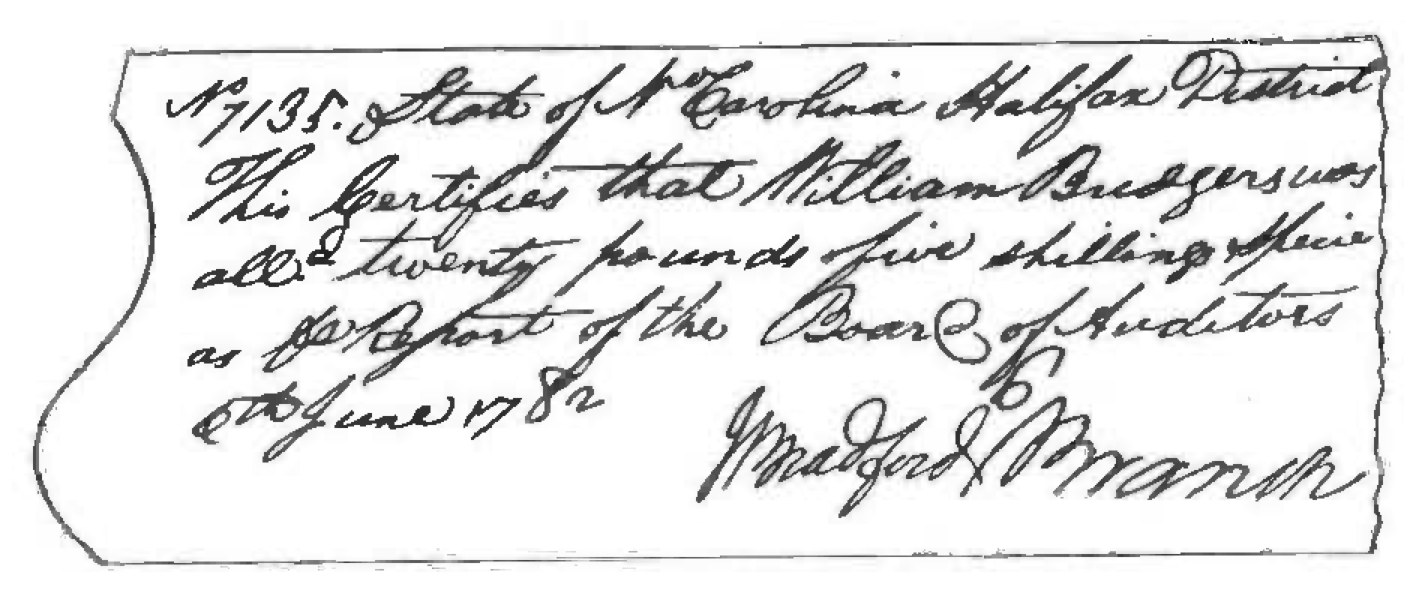
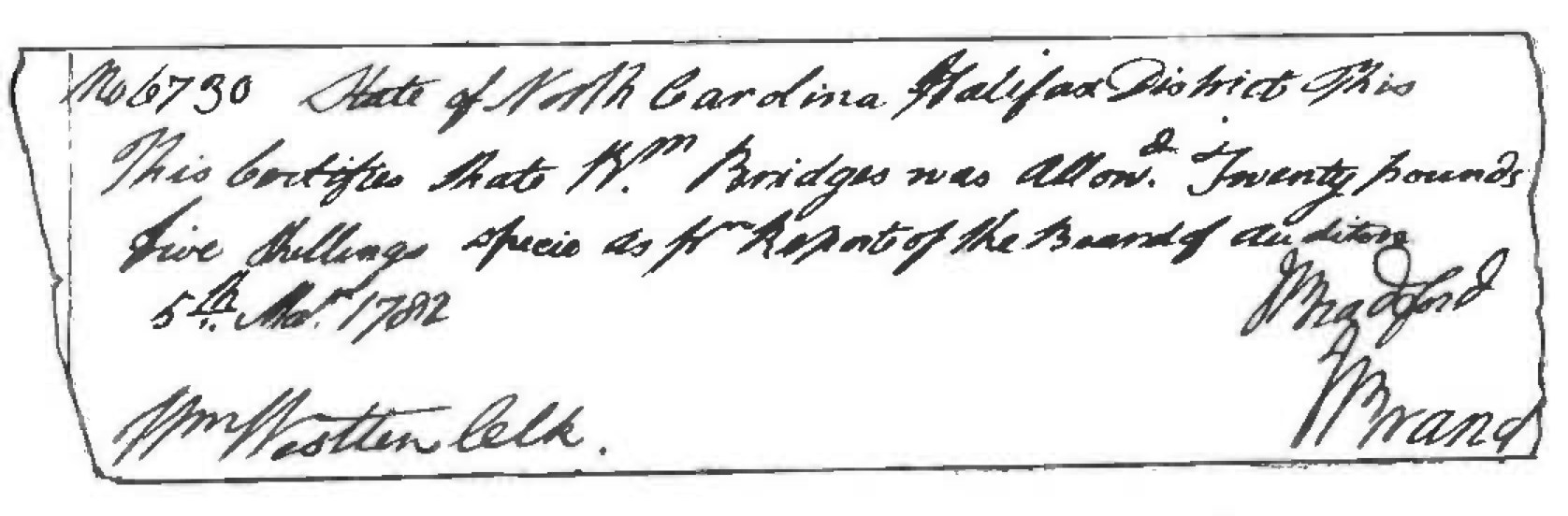
While living in the Halifax District of Edgecombe County, William Bridgers rendered material aid to the North Carolina Troops during the Revolution. This is evident through two certificates, one, No. 6730, issued March 5, 1782, allowed William Bridgers 20 pounds five shillings specie money. The other, certificate No. 7135, for the same amount, was issued William on June 6, 1782. Both were signed by Bradford Brannon, the district auditor, and recorded by William Westten, clerk.9 Just what kind of aid he rendered was not stated on the certificate, but it likely was food and other supplies, typical of that furnished by many North Carolina patriots to support their troops during that trying time.
On October 9, 1783, William Bridgers received through grant No. 452, 240 acres of land of land on the north side of Tyancoca Swamp, from Alex Martin, governor of North Carolina at Hillsboro. This land adjoined that of James Ricks. Three years later, however, October 27, 1786, William Bridgers sold this 240 acres to Samuel Skinner, Jr., for 50 pounds, 13 shillings, four pence.
The last mention of William Bridgers in the official records was on April 25, 1787, when he and his son Drury witnessed the deed involving the sale of a Negro man by Samuel Carter to Samuel Skinner. Probably not long after that, William Bridgers died.10 No record has been found of his death nor was there a will probated or an inventory listed.
Drury Bridgers, son of William, being only 38 years old when he left North Carolina for Kentucky, is mentioned only a few times in the official records of Edgecombe County. The first was in May 1784, when at the age of 20, he witnessed the deed of sale of land involving James Eastwood. The next time his name appeared on record was the previously mentioned witnessing of the deed in 1787 which his father, William, also signed.
Interestingly enough, there is no record of Drury Bridgers, son of William, ever having acquired his father’s property, or any other property for that matter. The supposition is that when William Bridgers died (1790 or before), Drury, the oldest child, simply took over where his father left off, just as his father apparently had done when Drury’s grandfather, Braswell Bridgers died, and continued to till the soil on the plantation on Tyancoca Swamp without taking the trouble to transfer the property to his name.
Two deeds recorded in the court house at Tarboro, county seat of Edgecombe, definitely place Drury Bridgers as living in the Tyancoca Swamp area, no doubt on land that had belonged to his father.
One of the deeds, made December 3, 1791, listed the purchase of property by John Cohoon from George Massingale. In bounding the property, it was described in the deed as “. . .beginning at a live oak on Drury Bridgers’ corner, then along his line. . .etc.” Adjacent land owners included Benjamin Brake, to whom Drury’s father had sold 326 acres in 1780; Thomas Atkinson, John Battle, Samuel Skinner, whose deed Drury and his father had witnessed in 1787; and Joseph Daughtery. Witnesses were William Haley and Joseph Daugherty. The deed was recorded during May Court 1798. Interestingly enough, the buyer was Drury’s father-in-law.
The final mention of Drury was in a deed transfer dated September 1793, when land of his father-in-law, John Cohoon, deceased, the same 200 acre tract on Tyancoca Swamp, was sold to Jesse Proctor for 77 pounds 10 shillings, North Carolina money, in order to settle the estate. Samuel Skinner and William Polk were witnesses and the transaction was recorded during Edgecombe County Court February 1799, just four years before Drury was to leave North Carolina for Kentucky. He was 34 years old at the time. In this deed, Drury’s name was spelled BRIDGES.11
When Drury, who about that time seems to have permanently dropped the R in the spelling of the family name, prepared to leave for the west, he apparently did just as James Thomas would do in Bertie County in 1806—he simply drove away with his family and did not worry about disposing of his land. There is no record of his ever having sold it and as his brothers and sisters headed west with him, it is likely that some of his wife’s relatives took over the property. In any event, Drury Bridges never went back to North Carolina.
Secretary of State, North Carolina Wills, 1663-1789, Vol. IV, page 53.↩︎
Ibid.↩︎
“William Bridgers & His Descendants,” by Marybelle Delamar, 1949, typescript. North Carolina State Library, Raleigh.↩︎
Nugent, page 59.↩︎
“Historical Southern Families,” Boddie, Vol. III, page 82. Named in the will were: sons William Bridgers, Joseph Bridgers, John Bridgers, Charles Cotten, William Cotten, Robert Cotten; daughters Saran Cotten, Patience Cotten, Priscilla Wells, Mary Cotten and Martha Scott.↩︎
Hathaway, Vol. I, page 180.↩︎
Colonial and State Records of North Carolina, Vol. 4, pages 524, 711. Edgecombe County deed Book 1, page 337; 3, page 137; 5, pages 478, 521; 3, pages 142, 391, 491; 4, pages 78, 199; Northampton County deed book 1, pages 80, 224; 2, pages 86, 103; 6, page 361.↩︎
Edgecombe County deed books 5, page 403; 2, page 353; 00, pages 237, 238, 243; Will book 1, page 150; Halifax County deed book C, page 156.↩︎
These receipts from Treasurers and Comptrollers Papers, Revolutionary Pay Vouchers, North Carolina Department of Archives and History, Raleigh.↩︎
Edgecombe County deed books D, page 165; 3, page 342; E, page 77; 4, pages 105, 467, 667.↩︎
Edgecombe County deed books 4, page 81; 9, pages 13, 134.↩︎