Benjamin Thomas
Benjamin Thomas
Benjamin Thomas, my great-great-great-great grandfather, is the reason the Thomases are Texans. He was born in North Carolina, the son of Major Theophilus Thomas, and over about ten years he took his wife, their eleven children and the people he enslaved from Edgecombe County to north Alabama, and then down the Natchez Trace to the Ayish Bayou, near what is now San Augustine, Texas. He lived there for about a dozen years. Exactly when he arrived, and when he died, are still open questions.
Most of what I know about Benjamin comes from Robert E. Thomas’s The Thomas Family in 300 Years of American History (1978). Robert is a cousin, descended from Benjamin’s son Iredell. He worked through the deeds, census returns and probate records for the places the family lived, though he says himself that he never searched the Texas archives for Benjamin’s land. I’ve also drawn on George L. Crocket’s Two Centuries in East Texas, a short biography of Benjamin in a Sons of the Republic of Texas collection, the Thomas Cemetery’s historical marker, and the census records I’ve collected.
North Carolina, 1778–1812
Benjamin was born on April 16, 1778, in Edgecombe County, North Carolina, the fourth of Theophilus and Mary (Rogers) Thomas’s eleven children. In about 1797 he married Mary Ann Dickinson, who was known as Polly. She was born on March 25, 1776, so she was two years older than him. Their first son, Geraldas, who was always called Gary, was born the next year.
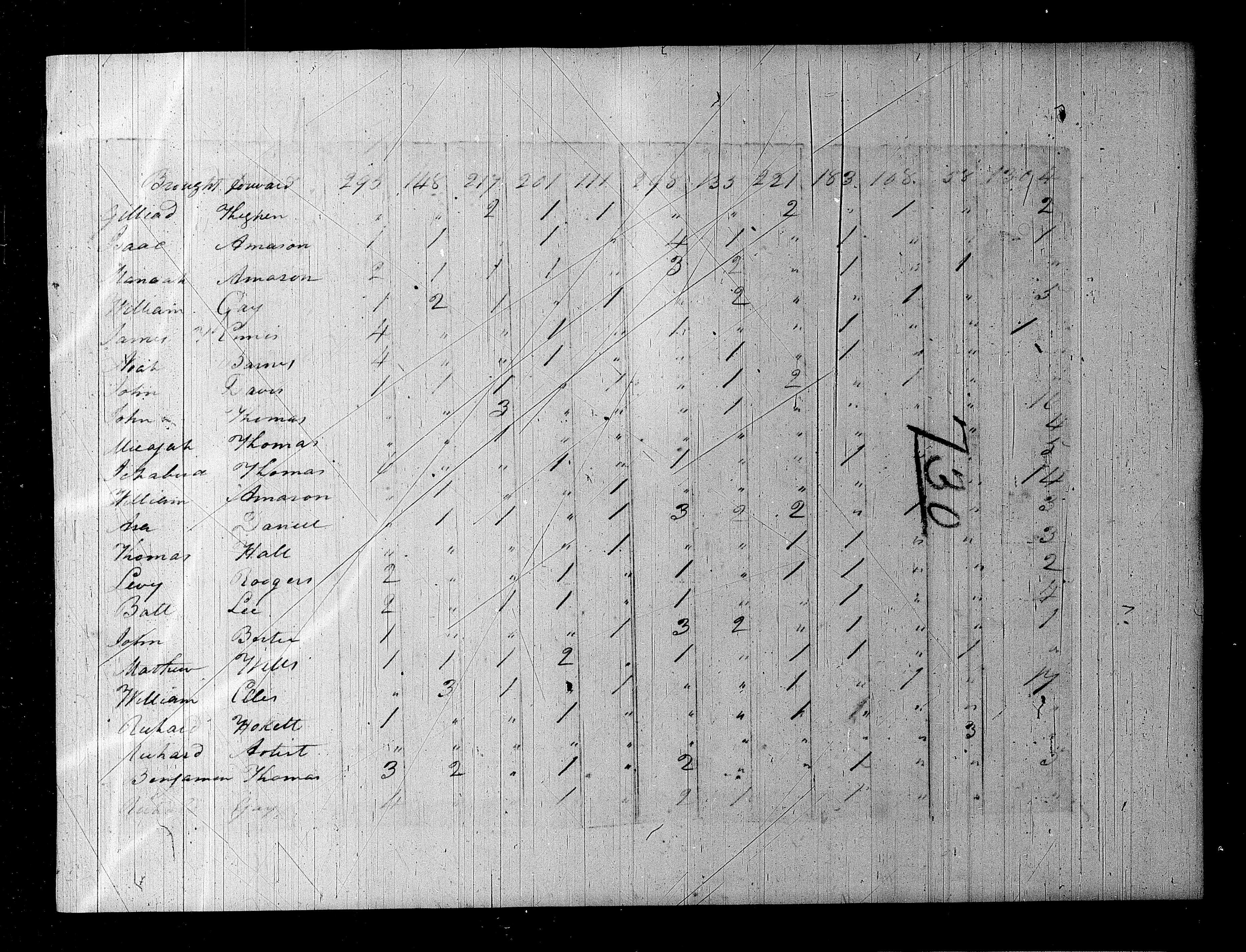
In February 1799 Benjamin’s father gave him a tract of land: 600 acres in one place in Robert’s book, and 550 in another. From 1805 he also owned another 100 acres north of Toisnot Swamp. He’s in the 1810 census in Edgecombe County, second from the bottom of this page:
By then the old family land was wearing out. Robert explains that some of the Thomas fields had been planted for fifty years without rotation or manure, while the price of land kept climbing because there was no more free land in that part of the state. At the same time, the cotton gin had made cotton the crop to grow, and the fresh cotton land was to the south and west. Benjamin was one of the first of the family to go, and the first to sell up in Edgecombe County: the 100 acres in August 1811, and the larger tract to Willie Stanton in February 1812, for about $3,000 in all. That sale, Robert notes, is the first family deed to give a price in dollars rather than pounds, shillings and pence.
Alabama, 1812–1822
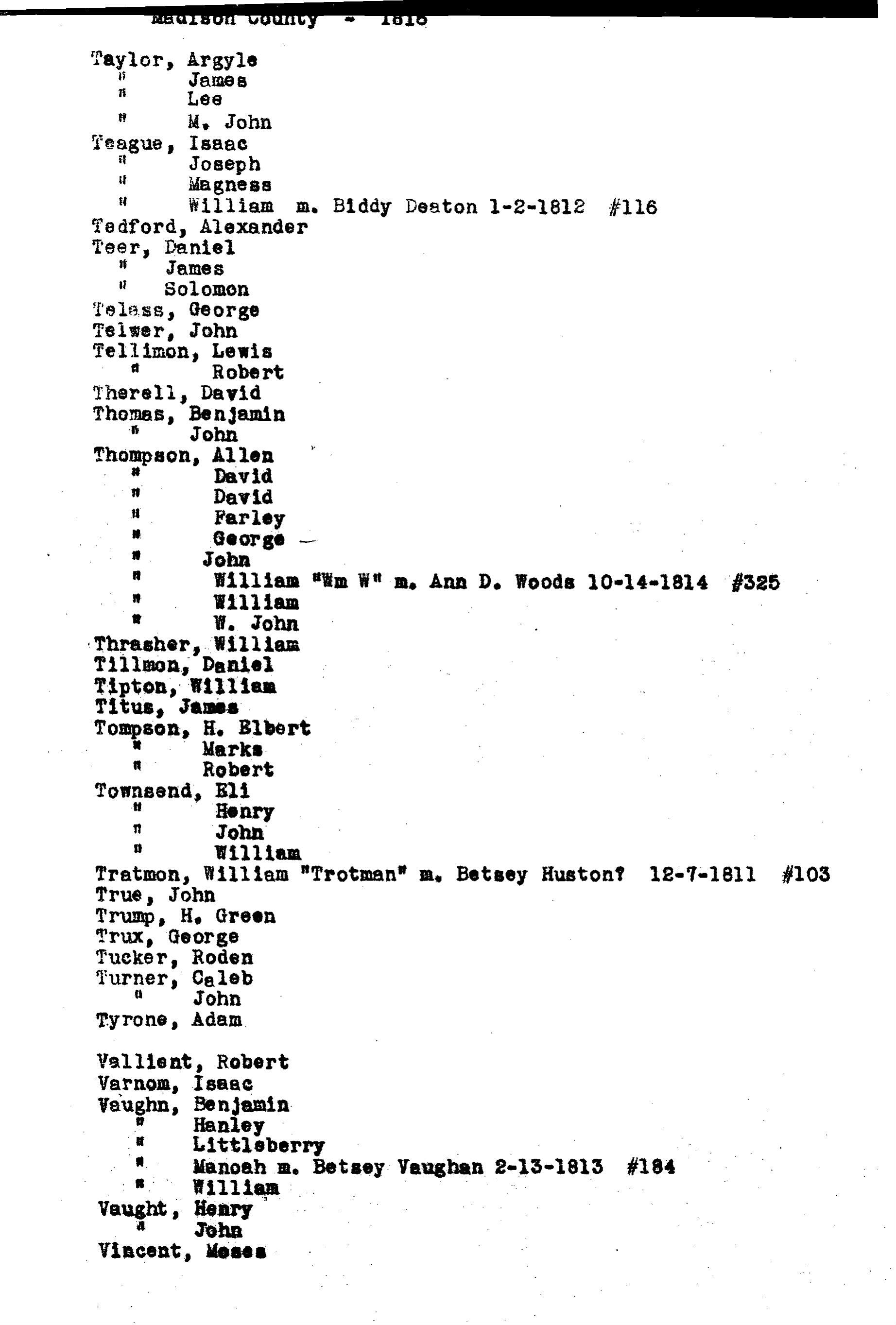
There’s no record of the route, but the family probably went first along the well-used road to Edgefield, South Carolina, and Augusta, Georgia, where there were already Thomas relatives, and from there to the newly opened cotton country north of the Tennessee River in Madison County, Alabama. The first record of a Benjamin Thomas there is in the 1816 count of the Mississippi Territory, which listed only the heads of families:
On December 11, 1816, he paid John and Alice Pettus $1,590 for a tract with houses on it. By the 1820 census the family had moved twenty-five or thirty miles west, to Lawrence County. That census shows Benjamin and Polly, who were then 42 and 44, with six sons and five daughters at home, Gary listed as a household of his own, and seven enslaved people counted as part of the household.
Benjamin seems to have talked up Alabama to the rest of the family, because several of them followed. His brothers Micajah and Theophilus Jr. were in north Alabama by 1819, and his sister Millicent and her husband probably came at about the same time he did. In Alabama his daughter Theresa married her first cousin, Dr. George B. Brownrigg, the son of Benjamin’s sister Obedience. Robert gives the year as 1819 in one place and 1821 in another.
Natchitoches, 1822
In 1821 Stephen F. Austin began advertising for settlers in Texas, offering 640 acres to each head of a family, 320 more for a wife, 160 for each child, and 80 for each enslaved person. Robert works out what that would have meant to Benjamin: more than 3,000 acres for his household, and 640 more for each of his grown sons. At the same time, Congress had just stopped selling public land on credit. Probably in the winter of 1821–22, Benjamin sold out again.
The party, twenty or more people, went down the Natchez Trace to Natchez, and then west across Louisiana to Natchitoches, the old French and Spanish river town that was the jumping-off point for east Texas. The Trace was too narrow for wagons, so most of them must have walked.
They were in Natchitoches by the end of February 1822, because on March 3 Benjamin and Polly appeared before Judge John C. Carr to sell 205 acres on Contentnea Creek, back in Edgecombe County, to their son Shadrach. It was Polly’s land, not Benjamin’s. The record describes it as “the same tract which fell to the share of Polly Thomas, one of the heirs of Shadrach Dickinson, deceased.” It’s the only clue I have so far to Polly’s own family, and it probably explains where her son Shadrach Dickinson Thomas got his name.
The family seems to have waited in Natchitoches until at least July, perhaps hoping that Austin would come and lead his settlers in himself. He didn’t: he was on the coast looking for his lost ship, and then in Mexico City, where the newly independent government had to approve his contract all over again. Iredell, who was 17, stayed behind in Natchitoches to clerk in a store. The rest of the family went on without Austin.
The Ayish Bayou
They crossed the Sabine and followed the Camino Real, and stopped where many families coming into east Texas in those years did: in the gently rolling country around the Ayish Bayou, which runs through the middle of present-day San Augustine. Benjamin settled a few miles west of town, on the road to Nacogdoches, near what is now the Thomas Cemetery. The sources can’t agree on the distance: five miles in Robert’s book, six in Crocket, seven in the account of a preacher who visited, and eight in the Sons of the Republic of Texas biography. For a hundred years afterwards that area was known as the Thomas Community.
Like most of his neighbours, Benjamin never got legal title to his land. The Mexican government’s land office barely functioned, and in 1826–27 Haden Edwards’s Fredonian Rebellion threatened the claims of every American settler in the district, and drove most of them back across the Sabine for a time. Robert guesses the Thomases fled with their neighbours. He also notes that the family later fell out with the Edwardses after Iredell married Haden Edwards’s niece, Penelope, in 1830.
Beyond that, there’s very little on Benjamin in Texas. There are no schools or churches to appear in, and no civic offices that I’ve found. One glimpse comes from the Methodist preacher Henry Stephenson, who crossed into Texas in 1834 and, though the Mexican authorities stopped him from preaching in some places, preached “at the house of Benjamin Thomas, seven miles west of town.” San Augustine became, in Robert’s words, “the cradle of Protestantism in Texas”, and two of Benjamin’s sons, Shadrach and Theophilus, would both become Methodist preachers there.
When did he come, and when did he die?
The sources disagree on both.
For his arrival, the family moved on from Natchitoches in the second half of 1822, and the historical marker says that’s when they founded the Thomas settlement. Crocket thought “it would probably be about 1821”. The Sons of the Republic of Texas biography says 1824. When the heirs’ claim was made in the 1850s (see below), Shadrach said his father came “in or about 1825”, and the lawyer Henry W. Sublett, who drew up the papers, said “1826 or ‘27”.
For his death:
- The Sons of the Republic of Texas biography, like most family trees, says he died in 1832, at 54.
- The witnesses for the heirs’ claim in 1857–58 said much the same. Burwell J. Thompson knew him “until the year 1832, soon after which time he died.” The merchant Matthew Cartwright thought it “occurred about the year 1832.” Sublett, though, gave 1834.
- An 1835 muster roll of the Ayish Bayou District lists a Benjamin Thomas twice. Robert reads that as Benjamin and his son Benjamin R., which would put him alive in 1835, or at least in 1834 if the list wasn’t up to date.
Robert settles on late 1834 or early 1835, before Polly was described as a widow in September 1835. The Texas Historical Commission went with 1834 when it made the Thomas Cemetery a Historic Texas Cemetery in 2008. My best guess is somewhere between 1832 and 1834.
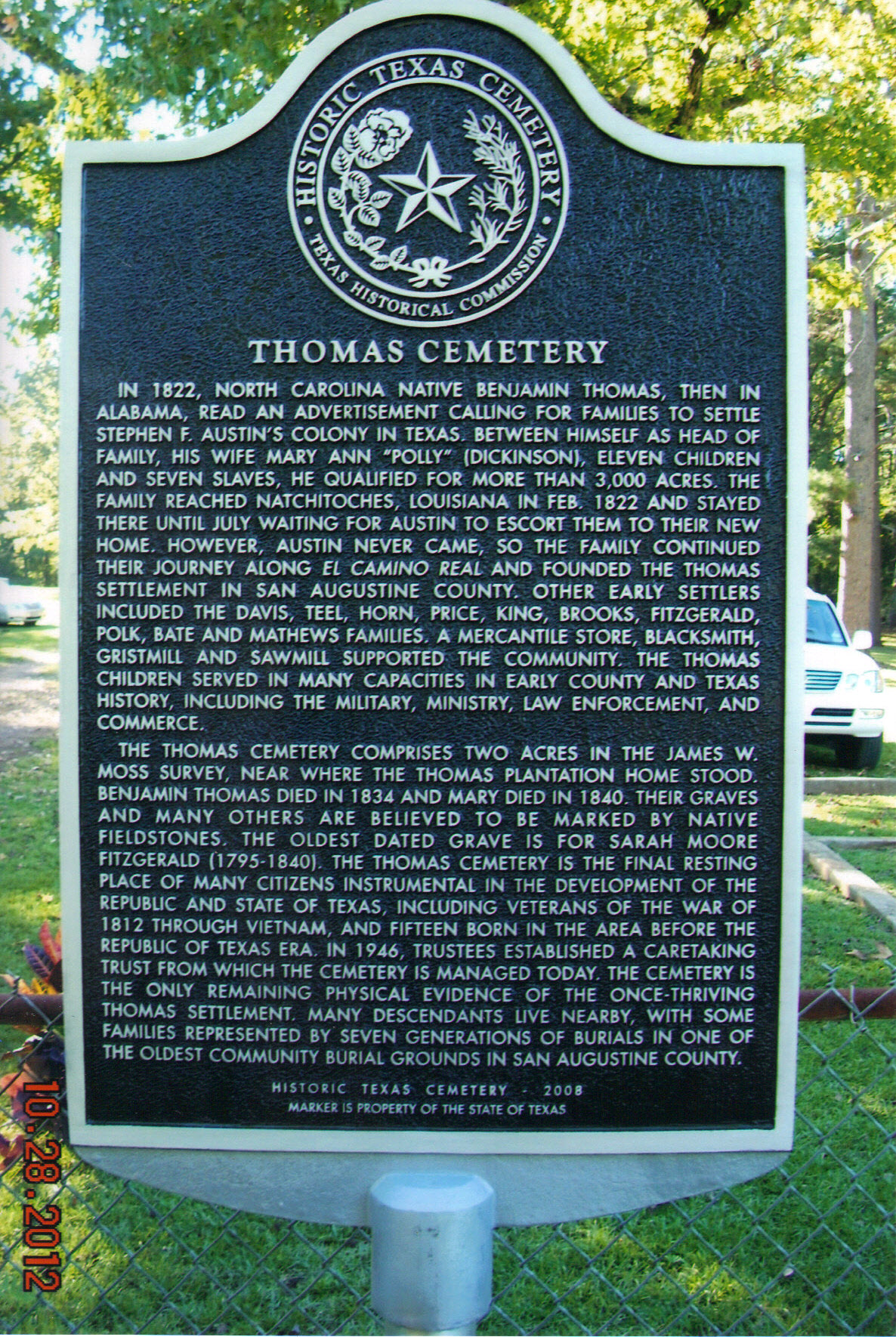
The Thomas Cemetery
The two-acre Thomas Cemetery, five miles west of San Augustine, is all that’s left of the Thomas settlement. According to the historical marker, it’s near where the Thomas plantation home stood, and Benjamin and Polly’s graves, like many of the others there, are believed to be marked by native fieldstones. Robert is more cautious: he assumes they’re buried there, but says he has no proof. The oldest dated grave is Sarah Moore Fitzgerald’s (1795–1840).
The marker tells the family’s story in brief: Austin’s advertisement, the eleven children and seven enslaved people that qualified Benjamin for more than 3,000 acres, the wait in Natchitoches from February to July 1822, and the Thomas settlement on the Camino Real. It also lists the neighbouring families: the Davises, Teels, Horns, Prices, Kings, Brookses, Fitzgeralds, Polks, Bates and Mathewses. Some families have seven generations buried there.
Polly
Polly outlived Benjamin by a few years, and those years are the best-documented of her life. In a census taken in 1835 she’s listed as a widow, and on September 23, 1835, she received a grant in her own name of a league of land, 4,428 acres, on Big Sandy Creek in what is now Polk County. Her sons Gary, Iredell and Wiley received grants the same year. Robert thinks she died two or three years after Benjamin, and certainly before the Republic of Texas census of 1840; the cemetery marker says 1840. By 1840 her son Benjamin R. was administering his father’s estate.
One source, the Four Families compilation, names Benjamin’s wife as “Mary Turner”. Everything else, including the 1822 sale of her Dickinson inheritance, says Mary Ann Dickinson.
The heirs’ league
Benjamin never received land from Mexico or the Republic of Texas. In 1858 Shadrach learned that Texas law let the heirs apply for it retroactively, and they were granted a league in Tarrant County, about nine miles north of downtown Fort Worth. They didn’t keep it: it was sold at auction on the courthouse steps in San Augustine for $750. Robert gives the sale as March 1, 1859, and the title as March 1859, so one of those dates is probably off. The fragmentary probate records show payments of $25 each to Shadrach, Theophilus, Martha (Thomas) Davis and Maria (Thomas) Roberts.
Benjamin and Polly’s children
Robert warns that the record for Benjamin’s children is less reliable than for the other family groups, and the sources differ on names and dates. This list follows his chart, with a few details from later in his book:
- Geraldas S. “Gary” (1798–1858), who married Emily Margaret Davis in 1827. He’s buried in Wallisville, Texas.
- Shadrach Dickinson (b. 1800), my ancestor. Robert says he “is reported to have married” Mrs. E. W. (Polly) Brown in 1827. My Samuel Brown Thomas post quotes his son’s obituary naming his parents as “Shadrach and Sarah”, but in the 1860 census his wife is Mary, 60, born in North Carolina, which fits Polly better. He was later the sheriff of San Augustine County.
- Margaret, called Martha elsewhere (about 1801–1842), who married Elias K. Davis in 1827, in what Robert believes was a double wedding in Natchitoches with her brother Gary and Elias’s sister Emily. He gives the date as May 27 in one place and July 27 in another. She died in San Augustine.
- Theresa (about 1803–1843), who married her cousin Dr. George B. Brownrigg in Alabama. She died in San Augustine.
- Iredell Dickinson “I.D.” (1805–1866), who married Penelope Edwards and later Elizabeth (Holman) Campbell. A merchant in San Augustine, he was more successful in business than his brothers Shadrach and Theophilus.
- Benjamin Rogers (about 1806–1891), who married Martha Engledow. He fought in the Texas Revolution and died in Bexar County.
- Wiley (1810 or 1811), who married Julia Smith and was living in Bexar County in 1850.
- Mary Ann “Polly” (1813), who never married and is buried in San Augustine.
- Theophilus (1815–1881), who married Susan Winn. He was a Methodist preacher, and is buried in the Thomas Cemetery.
- Maria (about 1816), who married Noel G. Roberts. Robert lists their children as born between 1834 and 1849.
- Jackson (about 1818).
All three of Benjamin and Polly’s married daughters settled in San Augustine near their parents. Margaret and Theresa both died young, within a few months of each other, in 1842 and 1843.
Open questions
- When exactly did Benjamin come to Texas, and when did he die? The sources give 1821 to 1827 for his arrival, and 1832 to 1835 for his death.
- Who were Polly’s parents? Shadrach Dickinson of Edgecombe County is the obvious lead.
- Was Shadrach’s wife Polly Brown, Sarah, or both?
- Where exactly was Benjamin’s farm? The marker places the cemetery in the James W. Moss survey, near the old plantation home, so the Moss survey is a place to start.
If you have any information on Benjamin, Polly or their children, I’d love to hear from you.
References
- Robert E. Thomas, The Thomas Family in 300 Years of American History (Dallas, 1978): “A Chart of the Family”, pp. x–xi; Chapter II, p. 28; Chapter III, “Moving Westward—To Alabama and Texas: The Seventh Generation”, pp. 32–51; and Chapter IV, pp. 56–57 and 81–84.
- George L. Crocket, Two Centuries in East Texas (Dallas, 1932), pp. 83–84, as quoted in Four Families, p. 115.
- “Benjamin Thomas, Sr. 1778–1832”, in a Sons of the Republic of Texas collection of members’ ancestors, p. 164.
- Inhabitants of Alabama in 1816 (Pell City, Ala.: Broken Arrow Chapter, D.A.R., 1955).
- United States Census, 1810, Edgecombe County, North Carolina.
- United States Census, 1860, San Augustine County, Texas, line 15.
- Texas Historical Commission, “Thomas Cemetery” (Historic Texas Cemetery marker, 2008), San Augustine County.